



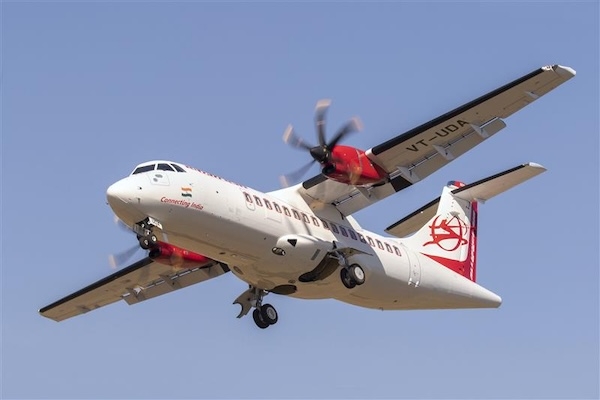
ATR released a new white paper demonstrating that India’s fast-expanding regional connectivity demand is fundamentally a turboprop market. Based on ATR’s MobilityMonitor platform, a backcast model built on the observation of tens of millions of actual journeys across all modes, the study finds that over 90% of India’s 4.6 billion annual inter-city journeys are under 400 nautical miles, the range where turboprops deliver unbeatable economics compared to regional jets, especially in low-fare environments and in today’s context of rising fuel prices.
The white paper, Exploring India’s Connectivity Landscape, identifies up to 900 new domestic routes, of which 420 fall squarely into turboprop territory. ATR estimates that 35 million of the 90 million additional annual passengers expected with UDAN-backed airport expansion could only be served efficiently and sustainably by turboprops. India remains one of the most price-sensitive airline markets in the world. To support the government’s UDAN objective of affordable, widespread connectivity, airlines must operate the most competitive aircraft for their networks. Turboprops offer:
Alexis Vidal, ATR’s Senior Vice-President Commercial said: “With a need for affordable air travel, and fuel costs set to increase, turboprops are the only economically viable solution to scale regional connectivity profitably.The lack of an airport does not imply the absence of mobility demand, especially in a country with an extensive rail network such as India. With the current airport infrastructure out of reach for so many Indians, it is no surprise that air travel accounts for only 3% of domestic inter-city trips."
India currently records only 3% of inter-city travel by air, significantly below nations like China or the United States. ATR’s study shows that the rapid expansion toward 230 airports by 2030 could radically shift this landscape by bringing millions of travellers within a 90-minute radius of an airport.
The report says that people living within 90 minutes of an airport are up to three times more likely to fly than those living farther away. Today, only about 30% of India’s population, approximately 425 million people, live close enough to an airport where it would become a convenient option.

With 85 additional airports:
“The Tier 2 and Tier 3 city pairs driving India’s next phase of aviation growth are quintessential turboprop markets, driven by short distances, variable load factors, and strong demand for affordable fares,” continues Vidal. “It is demand that already exists, but is largely tapped today by road and rail. Our analysis shows that this growth cannot be sustainably unlocked without turboprops. As the world’s only commercial turboprop manufacturer, ATR is uniquely positioned to support India’s regional development, with aircraft offering unmatched fuel efficiency, economics and versatility.”
ATR’s latest market forecast anticipates a need for 210 new turboprops in India by 2044, driven entirely by regional expansion.

Cirrus Aircraft is celebrating the 10th anniversary of its Collier Trophy-winning Vision Jet at NBAA-BACE 2026, marking a decade of innovation that has continuously advanced the world&r...
In business aviation, exceptional service is defined by attention to detail, and few amenities reflect that more clearly than premium catering. At the intersection of hospitality and private aviation,...
Daher Aircraft announced the delivery of a Kodiak 900 to Swiss owners Roland and Claudia Primus, who plan to use the aircraft for adventure flying to remote and short-runway destinations. Their travel...
Velocity Maintenance Solutions, an FAA-certified provider of maintenance, repair and overhaul services, has announced a significant expansion of its facilities at Wilmington Airport (ILG) in Delaware,...

