Lockheed Martin revealed the first images from an experimental, ultra-thin optical instrument, showing it could be possible to shrink space telescopes to a sliver of the size of today's systems while maintaining equivalent resolution.
Weighing 90 percent less than a typical telescope, the Segmented Planar Imaging Detector for Electro-Optical Reconnaissance (SPIDER) opens a path for extremely lightweight optical instruments, allowing for more hosted payloads or smaller spacecraft. More broadly, the sensor technology has applications for aircraft and other vehicles—anywhere that depends on small optical sensors. The future could see UAVs with imagers laid flat underneath their wings, and cars could have imaging sensors that are flush against their grills.
The SPIDER project has roots in research funded by the Defense Advanced Research Projects Agency (DARPA). Lockheed Martin independently completed this phase of research at its Advanced Technology Center (ATC).
"This is generation-after-next capability we're building from the ground up," said Scott Fouse, ATC vice president. "Our goal is to replicate the same performance of a space telescope in an instrument that is about an inch thick. That's never been done before. We're on our way to make space imaging a low-cost capability so our customers can see more, explore more and learn more."
The system uses tiny lenses to feed optical data divided and recombined in a photonic integrated circuit (PIC), which was originally designed for telecommunications at the University of California, Davis. Using these chips in a different way, Lockheed Martin researchers unlocked new potential for ultra-thin telescopes using a technique called interferometric imaging.
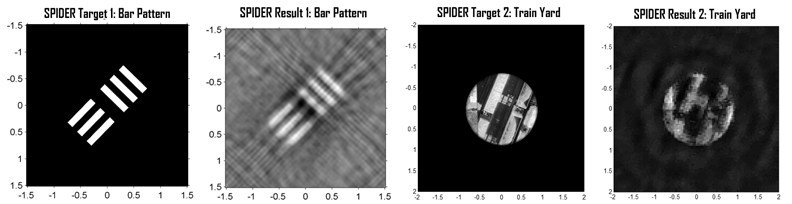
The tests involved a PIC aligned to a series of 30 lenses, each smaller than a millimeter across. An optical system simulated the distance from space to the ground, where scenes were illuminated and rotated. The first image included a standard bar test pattern, and the second image showed the overhead view of a complex rail yard.
The lenses and PIC comprise one section of a full instrument to be assembled in the next project phase. The team plans to increase the resolution and field of view in future phases.
The initial findings from this project were presented today at the Pacific Rim Conference on Lasers and Electro-Optics (CLEO-Pacific Rim) in Singapore.
Viasat has significantly expanded the capacity of its JetXP in-flight connectivity service across the United States, delivering up to five times more bandwidth for business aviation customers equipped...
Embraer has delivered the first E175 fitted with next-generation RECARO passenger seats to American Airlines, marking another step in the ongoing modernization of one of the world's most successfu...
Turkish Airlines has taken another major step in its fleet expansion strategy with the signing of a Memorandum of Understanding with CFM International for more than 300 LEAP-1B engines and a long-term...
Gogo has unveiled its long-term vision for the Galileo connectivity platform at NBAA-BACE 2026, outlining a roadmap designed to enhance and protect customer investments well into the mid-2030s and bey...