




The Federal Air Transport Agency (Rosaviatsia) has issued a Type Certificate for MC-21-300 passenger aircraft to Irkut Corporation (part of the United Aircraft Corporation of Rostec State Corporation). The Type Certificate confirms the MC-21-300 compliance with the certification requirements established for civil aircraft. At the same time, the Federal Air Transport Agency has issued the Design Organization Certificate to Irkut Corporation in relation to the MC-21 aircraft.
“The issuance of a Type Certificate for MC passenger aircraft is the result of work carried out by the Federal Air Transport Agency, the Aviation Register of Russia and accredited certification centers. This is the first important stage in the development of the latest domestic aviation technology. The Federal Air Transport Agency is ready to continue work on expanding the operating conditions of the aircraft and optimizing the structures, including remotorization for the domestic PD-14 engine. "- said Alexander Neradko, Head of the Federal Air Transport Agency.
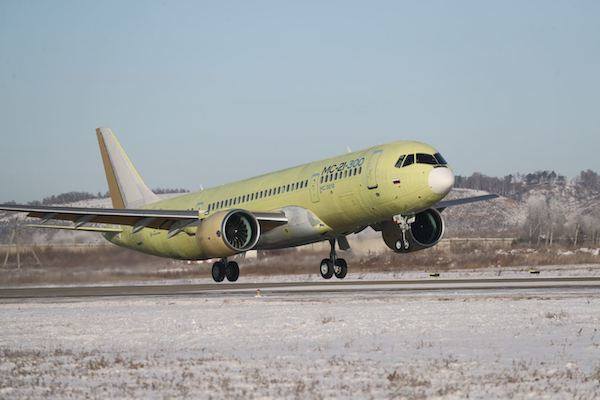
The MС-21-300 is a new generation medium-range aircraft with 163 to 211 seats. It is designed for the most popular segment of passenger air transportation and embodies the latest developments in aviation engineering.
"The obtaining of the Type Certificate from the Federal Air Transport Agency is the most important event for the MC-21 project and the aviation industry. The document confirms that the aircraft is ready for mass production and sales. The aircraft is modern, beautiful, and literally world-class, with a large number of design innovations and the largest cabin among its peers. I'm sure both airlines and passengers will appreciate it," noted Sergey Chemezov, CEO of Rostec State Corporation.
The MC-21 is the world’s first mid-range aircraft to be fitted with composite wings. Composites make about 40%.
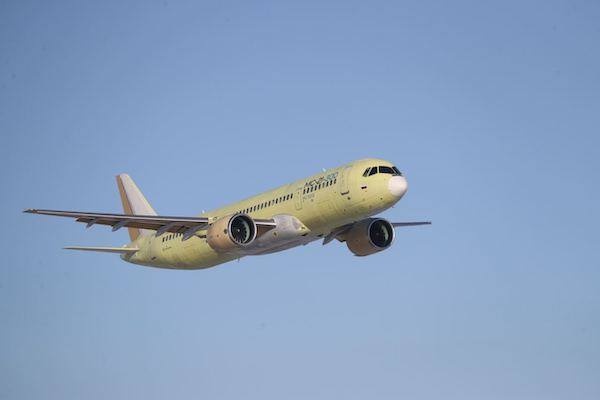
"Actually, thanks to the MC-21, we have experienced a technological revolution in the Russian aircraft industry. New materials for the manufacture of the wing have been developed and produced. The design, production and testing of aggregates made of composites has been mastered. Advanced technologies of modular assembly production have been introduced. The participants in the MC-21 cooperation were united by an information environment that provides digital design and production. The aircraft is intended for the most popular market segment. In the next 20 years, Russia alone is forecasted to need 800+ new aircraft of this size. After proving the aircraft’s outstanding performance in the domestic market, we will go to the international market," said Yury Slyusar, Director General of UAC.
Since 2021, it is only domestic materials that are used to make wings of the MC-21-300 aircraft. The first Russian-made composite wing was installed on the MC-21-300 in July 2021. In December 2021, the first MC-21-300 with the Russian-made composite wings commenced the flight tests.
“In 2022, we will focus our efforts on expanding the type certificate for the MC-21-300 aircraft. First of all, we will complete the certification of an aircraft with a wing made of Russian composite materials. We will also test the airliner in high altitude conditions, strong crosswinds, low and high temperatures. This will allow “Rossiya” Airlines to operate the MS-21-300 in any geographic zones," stated Andrey Boginsky, Director General of Irkut Corporation.
Gogo has unveiled its long-term vision for the Galileo connectivity platform at NBAA-BACE 2026, outlining a roadmap designed to enhance and protect customer investments well into the mid-2030s and bey...
Gulfstream Aerospace has enhanced the capabilities of its Customer Support Performance Analytics program, further strengthening its ability to transform aircraft data into actionable insight...
Few infrastructure projects have the potential to reshape an island's future quite like the ongoing transformation of Nevis Airport. To gain deeper insight into this ambitious development and the...
Viasat has significantly expanded the capacity of its JetXP in-flight connectivity service across the United States, delivering up to five times more bandwidth for business aviation customers equipped...

