



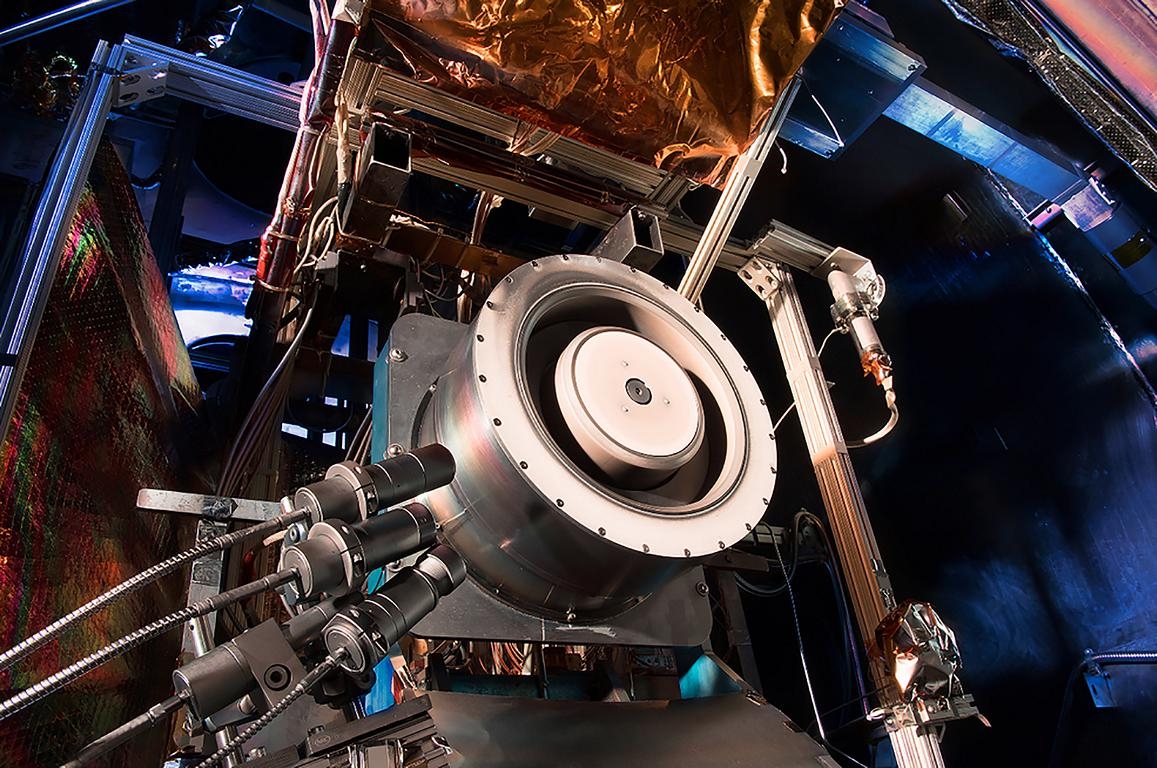
It wants super-efficient power for missions headed to asteroids and Mars.
In an effort to design more efficient spacecraft engines, NASA granted rocket manufacturer Aerojet Rocketdyne a three-year contract to develop advanced “solar electric propulsion” engines that could assist in deep space travel. The engines have the potential to be ten times more efficient than chemical engines, and have twice the thrust of the electric engines that are utilized now. They’ll help us travel further in our solar system and could even help send humans to Mars.
Solar electric engines aren’t a new idea. Electric engines have been in the works since the 1950’s, and since then NASA has pursued efficiency, working towards progressive solar electric technology.
Solar electric presently powers crafts exploring deep space as well as the International Space Station. NASA recently sent the record-breaking Dawn spacecraft to orbit both asteroid Vesta and dwarf planet Ceres between 2011 and 2015, and the probe was powered by a solar array. The International Space Station is currently powered by solar arrays that supply even more energy than the station requires at once.

As we probe deeper into our solar system, solar electric engines can help us get farther for less money since they provide thrust over a lengthy period of time. The recent contract signals NASA’s commitment to the efficient engines beneficial for deep space travel.
Depending on how well the new research goes, Aerojet Rocketdyne could deliver four of the super efficient units to fly in space. NASA has stated they’re working to snare an asteroid to orbit the moon during the next decade, and they would use the solar electric engines to do so.
NASA’s Space Technology Mission Directorate associate administrator Steve Jurczyk said, “Development of this technology will advance our future in-space transportation capability for a variety of NASA deep space human and robotic exploration missions, as well as private commercial space missions.”
Daher Aircraft announced the delivery of a Kodiak 900 to Swiss owners Roland and Claudia Primus, who plan to use the aircraft for adventure flying to remote and short-runway destinations. Their travel...
Velocity Maintenance Solutions, an FAA-certified provider of maintenance, repair and overhaul services, has announced a significant expansion of its facilities at Wilmington Airport (ILG) in Delaware,...
Qantas Freight and Australia Post have entered the next chapter of their long-standing partnership with the arrival of the first of three additional Airbus A321 Passenger-to-Freighter (A321P2F) aircra...
Aviation Capital Group, the Newport Beach, California-based global aircraft asset manager, has signed a firm order for 75 additional Airbus A320neo Family aircraft, bringing its cumulative orders for...

