



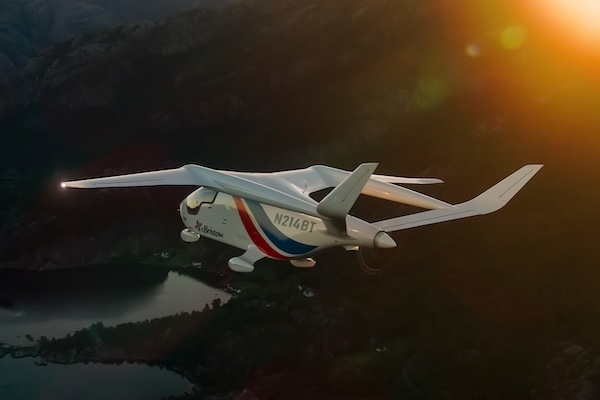
Norway reached an important milestone last Wednesday, January 28 in its transition to low- and zero-emission aviation with the completion of its first electric aviation test project, conducted as an international test arena. After roughly six months of operational testing, Bristow pilot Jeremy Degagne landed the BETA Technologies ALIA aircraft in Stavanger, bringing the project to a close and delivering valuable real-world experience in electric aircraft operations, infrastructure, and regulatory frameworks.
Karianne Helland Strand, Executive Vice President for Sustainability and Infrastructure, Avinor commentted: "As the national airport operator, Avinor has a clear responsibility to prepare our infrastructure for the next generation of aviation. Through this project, we have gained concrete experience that will guide how we develop airports and charging infrastructure and provide operators with a stronger basis for assessing the future commercial viability of routes based on new technologies. We will now build on these lessons in the next phase of our test and development projects."
The project has demonstrated how new aviation technologies can be introduced safely and gradually into a highly regulated environment, and how close cooperation among authorities, airports, operators, and technology providers is essential to a successful transition. Over a six-month period, the aircraft performed regular test flights on a cargo route between Stavanger and Bergen. Airports, air traffic control, and regulators gained hands-on experience with charging infrastructure, winter operations, new procedures, and future training needs.
For the Norwegian Civil Aviation Authority, being part of this first of a kind demonstration programme has been a rewarding experience on several levels.
Jan Petter Steinland, Director Strategic Analysis & Transformation stated: "We have established a first version of a Regulatory Sandbox and are able to evaluate how the different safety regulations work in the context of this new technological concept. We are also maturing our safety methodology to be more fit for purpose for an innovation setting and can broaden our competency on these technologies in the process. Another significant result of the programme is how we are developing insights and knowledge in collaboration – building on a much-appreciated level of trust between professional partners."
Close and continuous dialogue with air traffic control was a key factor in the project's success. Feedback from controllers indicates the aircraft could be integrated into existing airspace with limited additional workload, reinforcing that innovation and safety can go hand in hand.
Dave Stepanek, Executive Vice President, Chief Transformation Officer, Bristow Group said:"This project represents an important step toward the next generation of flight. We're proud to contribute real-world operational and safety experience that supports the careful, responsible introduction of electric and sustainable aircraft. It's also a source of pride to work alongside our partners in Norway, where Bristow has a long-standing presence, as we help move these technologies from testing toward practical, real-world use. We've learned a great deal, and we look forward to sharing that insight."
Simon Newitt, Head of Sales & Support, at BETA Technologies added: "This project demonstrated exactly how electric aviation should be introduced with a planned, safe approach conducted in close partnership with regulators, operators, and airport authorities. Norway's geography and regional connectivity needs make it uniquely well suited for electric aviation. Over six months of real-world operations, BETA was able to validate aircraft performance, charging infrastructure, procedures, and winter operations in one of the most demanding environments in aviation. The experience gained here directly informs how electric aircraft can be integrated into existing airspace and airport systems and scaled responsibly to enable commercial operations that deliver both lower cost and lower emissions."
The project has also highlighted key strategic needs for the next phase of electric aviation, including the development of robust charging solutions, winter-adapted infrastructure, and dedicated training for fire and rescue services related to batteries and alternative fuels. The test project has been met with strong interest and optimism both in Norway and internationally. Together, the partners now bring valuable experience into the next phase of advanced air mobility development, where technology, regulation, infrastructure, and market potential must advance in parallel.


The Tennessee Valley Authority is demonstrating the real-world value of the Tecnam P2012 Special Mission Platform (SMP), which has become a vital tool for monitoring and maintaining its...
Qantas Freight and Australia Post have entered the next chapter of their long-standing partnership with the arrival of the first of three additional Airbus A321 Passenger-to-Freighter (A321P2F) aircra...
Airbus 2026 Cargo Global Market Forecast, unveiled at the Cargo Facts Symposium, predicts that the global fleet of dedicated freighter aircraft will expand by 46%, rising from 2,360 aircraft in 2026 t...
Aviation Capital Group, the Newport Beach, California-based global aircraft asset manager, has signed a firm order for 75 additional Airbus A320neo Family aircraft, bringing its cumulative orders for...

