

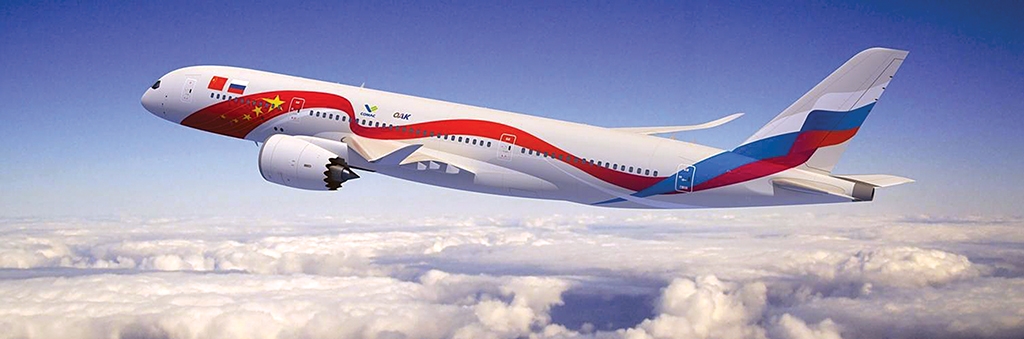
The proposed Chinese-Russian widebody airliner will require investment of between $13 billion and $20 billion. Confirming the outline program budget at last week’s Farnborough International Airshow, Yuri Slyusar, president of Russia’s United Aircraft Corporation, said that the final amount will depend on whether or not customer support arrangements will be able to use existing facilities of UAC and its Chinese partner Comac, AIN reported.
What has been resolved is that UAC and Comac intend to use Boeing “gate” process for managing the program. Gate 3—at which point the aircraft should be completely defined—is currently planned for around the 2018-2019 time frame. Comac and its Avic subsidiary will be responsible for final assembly and the majority of parts manufacturing, using existing factories around Shanghai and other Chinese cities, including those now being used for the ARJ21 and C919 airliners. The Russian partner will mainly be responsible for design and development work, according to Slyusar. UAC’s newlybuilt 463,000-sq-ft engineering center at Zhukovsky, near Moscow, will house Chinese and Russian engineers working on the program. The partners have dropped plans to base the new widebody on the existing Ilyushin Il-96 twinjet, instead opting for a completely clean-sheet design.
UAC and Comac have conducted meetings with a number of Asian airlines, which are the target market for the new aircraft, and their feedback has help to define requirements for an aircraft that will carry 280 passengers on trips of up to almost 6,500 nm, with service entry provisionally pegged for between 2025 and 2027.
During a visit to Beijing last month, Russian President Vladimir Putin signed government-to-government agreements with Chinese President Xi Jinping. At the same time, Russia’s trade and industry ministry signed agreements with its Chinese counterpart to establish a joint venture between UAC and Comac/Avic. The partners will contribute equally to development costs.
Initially, the engines for the new widebody are likely to be provided by Rolls-Royce or/and GE, “which already have suitable models with the required thrust of 35 metric tons,” according to Slyusar. Later on, the Russian design house Aviadvigatel in Perm is expected come up with its own PD-35 turbofan, which will be an up-scaled copy of the PD-14 engine that is now being tested.
BPE Air, the aviation company founded and wholly owned by entrepreneur Aldrew Crowe, reported approximately US$90 million in revenue in 2025, marking a major milestone in the growth of its integrated...
Gogo has unveiled its long-term vision for the Galileo connectivity platform at NBAA-BACE 2026, outlining a roadmap designed to enhance and protect customer investments well into the mid-2030s and bey...
Daher Aircraft announced the delivery of a Kodiak 900 to Swiss owners Roland and Claudia Primus, who plan to use the aircraft for adventure flying to remote and short-runway destinations. Their travel...
Qantas Freight and Australia Post have entered the next chapter of their long-standing partnership with the arrival of the first of three additional Airbus A321 Passenger-to-Freighter (A321P2F) aircra...