



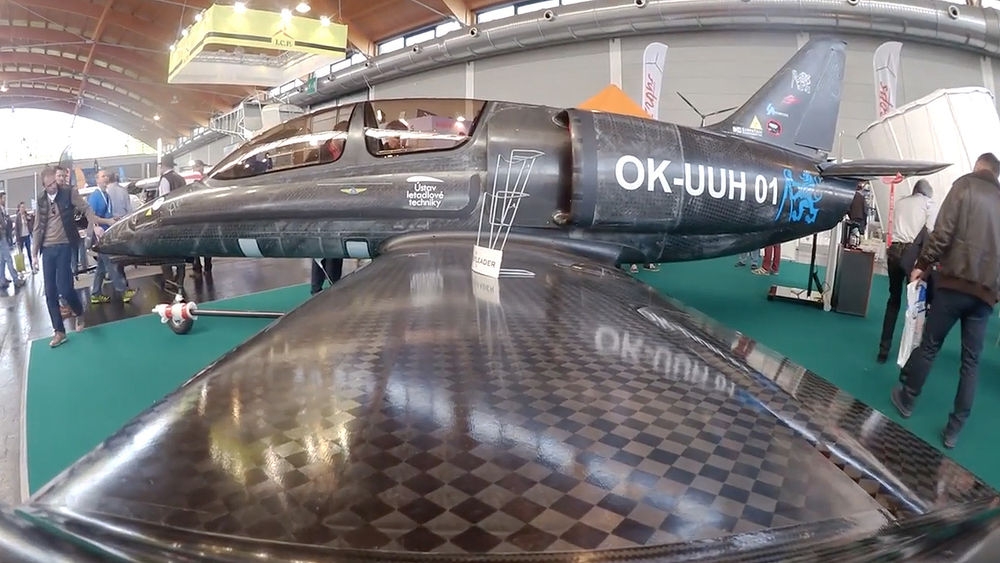
BMW’s superbike engine makes this L-39 Albatross go.
Whether it’s the DNA or something in the water, in aviation circles, the Czech Republic is renowned for creative, innovative and sometimes downright bizarre aeronautical designs. But at this week’s big Aero global aviation show in Friedrichshafen, Germany, even the Czechs outdid themselves.
There on the display floor was a perhaps two-thirds scale rendition of the famed Czech fighter trainer, the L-39 Albatross. Since the fall of the Soviet Union, the ‘tross has become a rich-guy toy and there are quite a few knocking around the US in private hands. So what was this? Had the Czechs pulled another one out the hat, perhaps adapting an APU engine for this mini-fighter? The truth was even weirder. The little jet wasn’t a jet at all, but a ducted fan driven by a BMW S1000RR engine having its neck wrung in flight to what’s got to be near the breaking point.

The airplane is called the UL-39 Albi, short for Albatross. It’s actually intended to be less of a commercial airplane project than a test bed for the cutting-edge carbon fiber used in its construction. It’s the product of the mechanical design department at the Czech Technical University in Prague. It gets even weirder when you consider that the UL part of the designator means ultralight, a class of airplanes unique to Europe whose weight is limited to 450 kg or 992 pounds. That’s gross weight. The empty weight is 320 kg (705 pounds) or a little lighter than, say, a BMW K1600GTL .
What makes this startling to a pilot’s eyes is that most of us know that ultralights are quite small indeed, with intimate—okay, claustrophobic—cockpits, tiny little engines and pokey performance to match. But the UL-39 is a big airplane by that metric and the only way it makes the weight limit is through the lavish use of expensive, carbon tube fiber of the sort normally reserved for aerospace things with Airbus in the name.
And that gets us to the RR engine. The builders used it because the Yamaha R1 engine they originally spec’d wouldn’t work. Even though the airplane is light, it’s not that light and because a ducted fan is less efficient than a conventional propeller, they need all the power they can get; the RR had better power-to-weight than the Yamaha.

Even at that, the Beemer won’t be leading a pleasant life. The designers are running it at 12,000 rpm or so continuously in flight, right at the peak of the torque curve. If that weren’t enough, the power is delivered through a clutch reduction assembly—they strip away the stocker’s transmission—to the fan some 80 cm away (about 30 inches) through a hollow carbon-fiber tube. The fan itself is a 13-blade affair that is itself ultralight: less than 2 pounds total.
The RR engine retains the stock configuration, mostly, but the builders designed their own ECU and kept the throttle-by-wire capability for the pilot in the cockpit. Those big inlets funnel air to that fan disc and to the engine’s radiator because I’m pretty sure at 193 hp continuous, it’s going to need all the heat rejection it can get.

Few infrastructure projects have the potential to reshape an island's future quite like the ongoing transformation of Nevis Airport. To gain deeper insight into this ambitious development and the...
Viasat has significantly expanded the capacity of its JetXP in-flight connectivity service across the United States, delivering up to five times more bandwidth for business aviation customers equipped...
Gogo has unveiled its long-term vision for the Galileo connectivity platform at NBAA-BACE 2026, outlining a roadmap designed to enhance and protect customer investments well into the mid-2030s and bey...
Archer Aviation all-electric Midnight air taxi successfully completed several days of piloted flights across the San Francisco Bay Area as part of the company’s “No Roads” flight tou...

