



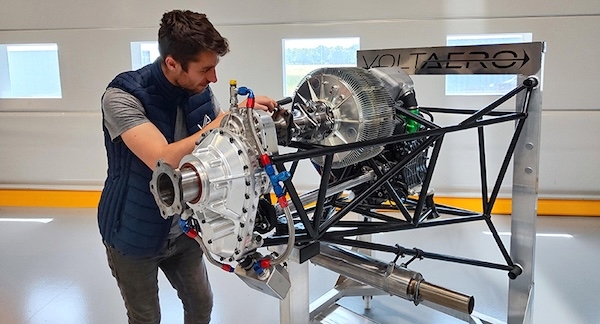
VoltAero unveiled its HPU 210 aircraft powertrain, which brings the company’s patented hybrid-electric propulsion technology to propeller-driven airplanes in the homebuilt, kit-built and very light aircraft categories. Displayed for the first time on VoltAero’s exhibit stand at France Air Expo in Lyon, France, the HPU 210 hybrid power unit combines a high-performance thermal engine with an advanced electric motor to provide revolutionary push-to-climb functionality that boosts power by 40 percent – enabling safer, more efficient and enhanced flight operations.
Jean Botti, VoltAero’s CEO & Chief Technology Officer commented:“With the HPU 210, a new category of airplanes will benefit from the patented, proven hybrid propulsion technology pioneered by VoltAero for our Cassio family of regional aircraft, which are now advancing into their pre-production phase. We’ve validated our hybrid propulsion architecture on our in-house Cassio S flying testbed, which has logged more than 185 flight hours and flown approximately 25,000 kilometers in a full range of operating conditions.”
The HPU 210 is equipped with Kawasaki’s H2SX thermal engine – which provides maximum power of 150 kW, along with a 60-kW electric motor. In typical operation, the thermal engine delivers baseline propulsive power, while the electric motor kicks in during high-power demand situations, resulting in shorter takeoff distances, enhanced obstacle clearance and significantly increased cruise speeds.
The supercharged H2SX is derived from its utilization on Kawasaki’s iconic Ninja H2 SX sport motorcycle, tailoring this proven high performance, four-cylinder in-line engine for airplane applications. It uses electronic fuel injection, and has an estimated TBO (time between overhaul) of 1,500 hours.
In VoltAero’s HPU 210 configuration, the hybrid-electric propulsion unit is controlled by a single throttle – with the thermal engine generating the power from zero to 70 percent, and the additional boost power delivered by the electric motor and its battery. With fuel consumption as low as 38 liters per hour at cruise settings, the HPU 210 runs on aviation gasoline, biofuel (such as the E85 ethanol-gasoline blend) and standard unleaded automotive fuel – allowing operators to optimize their running costs and carbon footprint.
The HPU 210 will be supplied by VoltAero as a turnkey solution, with the kit including a complete powertrain unit composed of the thermal engine, electric motor, gearbox and electronic control unit. A bench test campaign with the HPU 210 has been performed at VoltAero’s partner, AKIRA, in southern France. VoltAero will initiate HPU 210 production at the company’s purpose-built Rochefort Airport industrial facility in France’s Nouvelle-Aquitaine Region, where its Cassio family of regional aircraft also will be assembled. Deliveries of HPU 210s are targeted to begin late 2026.
The U.S. Federal Aviation Administration has certified the Boeing 737-10, the newest and largest member of the 737 MAX family, paving the way for Boeing [NYSE: BA] to begin customer deliveri...
Asco, a subsidiary of Montana Aerospace AG, achieves significant technological milestone in the development of a hybrid multi-material Rear Secondary Structure for Airbus. Montana Aerospace,...
TARMAC Aerosave has set a new industry benchmark by becoming the first company in the world to secure Aircraft Fleet Recycling Association (AFRA) accreditation across all three scopes of aircraft disa...
Velocity Maintenance Solutions, an FAA-certified provider of maintenance, repair and overhaul services, has announced a significant expansion of its facilities at Wilmington Airport (ILG) in Delaware,...

