




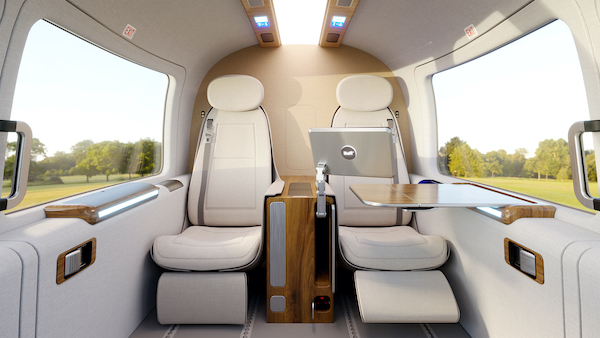
After more than three years of development and successful ground tests of its technological demonstrator, ZURI presents a new model of its hybrid VTOL aircraft in the passenger version with internal designation ZURI 2.0 and a dedicated version for cargo transport with internal designation ZURI 2.0 CARGO.
The concept of the new model is based on the experience that the ZURI team has gained throughout the recent development process. The team completed the previous development stage in summer 2021 with successful technology demonstrator tests. The work on the demonstrator gave the ZURI development team answers to many questions concerning aerodynamics, control systems, the number and required output of power units, and other parameters.
Thanks to the information gained from previous developments and ground tests, the ZURI team prepared a new concept that considers all the positive and negative experiences obtained from the previous hybrid VTOL aircraft concept trials.
The basic parameters of the new ZURI 2.0 concept are as follows:
Wingspan: 12-13 m (39 - 43 ft)
Maximum cargo payload: 300 kg (660 lbs)
Crew: one pilot
Number of passengers: 4 in the Executive version, 3 in the VIP version
Range: 700+ km (435 miles) plus 30-minute reserve
Cruising speed: 300+ km/h (186+ mph)
Power units: 8 tilting electric motors
On-board generator: turbine with an electricity generator for powering electric motors and recharging Lithium batteries.
With the introduction of the ZURI 2.0 model, the next stage of ZURI development began. During this stage, the team is already building smaller, fully functional ZURI 2.0 models, mainly to verify aerodynamic parameters and compare several versions of control systems. We will lock the design of the hybrid VTOL ZURI design during this development phase.
The company plans to develop hybrid VTOL aviation technology by certifying both models, i.e., ZURI 2.0 for passenger transport and ZURI 2.0 in the CARGO version. The certification will occur
under EASA (European Union Aviation Safety Agency), i.e., in the first years, VTOL ZURI will be intended only for the European market and markets where EASA certification is valid. ZURI is also interested in obtaining FAA certification for the North American market in the next step.
The hybrid VTOL ZURI technology aims at regional air transport. This market segment is currently facing several legislative restrictions to reduce the negative impact of air transport on the environment. Purely electric or hybrid technologies such as ZURI 2.0 can help reduce the adverse effects of aviation on the environment while allowing further development of regional aviation. In addition, ZURI can significantly expand regional air transport as VTOL technology does not need expensive airport infrastructure and thus provides take-off and landing from existing small airports, heliports, or any VTOL certified place with dimensions of about 25x25 m.


Bombardier marked the 40th anniversary of its industry-leading Smart Services cost-per-flight-hour programs, which today support more than 1,500 enrolled aircraft and account for over 11 mil...
Samson Sky has enlisted renowned Italian automotive designer Luigi Memola to develop the interior design of its Switchblade Flying Car, bringing world-class automotive styling expertise to the roadabl...
Daher Aircraft will present its TBM and Kodiak aircraft families at next week’s NBAA Business Aviation Convention & Exhibition (NBAA-BACE), showcasing how their combination of performance, e...
Embraer has delivered the first E175 fitted with next-generation RECARO passenger seats to American Airlines, marking another step in the ongoing modernization of one of the world's most successfu...

