



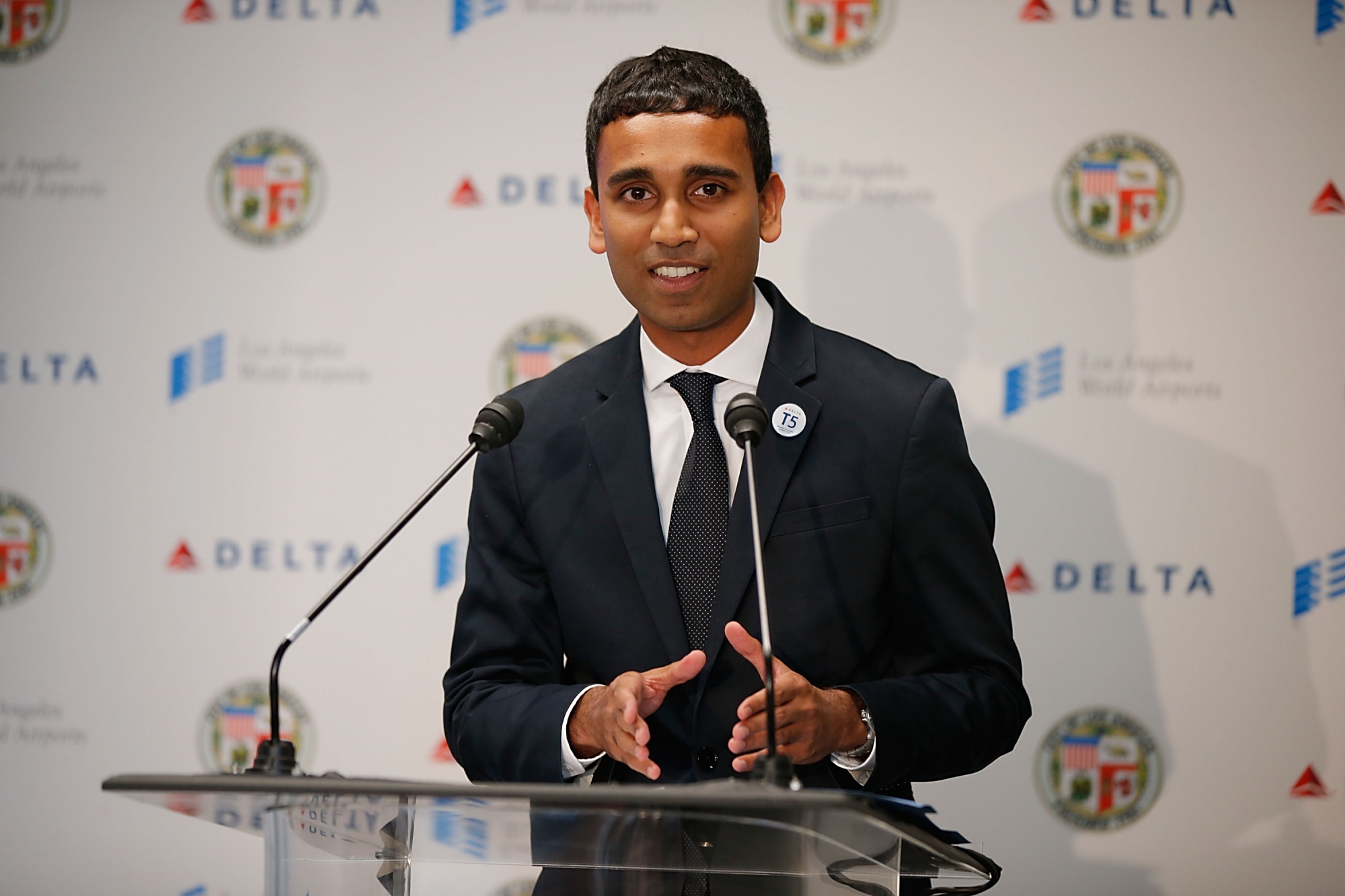
Ranjan Goswami was promoted to vice president, sales – west at Delta Air Lines in December 2014. In that position, he is responsible for Delta’s West Region, including Los Angeles, along with other strategic markets: Seattle, Portland, San Francisco, Salt Lake City, Denver and Phoenix. He also manages Delta’s marketing efforts and coordinates relationships with Delta’s alliance partners in the region.
Before joining global sales, Goswami led Delta’s eCommerce efforts in third-party merchandising, personalization and content management as Director, eCommerce Commercial. He also led Delta’s product development team as Director – Customer Experience Planning & Development, where he was responsible for the merger integration product alignment between Delta and Northwest and long-term customer experience strategy, including the Sky Priority ground product for high-value customers, Sky Club airport lounges, Delta’s flat-bed business class seat product design, in-flight Wi-Fi and entertainment, and Sky Magazine.
Goswani spoke to AirwaysNews.com about Delta’s growth in Los Angeles, his expanded role on the West Coast, the upgrade of LAX’s Terminal 5 and how the airline has improved the passenger experience at the facility.

The welcome desk at Delta One at Los Angeles International Airport. Image: Courtesy of Delta
AirwaysNews.com (AN): You were promoted from managing director of sales-west to VP-Sales -west in December. Why did Delta upgrade your job?
Ranjan Goswami (RG): I think for a couple of reasons. We’ve been growing our western footprint significantly. Back when Delta did the Western Airlines merger, it had a significant western presence, including in Los Angeles. But we didn’t maintain it, instead focusing on Salt Lake City. But after the Northwest merger, we saw we needed a larger West Coast presence, and Los Angeles and Seattle became critical to that strategy. We’re growing our capacity and LAX is important to our network.
My role here is to oversee all B2B sales for the west. I also focus on Los Angeles and how to grow faster and be competitive in the largest O&D market in the United States. I also maintain Delta’s long-term relationship with the city and local businesses in Los Angeles.
AN: What duties and responsibilities were added under your new title?
RG: I’ve really become Delta’s main person in California representing the company. As we discuss our future in LA with Los Angeles World Airports (LAWA), I also develop ties with city hall and handle the B2B sales role from Colorado west. I spend time with city businesses and leaders to discuss aviation in general and Delta in particular.
AN: LAX doesn’t quite have hub status, so how would you categorize it in comparison to all the cities Delta serves?
RG: LAX is the largest O&D market in aviation. LAX right now is the fifth-largest market for Delta, so there’s a lot of room to grow. We’re at 165 to 168 daily departures, which is a large operation. LAX is a very competitive market and fragmented in an even way with United Airlines and American Airlines in a capacity aspect. We want to grow LA, but it’s not a hub likeNew York, Salt Lake City, Atlanta, Minneapolis and Detroit. We’re going in the right direction, but we’re not there yet. But it is a major market for us and our goal is to grow in a competitive market.
AN: Delta has spent nearly $230 million on passenger experience upgrades at LAX, including the Delta One private lounge, new concessions, a renovated Sky Club, an expanded ticketing lobby and four more security screening checkpoints. Why was it so important to make these improvements?
RG: First and foremost, we learned that the passenger experience is important digitally, on the ground and in the air. Since the merger, we’ve invested in all three areas. Passengers spend a lot of time on the ground. They can have an experience like they have at a normal airport or they can have one that’s fun and engaging, where they can get work done and have a bite to eat.

The lounge area of Delta One at Los Angeles International Airport Terminal 5. Image: Courtesy of Delta Air Lines
The second thing is that we worked with the city and LAWA in a public-private partnership that allowed us to touch every aspect of the Terminal 5 experience, since work hadn’t been done in decades. The first thing we did was redo the baggage claim area. We also replaced every jet bridge.
But we also had to make sure our operations were safeguarded. If you look at our operation, we have 16 gates with 160+ daily departures, which come to 10 + turns per gate.
Another priority was a complete revamp of the concessions program to make it more likeLaGuardia. We wanted to go local, so we work with airport concessions company Westfield to get food concepts like Ford’s Filling Station, Lemonade and Farmers Market. Visitors get to taste local LA foods and residents can enjoy brands that they already know.
We redid all the restrooms. And like Atlanta, we created islands for check-in because the head house at T5 is shallow. We’ve been moving away from wall check-ins and went to four islands – three for economy and one for business class.

A check-in island at Los Angeles International Airport’s Terminal 5. Image: Courtesy of Delta
We created a separate entrance for Delta One and Delta 360 passengers [those above the airline’s Diamond Medallion status], along with those in Los Angeles who use our [paid] meet-and-greet service. We’re trying to cater to our high-value customers who have a need for privacy, extra service and speed in the check-in and security process.
AN: How did you work with Westfield to bring a balance of food and retail concessions in Terminal 5?
RG: The majority of the concepts are local food companies, but we do have Coffee Bean & Tea Leaf. We wanted a combination of grab-and-go places like Farmers Market or Lemonade. We also offer eateries for when you have more time to sit and have a meal or a drink at places like Rock & Brews Concert Bar & Grill. Picking the right restaurants was a great discussion we had with our concessions provider. What you see as a result is a lot of variety.
AN: Who is your target passenger flying into/out of LAX?
RG: It’s actually a combination of people. First, it’s local Angelinos, because we’ve built a network and franchise to fill their needs. For example, business people in LA go to New York City or places with movie tax incentives like North Carolina, Louisiana or Michigan. New York will reach 10 trips a day in October. We have the most transcon seats, which is incredible, because we weren’t even in the market six years ago.
We also have business people coming to Los Angeles, which is the fourth-largest corporate market in the country. And tourists come to LA from all over the world. We launched LAX-Shanghai [in July] and it has gone like gangbusters. LA is one of the biggest ports of entry from Asia and Mexico. Overall we support diverse travel needs for business and leisure.

Los Angeles International Airport’s Terminal 5 baggage claim. Image: Courtesy of Corgan Architecture.
AN: You created the LAXtoLUX.com website as part of your marketing campaign for the city. Why did you feel it was necessary to do this?
RG: One reason is that we’ve invested so much for our high-net-worth customers. There’s a lot of demand for our high-end products and services, including the most lie-flat seats, our Porsche car program, our Delta One service and our renovated Sky Club with expanded food and beverage offerings. With all these changes that focus on luxury, we wanted a marketing campaign to bring it all into focus. The exposure has been great. We wanted to show how Delta has been investing on luxury and quality. We wanted to talk about it in a comprehensive way and tell our story.
AN: What do you hope Delta looks like in Los Angeles 10 years from now?
RG: I want Delta to have a disproportionate share of premium business travelers. I want to be the preferred carrier for Angelinos. They have a lot of choice and always will because of the way LAX is set up. We want to be the first impression travelers have of LA.
Bombardier marked the 40th anniversary of its industry-leading Smart Services cost-per-flight-hour programs, which today support more than 1,500 enrolled aircraft and account for over 11 mil...
Velocity Maintenance Solutions, an FAA-certified provider of maintenance, repair and overhaul services, has announced a significant expansion of its facilities at Wilmington Airport (ILG) in Delaware,...
A Discover Airlines Airbus A330 has become the first Airbus aircraft worldwide to enter regular commercial service after undergoing a full-scale AeroSHARK retrofit, marking a signi...
TARMAC Aerosave has set a new industry benchmark by becoming the first company in the world to secure Aircraft Fleet Recycling Association (AFRA) accreditation across all three scopes of aircraft disa...

