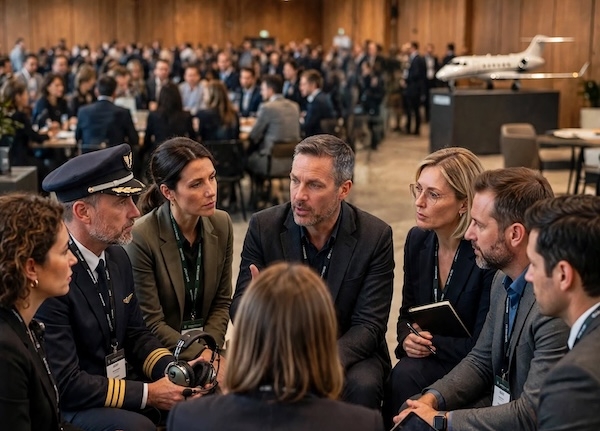
One major international business aviation conference in the USA behind us. More to come soon elsewhere. What can be learned or should have been learned before?
The more that one feels the need to prove that one is somebody, the more it reveals that one is not yet comfortable with who one is. The more one wants, shows that the less one has. It applies to people but also to events, organizations and businesses.
Event organizers who are trying to reach everybody cannot resist the temptation of impressive participant numbers. A large audience looks impressive in the media. Yet mind that an annual report of a bank will never mention how many people came through their door. It concentrates instead on value and results.
Start counting decision-makers and stop counting delegates. Attendance is only a number. The goal is consequence, not attendance. Focus on the right people delivering real value. Events seeking to look important may chase numbers but they may fall into the trap of wanting to be “more” and its irony that the pursuit of scale can sometimes reduce the actual value and importance of the conference.
Organizers, sponsors and governments may judge success by appearances. Crowds, large exhibition halls and famous speakers provide social proof, suggesting an event is worthwhile. This psychological shortcut may mistake apparent value for real value;
What organizers see as value, participants may experience as overload. Overly broad, packed event programs can reduce value through cognitive excess and information dumping. Behavioral psychology explains the urge to expand; financial discipline asks whether expansion is worth the cost.
There is also a hidden cost to “more.” More attendees require more space, more logistics, more promotion, more staff, more production and more infrastructure. At some point, additional expenditure produces little additional value. Bigger rooms, elaborate production and larger crowds may impress without delivering better results. Success demands financial discipline and return on investment, not scale.
Smaller, specialized conferences often outperform large general events through focus and targeting. Scale can support exhibitions, aircraft displays, product launches, networking, media coverage and commerce. But for knowledge, influence and decision-making, it can be counterproductive. For important subjects, conversation quality outweighs audience size. Less spectacle. More core, less mass.
Event research increasingly favors small, curated formats for engaging senior audiences. Smaller trade shows have produced higher lead-conversion rates than the largest events. Relevance, connection and purposeful participation can offer more value than show. Attendees prioritize meaningful networking and learning over flashy production. Audience size is not audience value.
Prominent people may want to avoid sales pitches, requests and publicity that make informal conversation difficult. Senior executives, investors, decision-makers and experienced specialists may avoid large conferences when the return on their time is uncertain. Travel, preparation and time away must offer more than information available elsewhere. Crowds do not guarantee access to relevant people: five focused conversations may offer more than five hundred applauding attendees. Large gatherings can hinder genuine dialogue.
Claiming that visibility wins over value, is a behavioral trap. It applies to exhibitors as well as sponsors. A psychologically impressive number may be in the hundreds of potential customers. The economically meaningful number may be in the tens of genuine decision makers. That is where behavioral psychology and ROI meet.
Targeted conferences may position the event as a selective gathering, not a mass-market event. They offer sponsors access and influence. Genuine scarcity can increase desirability and add value when participants are relevant. But mind, promoting exclusivity while admitting everyone undermines the offer.
Curate the speakers ruthlessly. Don't ask: “Who is famous?” Ask: “Who knows something the audience needs to know?” A long list of speakers feels more impressive than a few specialists, however one outstanding specialist can be worth more than five recognizable names with impressive titles. Attendees judge the speaker and look for relevance. They don't simply absorb information. They filter it. They seek validation and look for opportunities.
Don’t use panels as the principal means of delivering information. Don't put five people on a stage in a panel discussion to tell the audience what one expert could explain properly and more clearly and deliver substance. Panels exchange views like at a TV talk-show. More opinions do not guarantee better answers or more knowledge. The audience may experience five people saying variations of the same thing. Yet, an organizer may have thought that such a panel looks impressive.
Officials and industry leaders as panel members typically avoid controversy, offering cautious consensus rather than insight. Opinions can be interesting, but it doesn't necessarily teach the audience something.
Some companies at large conference are throwing things at the wall to see what sticks. They use the event as a form of marketplace experimentation. They present products, messages, ideas or offers to a broad audience and to find out what attracts attention. A company may be testing demand, gauging competitors, generating leads or discovering an opportunity it had not anticipated. But there is a distinction between deliberate market testing and indiscriminate exposure.
Last but not least. Don't attend an event just to be there. The fear may be missing out. Attendance is not an achievement. Visibility is not influence, and activity is not progress. Being seen may signal status or insider access, but appearances do not necessarily replace meaningful business, knowledge or relationships.
I am the author of incisive articles, commentaries and interviews. Yet, in contrast, I also write fictional stories about fictitious people. I know the difference between both worlds and if you ask me...
While governments worldwide remain hesitant and cautious about the use of A.I. and its regulation, Saint Tosia in the Caribbean took decisive action and officially established a Ministry of Artificial...
When Ministers attend an industry conference, it is usually formal and decorous and just for an hour as to show that they have other more important things on their mind. And their short attendance com...
We all want a stronger, safer, more prosperous Caribbean. Innovation isn’t a luxury — it’s how we get there. We should not just talk about change but rather lead it. A problem may be that we’ve been b...
Eagles soar because they always focus on their goal. One will never become an eagle by thinking like a chicken. Having said that, there is no approval for conferences with grotesque show characteristi...