



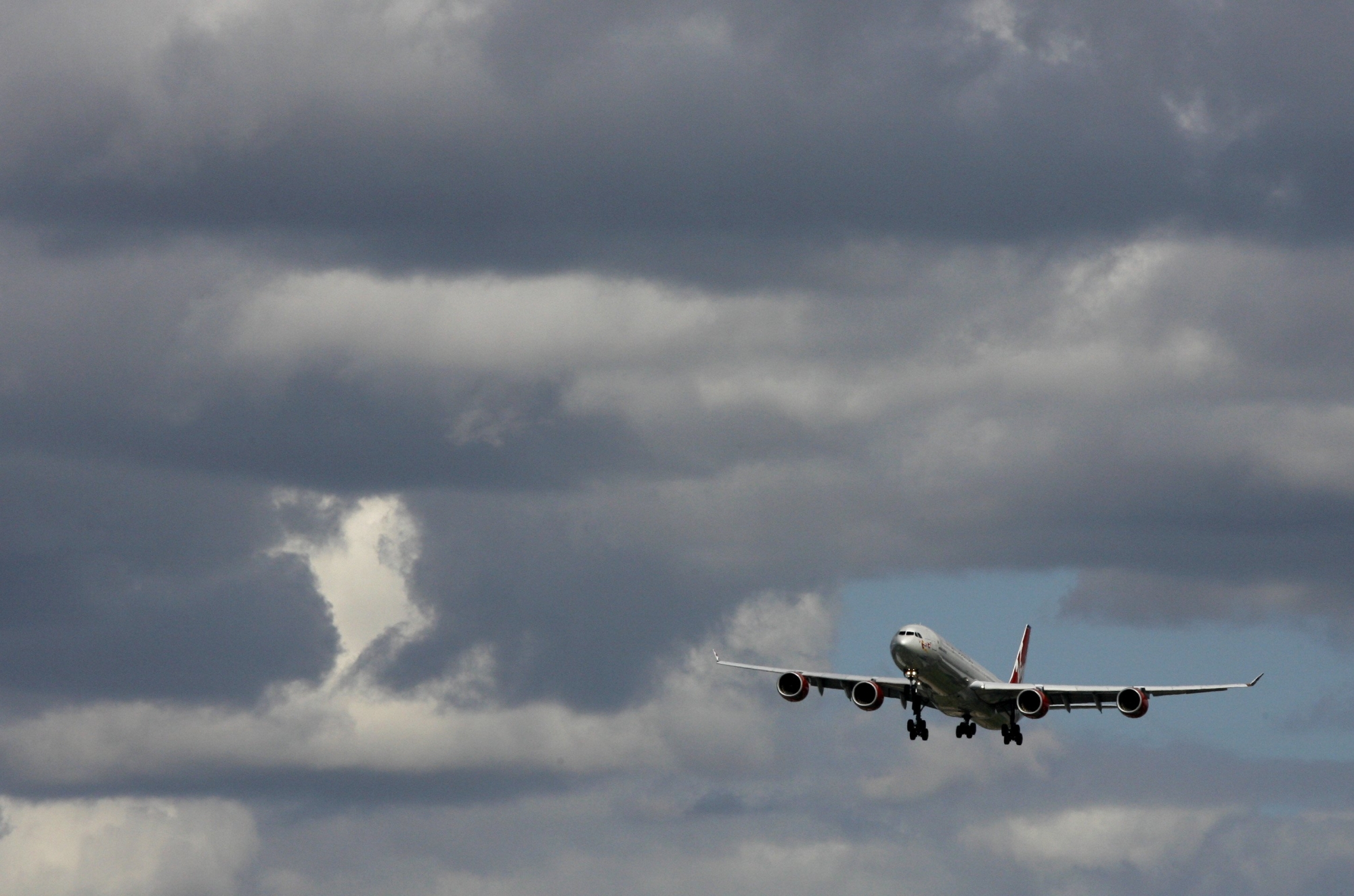
In January 1959, the first transcontinental commercial jet trip flew from Los Angeles to New York City in five and a half hours. Today, the same trip will take a half hour to an hour longer (that is, if your flight isn’t delayed). A lot has changed since 1959—fares are less expensive, planes have reduced effects on the environment, and we’ve reached astonishing levels of safety—yet the speed hasn’t increased, and the romance of flying is gone. So why is the Concorde, the fastest commercial airliner ever built currently sitting in a museum collecting dust? And what’s next for aviation? On Wednesday, May 11, Future Tense—a partnership of Slate, New America, and Arizona State University—brought together industry experts, leaders, and innovators to weigh in on the future of flight at an event in Washington, D.C.
Greg Zacharias, chief scientist of the U.S. Air Force, joined NASA Deputy Administrator Dava Newman in conversation with moderator James Fallows, national correspondent for the Atlantic, to discuss the historic role the Air Force and NASA have played in driving the research and investment that gets adopted by the private sector and creates jobs in the U.S. economy. In February, NASA announced the arrival of a new era of cleaner, quieter, and faster aircraft. “New Aviation Horizons,” an initiative included in the president’s budget, will design, build and fly a series of X-planes, or experimental aircraft, during the next 10 years. Newman emphasized the importance of investing in such new initiatives to ensure the United States is a leader of this field. According to her, the public/private partnerships are stronger than they’ve ever been with the goal of “transition[ing] these technologies sooner, quicker, and cheaper” into commercial markets.
The private sector, however, faces the financial challenge of taking designs to market. Richard Aboulafia, vice president of analysis for the Teal Group Corp., reminded the audience that even with the support of public sector partnerships, the commercial aviation industry is a low-margin business. So private sector companies that aim to design paradigm-shifting planes face the additional challenge of making them economically viable. Joining Aboulafia in conversation were representatives of three companies—Airbus, Boom Technology Inc., and Lightcraft Technology Inc.—that are attempting to do just that. Airbus and Boom are aiming to build and market the next supersonic jet that can achieve what the Concorde could not, unmatched speed at a cost-effective price. Leik Myrabo’s lightcraft technology aspires to achieve speed and environmental sustainability within an entirely new infrastructure for air travel that includes light-ports and laser-projecting satellites.

The shock wave of a T-38C supersonic jet flying over the Mojave Desert in California is seen in an undated NASA schlieren image released Aug. 25, 2015.
But it’s not just about the cool new technology. David Lackner, vice president and head of research and technology for North America Airbus Group Innovations, reminded the audience that the industry must also grapple with existing policy and infrastructure. For instance, one of the greatest barriers to supersonic air travel is bans on flight over land. When supersonic jets travel at a speed of Mach 1 and above, they generate the sound we know as the sonic boom. Today, NASA is working with Lockheed Martin on a preliminary design for Quiet Supersonic Technology, aircraft that can fly at supersonic speeds while only registering a soft thump. As the technology moves to market, the public’s appetite will change and so will the policies that once limited supersonic travel. For example, when consumers realize they can travel faster from Los Angeles to Tokyo than from L.A. to New York due to regulations of supersonic travel over land, policymakers will feel the need to respond. Michelle Schwartz, chief of staff of the Federal Aviation Administration, said the FAA is more collaborative with industry than ever before and she understands that with “industry moving at the speed of Silicon Valley, FAA can’t be moving at the speed of government.”
But new technology won’t fix our aviation system. We still have other problems to deal with—like long lines at airports and an air traffic control system that needs modernization. Justin Powell, principal at Arup Group, and Diana Pfiel, CTO of Resilient Ops Inc., believe that innovation in the private sector can respond to the infrastructure problems that affect passengers’ journeys. For instance, Pfiel and her team use crowdsourcing and data sharing to increase transparency and give passengers more control of their experience by identifying the source of delays in airports.
As Fallows noted, “Flight today is both a miracle and a frustration.” Perhaps in the future the romance of flying will once again return.
Skandia’s King Air 200/300 soundproofing kit has received final approval from Brazil’s ANAC, opening the door for wider adoption among operators across the country. The certifica...
Tecnam has announced a landmark strategic partnership aimed at accelerating the growth of its P2012 aircraft family across the United States. Under the agreement, Finnoff has been appointed the exclus...
UH-60 Black Hawk helicopters operated by Helicopter Alliance played a vital role in combating wildfires across Central and Southern Europe during the aerial firefighting season that has now concluded....
TRU Simulation + Training Inc. will showcase its Veris Virtual Reality Flight Training Device (FTD) for the Cessna Skyhawk at NBAA-BACE 2026, marking the simulator's first appearance at the indust...

