



World War I pilot Fédèle Azari spent the decade after the war making airplane-related art as part of the Italian Futurist movement. These photos, part of a group of Azari's images that have been digitized and made available through the J. Paul Getty Museum's Open Content Program, reflect Azari's vision of aviation as a gorgeous, transcendent art form.
Azari wrote a manifesto, "Il teatro aereo futurista" (Futurist aerial theater), in 1919. Following futurist precepts that emphasized the compelling and vital qualities of machines, Azari wrote that a new type of theater in which airplanes were the stars would, in some ways, transcend performances executed with human actors and dancers:
The artistic form that we create with flight is analogous to dance, but is infinitely superior because of its grandiose background, its superlative dynamism, and the greatly varied possibilities which it permits ...
To spread these ideas, Azari dropped copies of his manifesto onto Milan's streets from an airplane. (Several of the photographs in the Getty's collection show propaganda drops, but it's not clear whether the leaflets in the photographs are this manifesto, or some other publication.)
Last year, the New Yorker's Peter Schjeldahl wrote in a review of the Guggenheim's survey of Futurist art, that the movement, while politically linked to Italian fascism, could also be quite conservative in its approach to artistic form:
Futurism hewed to traditional formats of painting and sculpture and only fitfully ventured into photography and film. It couldn’t match the aesthetic innovations of Cubism or, a few years later, the conceptual genius of Dada, or the dynamic mergers of art and design in Russian Constructivism, or the experimental discipline of the Bauhaus. It remained closest in spirit to the emotional heat, in laggard forms, of German Expressionism.
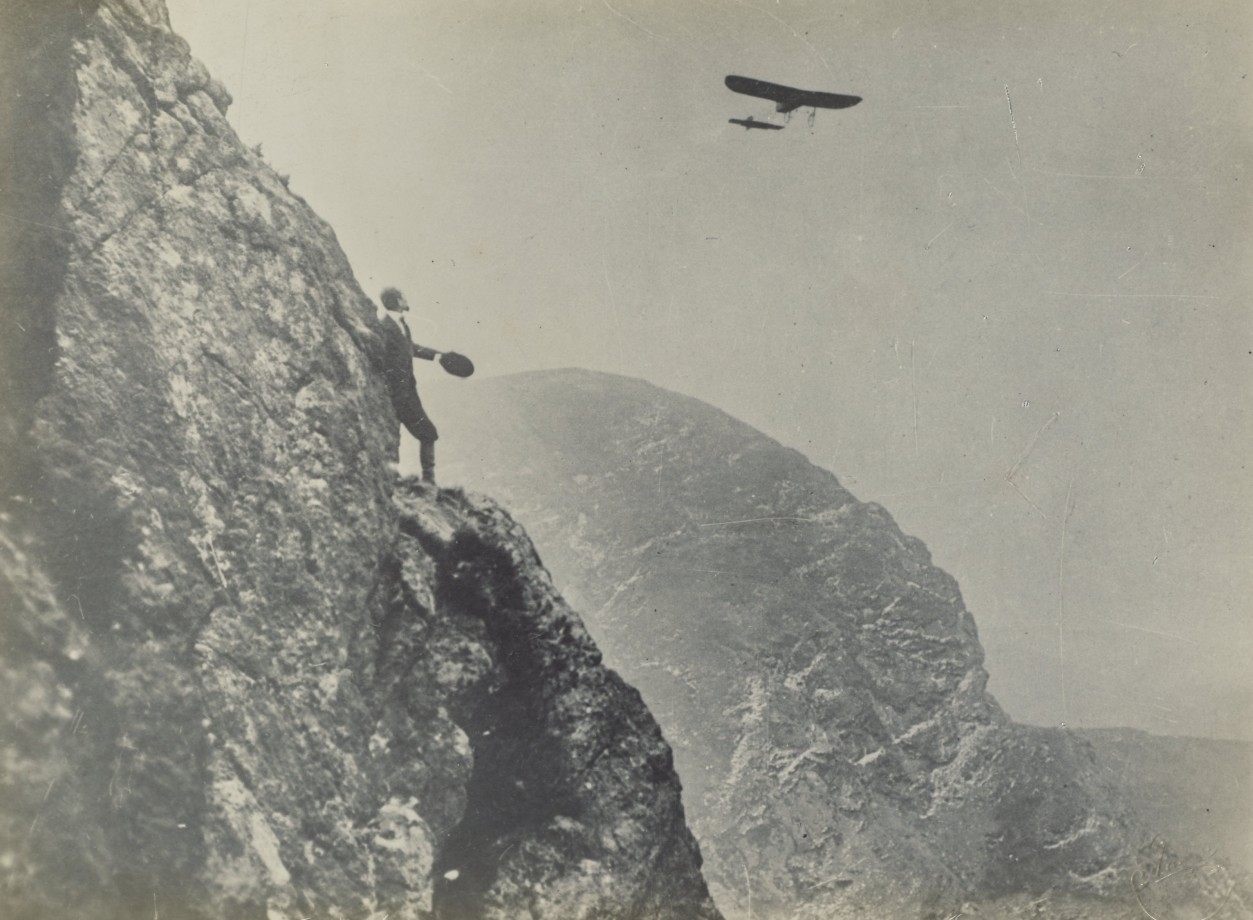
Some of Azari's photographs—the image of a mountain climber hailing an airplane; the monumental vision of a blimp nestled in its
hangar—feel like they come from a much earlier period, evoking a kind of moody romanticism.

Untitled [Airplane and Spectator], Fédèle Azari, between 1919 and 1929.
The J. Paul Getty Museum

Untitled [Blimp coming out of hangar], Fédèle Azari, between 1919 and 1929.
The J. Paul Getty Museum

Untitled [Air show], Fédèle Azari, between 1919 and 1929.
The J. Paul Getty Museum

Untitled [Propaganda Drop], Fédèle Azari, between 1919 and 1929.
The J. Paul Getty Museum

Untitled [Airplane crash], Fédèle Azari, between 1919 and 1929.
The J. Paul Getty Museum

Untitled [Blimp's gondola], Fédèle Azari, between 1919 and 1929.
The J. Paul Getty Museum

Untitled [Early airplane with a gun], Fédèle Azari, between 1914 and 1929.
The J. Paul Getty Museum

Untitled [Airplane hangar], Fédèle Azari, between 1919 and 1929.
The J. Paul Getty Museum
Following the successful public flight demonstrations at Expo 2025 Osaka, SkyDrive announced plans to undertake a feasibility study exploring the conversion of Osaka City’s existi...
Emirates has officially inaugurated services to Helsinki, marking a significant milestone in connectivity between Finland and the United Arab Emirates. The new daily route is the only year-r...
A new travel industry coalition is urging EU policymakers to adopt a balanced and proportionate approach to biometric travel, ensuring passengers can benefit from secure and seamless journeys while ma...
Tecnam has announced a landmark strategic partnership aimed at accelerating the growth of its P2012 aircraft family across the United States. Under the agreement, Finnoff has been appointed the exclus...

