



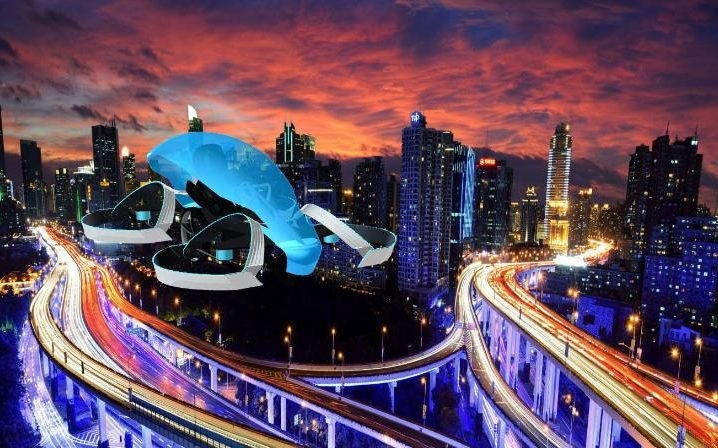
A team of young Japanese engineers is developing a flying car with the goal of launching it in time for the 2020 Tokyo Olympics.
The futuristic vehicle – dubbed Skydrive – is fitted with three wheels, a motor and four rotors, enabling it to take off and land vertically from public roads without the need of a runway.
Measuring only 9.5 feet by 4.3 feet, Skydrive claims to be the world’s smallest flying car, with a target top flight speed of 62 mph, while travelling up to 32 feet above the ground.

Tsubasa Nakamura, 31, from Mikawa in Aiichi prefecture, is heading a team of about 20 engineers and designers from across Japan’s car industry to build the new generation flying vehicle.
The goal is to provide a new form of personal transport in part to help avoid disruption caused by Japan's earthquakes.
“Our vision is to initiate a new era [in which] everyone can fly freely. We are developing the world’s smallest flying car with vertical taking off and landing (VTOL) system and it can fly anywhere and anytime," said the team on its website. "It enables us to go places where we cannot go now or to live on water, by releasing [us from] transportation on roads.”

A prototype of the flying car – measuring a fifth of the final size and fitted with adapted drone technology– was recently tested near Toyota city, hovering almost 10 feet off the ground, according to media reports.
“We hope to complete it and get it ready for use as soon as possible,” Mr Nakamura told the Japan Times.
Mr Nakamura, who studied mechanical engineering before developing racing cars, launched the flying car project in 2014 by creating a small prototype using a toy motor.
After raising more than (2.6 million yen £16,000 (£16,000) via crowdfunding, he was able to build the first full-scale prototype last year.

The race for the launch of the world’s first commercial flying car has heated up in recent years, with a growing number of global companies investing in futuristic flying technology.
Among them is AeroMobil, a Slovakian company, which unveiled a prototype with stowable wings in 2014, while Terrafugia is aiming to complete its TF-X flying vehicle by 2018.
Lilium Aviation, a German company, is also hoping to launch a lightweight and compact flying car, complete with an electric engine and a computer assisted piloting system, within the next two years.
Air France-KLM today has submitted a binding offer to Parpública for the acquisition of a 44.9% to 49.9% stake in TAP Air Portugal, marking a decisive step in the airli...
Atoms and Joby Aviation announced a strategic partnership to acquire and develop vertiport sites in the United States. The companies will initially focus on Florida, New York, and Texas, the markets w...
The groundbreaking event of Liebherr-Aerospace Technology (Shanghai) is a milestone that marks a significant step for Liebherr – one of the world's top three landing gear suppliers with deca...
Riyadh Air celebrated the launch of its inaugural service between Riyadh and Kuala Lumpur, establishing its first gateway into Southeast Asia. The inaugural event was celebrated in both cities, kickin...

