



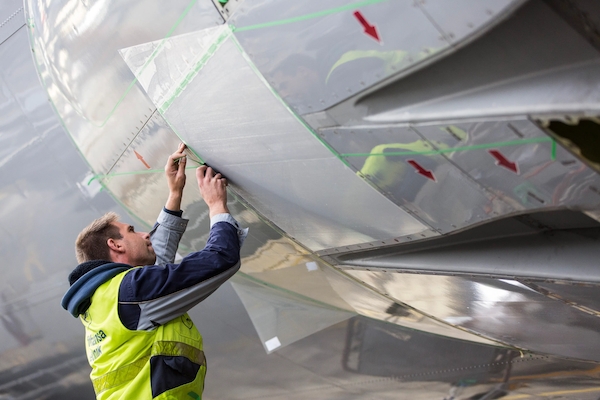
Together with Austrian Airlines, Lufthansa Technik is introducing the fuel-saving AeroSHARK surface film to another aircraft type. From winter 2024, four Boeing 777-200ER aircraft of the Austrian carrier will be equipped with the sharkskin technology. The riblet film reduces frictional resistance during flight and thus lowers the kerosene consumption as well as CO₂ emissions of long-haul aircraft.
Four of Austrian Airlines’ six Boeing 777-200ERs will be sequentially modified with Lufthansa Technik’s AeroSHARK surface film as of December 2024. As a result, total savings of approximately 2,650 metric tons of fuel and over 8,300 metric tons of CO₂ are expected over a service life of four years. This corresponds to around 46 flights from Vienna to New York.
Francesco Sciortino, Chief Operating Officer at Austrian Airlines, commented: “We take our responsibility seriously and take every possible step to reduce CO₂ emissions within our flight operations. At one percent, the sharkskin’s efficiency potential may not sound like much, but in total it will save thousands of tons of CO₂ per year on long-haul flights. Even though our Boeing 777-200ERs are in their final years of service, we take this investment to get one step closer to our CO₂ reduction targets.”
Harald Gloy, Chief Operating Officer at Lufthansa Technik stated: “The rollout of the fuel-saving sharkskin technology on another aircraft type with Austrian Airlines is great news for other Boeing 777-200ER operators as well. These are the first of hopefully many more aircraft of this type that, thanks to AeroSHARK, will have lower kerosene consumption and an improved carbon footprint.”

AeroSHARK is a surface technology for aircraft developed by Lufthansa Technik and BASF that consists of riblets around 50 micrometers thick. It imitates the special structure of sharkskin, including its friction-reducing characteristics. This optimizes the aerodynamics in relevant areas of the aircraft, which reduces fuel consumption and cuts CO₂ emissions. By applying around 830 square meters of the riblet film to the Boeing 777-200ER’s fuselage and engine nacelles, a saving of around one percent of the total fuel consumption per flight can be achieved.
A total of 17 Lufthansa Group aircraft have already been fitted with AeroSHARK – and the number is steadily increasing. The modified fleet includes a Boeing 747-400 of Lufthansa Airlines, 12 Boeing 777-300ERs of SWISS and four Boeing 777Fs of Lufthansa Cargo. The modification of the four Boeing 777-200ER aircraft operated by Austrian Airlines should be completed in March 2025.
Skandia’s King Air 200/300 soundproofing kit has received final approval from Brazil’s ANAC, opening the door for wider adoption among operators across the country. The certifica...
At AERO 2027, taking place from 14 to 17 April 2027, gliding will once again take centre stage with the dedicated AERO Gliding Expo exhibition area. As part of Europe’s leading trade show for ai...
The International Aircraft Dealers Association (IADA) has released its 2026-2027 Current Market Portrait & Forecast, offering an in-depth analysis of the global preowned business av...
Sky Travel and parent company Cove Capital Investments, LLC, have unveiled plans to bring nearly 20 business aircraft to market during Q4 2026, reinforcing their commitment to meeting growing demand f...

