



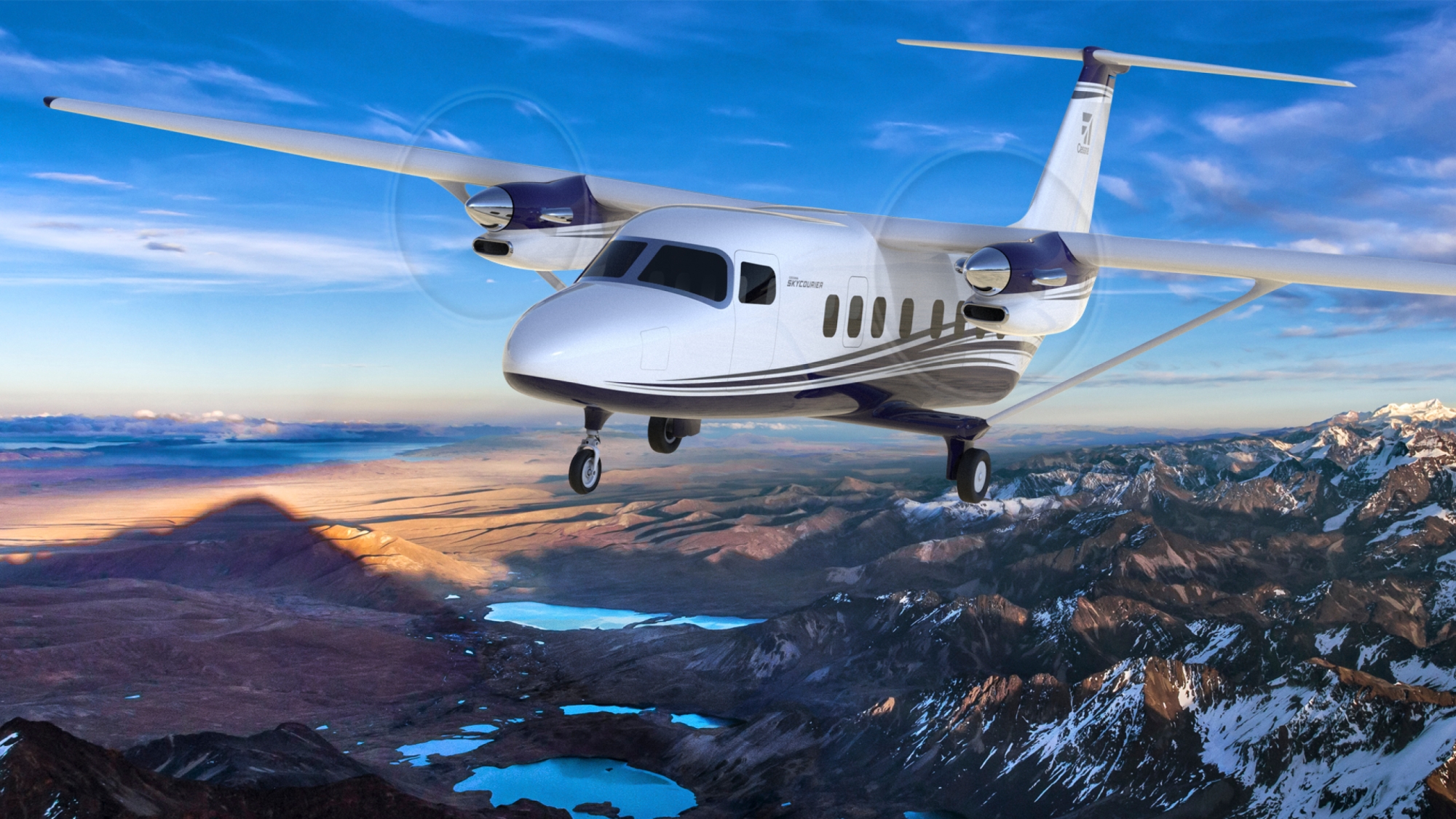
Textron Aviation Inc., announced it has completed initial wind tunnel testing of its new twin-engine Cessna SkyCourier turboprop. Results from comprehensive wind tunnel tests will provide performance and aerodynamic characteristics and structural load data, further finalizing the aircraft design.
“For the initial wind tunnel testing, we use a custom, precision model with electric motors and scaled propellers calibrated to represent the thrust produced by the real aircraft,” said Brad Thress, senior vice president, Engineering. “We’re making outstanding progress in the development of this clean-sheet aircraft and are eager to continue defining the details that will allow us to start creating tools and parts.”
Since Textron Aviation announced the Cessna SkyCourier in November 2017, the company has seen tremendous interest from operators looking for a modern solution in the large twin-utility space. As part of the aircraft’s design development, the company is garnering feedback from its Customer Advisory Board – empowering operators to affirm what customers need in this segment.
“The flexibility and mission potential for the Cessna SkyCourier is attractive to a wide variety of operators,” said Thress. “The feedback we’re gathering from the CAB is extremely important as we develop an aircraft that is reliable, efficient and meets the diverse requirements of an array of mission profiles.”
The company is anticipating first flight of the Cessna SkyCourier in 2019 with entry into service in 2020.
About the Cessna SkyCourier
The Cessna SkyCourier is a twin-engine, high-wing, large utility turboprop that will offer a combination of high performance and low operating costs for air freight, commuter and special mission operators. The freighter variant will feature a large cargo door and a flat floor cabin that is sized to handle up to three LD3 shipping containers with an impressive 6,000 pounds of maximum payload capability. The aircraft will also afford a maximum cruise speed of up to 200 ktas and a 900 nautical-mile maximum range.
The efficient 19-passenger variant will include crew and passenger doors for smooth boarding, as well as large cabin windows for great natural light and views. Both configurations will offer single-point pressure refueling to enable faster turnarounds. The aircraft will be powered by two wing-mounted Pratt & Whitney PT6A-65SC turboprop engines, and operated with Garmin G1000 NXi avionics.
The Cessna SkyCourier will be backed by Textron Aviation’s service network, a world leader in commuter, cargo and special mission fleet support.
A professional training device such as the new PC-12 PRO simulator is built on flight data supplied and validated by Pilatus. Drawing on actual flight-test and performance data, it accurately reproduc...
Electra has successfully completed the takeoff and landing of its hybrid-electric Ultra Short aircraft at Downtown Skyport in Lower Manhattan, in what is believed to be the first time a fixed-wing air...
Lufthansa Technik Engine Services (LTES) is significantly expanding its engine maintenance capabilities in Tulsa, Oklahoma, nearly doubling its operational capacity as part of its growth strategy acro...
Emirates will introduce its latest-generation Airbus A350 on the Dubai-Mauritius route from 1 November 2026, replacing the Boeing 777 currently operating the carrier’s daily EK709/710 service.&n...



