



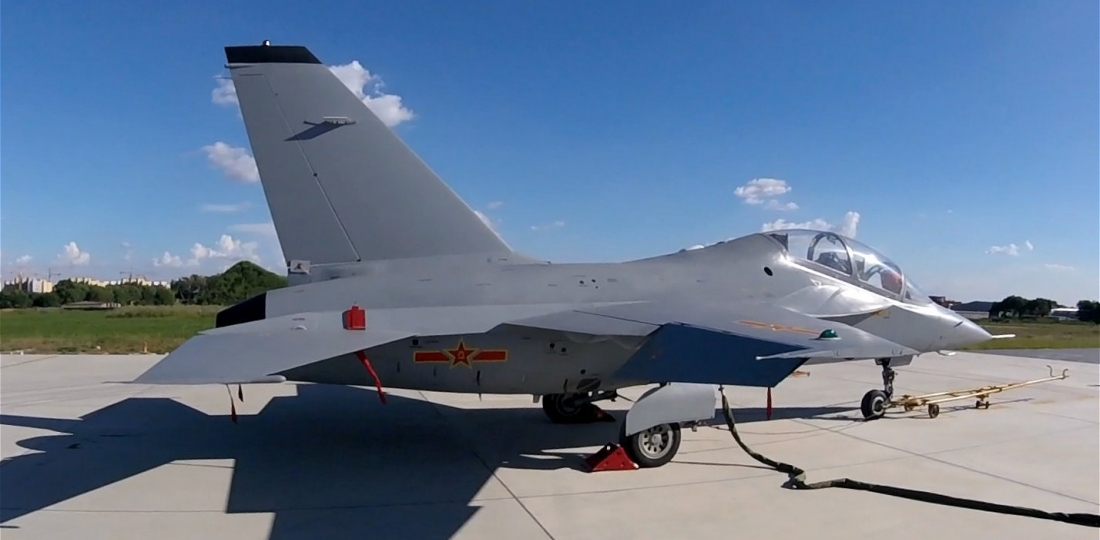
Photos emerging from China have suggested that the People’s Liberation Army Air Force (PLAAF) has taken delivery of the first Hongdu L-15 jet trainer. The supersonic, twin-engine, twin-seat trainer is among a variety ofPLAAF aircraft that will be taking part at an open day at Changchun Airbase, Jilin Province in northeastern China from September 1 to 4.
This is the first time the L-15, reportedly designated JL-10 in PLAAF service, has been seen in PLAAF colors, although it is not clear which unit the type has been assigned to.
Analysts expect the PLAAF will use the JL-10 as a lead-in fighter trainer (LIFT) or a light attack aircraft, while advanced jet training will be conducted using the lower-performance Guizhou JL-9, which is currently in service with the PLAAF and the People’s Liberation Army Naval Air Force. The JL-10 will be a lower-cost option to transition pilots into fighters such as the Chengdu J-10 or Shenyang J-11.
The L-15 made its first flight in 2006, with development reportedly assisted by Russia's Yakovlev Experimental Design Bureau. According to the manufacturer, the L-15/JL-10 can be configured as an advanced jet trainer or as a LIFT aircraft, with the LIFT variant capable of carrying a range of weaponry including the PL-8 air-to-air missile and LS-6 satellite guided bombs.
Hongdu has also said the type features a digital fly-by-wire control system with a glass cockpit and integrated avionics. The LIFT variant is equipped with a locally developed passive electronically scanned array radar.
The L-15/JL-10 is powered by the Ukrainian Ivchenko Progress AI-222K turbofan; the LIFT variant uses the afterburning AI-222K-25F model. China is believed to be developing an indigenous engine to power the aircraft, reportedly designated the WS-17.
China’s well-known inability to produce aircraft engines of sufficient quality is part of the reason why it has set up a new company to oversee civil and military aircraft engine development and production efforts. The Aero Engine Corporation of China (AECC) incorporates subsidiaries of a series of state-owned firms, including the Aviation Industrial Corp. of China (AVIC).
With a registered capital of 50 billion RMB ($7.5 billion) and a workforce of 96,000, the group’s formation has been described by Chinese President Xi Jinping as a “strategic move” to make China an aviation power and modernise the military, according to China’s state news agency Xinhua.
Summer high season in Spain is always a defining period for general aviation sector, and this year is no exception. With the first two months already behind us, preliminary results are offering a clea...
The first TBM 980 for a Brazilian customer delivered by Daher Aircraft, marking the introduction of this newest fast and efficient turboprop-powered airplane in a market where the TBM family continues...
Capital Jets, an aircraft management company and 14 CFR Part 135 aircraft operator, has expanded its operations with the addition of a Learjet 60XR. Based at Fort Lauderdale-Hollywood Internation...
The groundbreaking event of Liebherr-Aerospace Technology (Shanghai) is a milestone that marks a significant step for Liebherr – one of the world's top three landing gear suppliers with deca...

