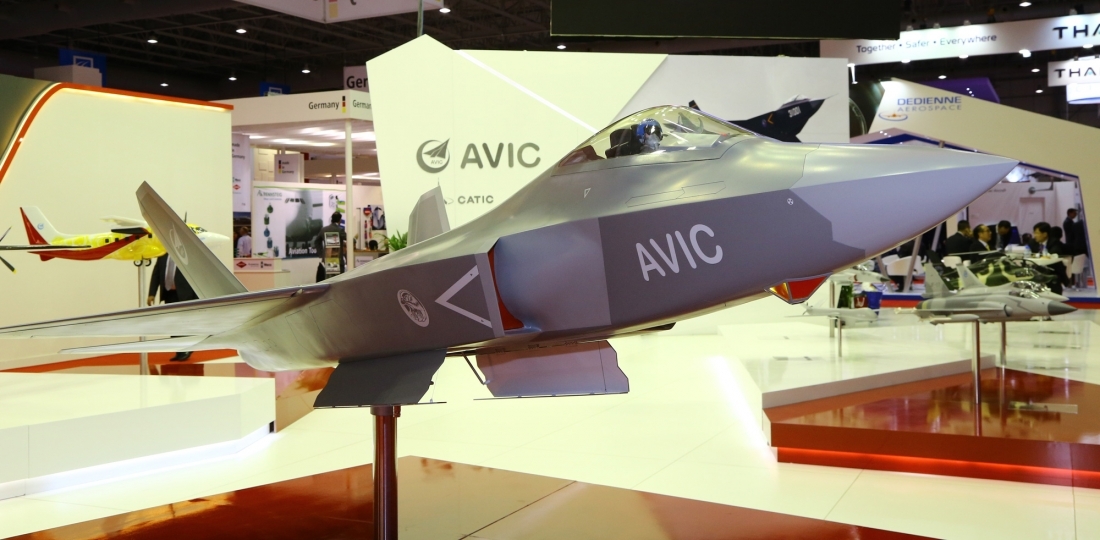
China’s AVIC is displaying a model of the FC-31 fifth-generation fighter for the first time at Dubai, having first aired the concept at Airshow China in Zhuhai last year. A product of the Shenyang concern, the FC-31 is based to a large extent on that of a “J-31” prototype (31001) that has been flying since 2012, but shows some notable differences from that aircraft. The fins are shorter and more swept-back than those of the prototype, and an electro-optical sensor system is located under the nose. Aircraft 31001 made its first public appearance at last year’s Zhuhai show.
AVIC (Aviation Industry Corporation of China, Stand 820) has reportedly developed the aircraft primarily for export, although there have been some suggestions that the aircraft could be intended for carrier operations. The prototype has a twin-wheel nose gear, a feature shared with most carrier-borne fighters. In the export arena, the aircraft is intended to appeal to nations seeking an F-35-style aircraft but at much lower cost. On the surface, the FC-31 shares many similarities with the Lockheed Martin aircraft, such as a low-observable shape, a wide internal weapons bay, and the ability to carry weapons on six underwing pylons in “non-stealthy” mode. It also has serpentine diverterless inlets.
AVIC has only just released a basic specification for the FC-31 aircraft. Length is 55 feet, 1.5 inches, span is 37 feet, 8.75 inches and height is 15 feet, 8.5 inches. Maximum takeoff weight is listed at 55,000 pounds and weapons carrying capability at 17,600 pounds. AVIC claims that the FC-31 will be able to reach a service ceiling of 52,500 feet, and a top speed of Mach 1.8. Combat radius is 648 nm. The airframe is stressed to +9/-3 g, and has a projected service life of 6,000 to 8,000 hours, or 30 years.
Prototype 31001 first flew with Klimov RD-93 engines bought from Russia, but it is expected that production aircraft would be powered by engines of Chinese origin, such as the Guizhou WS-13A.
Archived
10 years ago
For the fourth consecutive year, Corsair is reaffirming its commitment to the fight against breast cancer by partnering with the association "Les Hôtesses de l’Air cont...
As the first aviation company in Kansas to introduce state-registered youth apprenticeships through the Kansas Office of Apprenticeships, Textron Aviation is taking a leading role in workforce develop...
PAL-V has signed a Memorandum of Understanding with AVION, a specialist in advanced flight training devices, and FLYVE, a developer of FlyDrive ecosystems for professional and government operator...
Boeing and Ethiopian Airlines have announced a new cargo fleet expansion agreement, with the African carrier ordering eight 777-8 Freighters and two additional 777 Freighters. The investment will enab...