



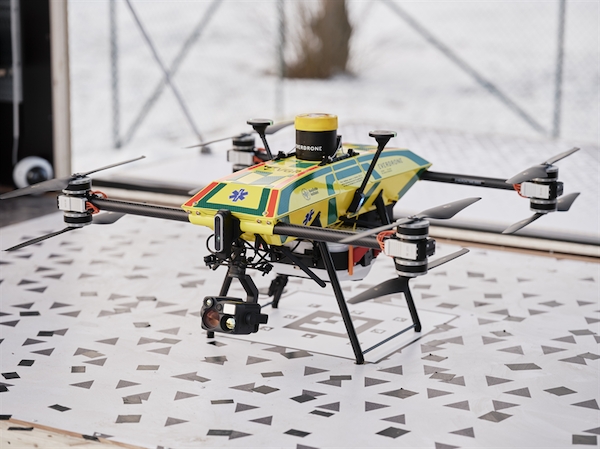
Everdrone, headquartered in Gothenburg, develops drone services for emergency medical purposes. The previous generation, E2, was a development platform based on commercial components. Everdrone is now launching the next generation, E3, which has been entirely developed in-house. The drone’s performance has been substantially improved.
The E3 drone is developed using both OEM products and proprietary components. For example, it includes parts from suppliers such as Ligpower and Aston Harald Composite, giving the drone four rotor pairs with eight blades. The drone measures 90 × 75 × 55 cm, excluding propellers, and weighs 24 kg. Proprietary damping creates a vibration-free cruising speed of over 80 km/h. The battery capacity provides a solid margin for multiple types of deployments, and the choice of battery supplier is continuously evaluated to further improve performance and endurance. The E3 is flown autonomously and monitored by a drone operator.
Mats Sällström commented: “Our initial focus was on developing software for drone services, but we realized that there were no commercially available drones that matched the needs of emergency medical care. Therefore, we chose to develop our own. Allowing drones to transport emergency medical equipment significantly reduces transport time. On average in Sweden, it takes ten minutes for an ambulance to arrive at an emergency scene. While waiting for an ambulance, Everdrone’s new drone can be on site in under three minutes, making it a complement to emergency medical services that saves lives."
The predecessor, E2, was capable of carrying a 2 kg payload consisting of a defibrillator. The new drone, E3, can carry up to 4.5 kg. The payload module has a flexible design that allows it to transport both defibrillators and other types of medical equipment, such as adrenaline for anaphylactic reactions, antidotes for opioid overdoses, as well as bandages and tourniquets to stop life-threatening bleeding.

The U.S. Federal Aviation Administration has certified the Boeing 737-10, the newest and largest member of the 737 MAX family, paving the way for Boeing [NYSE: BA] to begin customer deliveri...
Bombardier announced plans to further expand its presence across the United States, with the creation of 800 jobs supported by ongoing growth initiatives and strategic infrastructure investments. ...
The Tennessee Valley Authority is demonstrating the real-world value of the Tecnam P2012 Special Mission Platform (SMP), which has become a vital tool for monitoring and maintaining its...
Emirates will introduce its latest-generation Airbus A350 on the Dubai-Mauritius route from 1 November 2026, replacing the Boeing 777 currently operating the carrier’s daily EK709/710 service.&n...

