



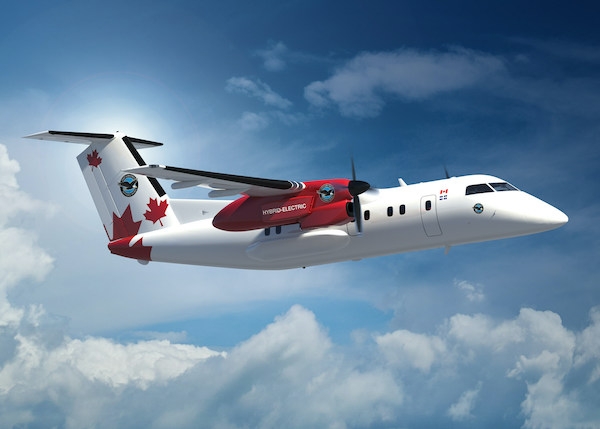
Pratt & Whitney Canada announced the development of an advanced mobile charging unit capable of charging high-power batteries at up to 1500 volts, making it compatible with Megawatt Charging System standards the industry is advancing for high voltage power applications. The MCU was developed in collaboration with the National Research Council of Canada (NRC) and the Innovative Vehicle Institute (IVI) as part of the RTX hybrid-electric flight demonstrator project.
Alexandre Gagnon, vice president of corporate affairs, Pratt & Whitney Canada, commented: "This is the latest example of our hybrid-electric flight demonstrator project, driving collaboration and innovation within Canada's aerospace ecosystem to enable a more sustainable future for aviation. High voltage, bidirectional charging systems will be critical for a growing number of electric and hybrid-electric systems including aircraft, as well as other transport applications."
The MCU is assembled from commercially available components and can deliver up to 280 kW and 1500 volts. In collaboration with IVI, Pratt & Whitney Canadadeveloped a distributed control and protection strategy. The NRC focused on the hardware design, assembly, testing and delivery of two charger units, which will be used on the hybrid-electric flight demonstrator project. The charger's bidirectional capability enables it to both charge and discharge batteries, which creates opportunities to recycle unused energy back into the electrical grid.
Pratt & Whitney Canada continues to progress in testing the propulsion system for the RTX hybrid-electric demonstrator, which targets a 30% improvement in fuel efficiency and reduced CO2 emissions compared to today's most advanced regional turboprops. In 2024, the propulsion system will be linked to batteries developed by H55, which will be charged using the new charger. Hybrid-electric propulsion is a critical component of RTX's strategy for enabling more sustainable aviation and supporting the industry's goal of reaching net-zero CO2emissions by 2050.
PAL-V has appointed Nobleo Manufacturing as its strategic industrialisation partner for the world’s first FlyDrive production facility. Following the achievement of both automotive and aviation...
Lufthansa Technik Engine Services (LTES) is significantly expanding its engine maintenance capabilities in Tulsa, Oklahoma, nearly doubling its operational capacity as part of its growth strategy acro...
The U.S. Federal Aviation Administration has certified the Boeing 737-10, the newest and largest member of the 737 MAX family, paving the way for Boeing [NYSE: BA] to begin customer deliveri...
Emirates will introduce its latest-generation Airbus A350 on the Dubai-Mauritius route from 1 November 2026, replacing the Boeing 777 currently operating the carrier’s daily EK709/710 service.&n...

