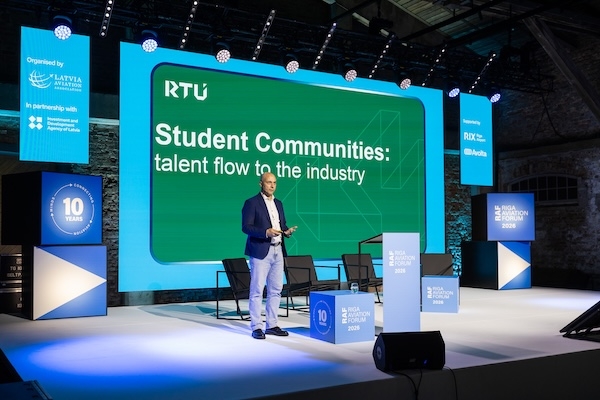
Speaking during the Riga Aviation Forum 2026, Pauls Irbins, Head of the Aerospace Direction at the RTU Innovation Office, presented a compelling vision of how Riga Technical University (RTU) can become a strategic partner for aeronautical and aerospace companies across Europe. As Europe’s aerospace sector seeks innovation, skilled talent, and cost-effective research partnerships, the presentation showcased RTU's growing Aerospace Technology Centre and student innovation ecosystem, highlighting a unique model that connects research, prototyping, industry collaboration, and talent development.
From Student Talent to Industrial Innovation
One of the strongest messages delivered during the presentations was simple: universities cannot prepare specialists for every individual company. Instead, successful collaboration comes when industry actively engages with students throughout their educational journey. Pauls Irbins emphasized this reality, noting that companies should view universities not merely as education providers, but as long-term innovation partners.
RTU's model creates a structured talent pipeline that begins with students exploring industries, progresses through participation in real company challenges and pilot projects, and culminates in internships, thesis work, advanced research, and ultimately employment and innovation.
For aerospace companies, this offers a practical opportunity to identify future engineers early, test concepts with multidisciplinary student teams, and build relationships with potential recruits before graduation.
Collaboration Models: How European Aerospace Companies Can Work with RTU
Beyond technology development and talent acquisition, Riga Technical University offers several practical collaboration models that can create tangible value for aerospace and aeronautical companies of different sizes. The university's approach combines research capabilities, student engagement, testing infrastructure, and industry partnerships into a flexible ecosystem.
1. Joint Research and Development Projects
Companies can partner with the Aerospace Technology Centre on specific technology challenges, ranging from unmanned aerial systems and high-altitude platforms to propulsion, energy systems, and advanced materials. These projects can leverage RTU's academic expertise while allowing companies to validate concepts, develop prototypes, and advance technologies through different Technology Readiness Levels.
This model is particularly attractive for organizations seeking access to innovative solutions without maintaining large internal research teams.
2. Student Innovation and Talent Programmes
One of RTU's greatest assets is its student community. Companies can engage students through:
As highlighted by Pauls Irbins, universities cannot prepare specialists for every individual company. Instead, direct engagement enables businesses to shape future talent according to their own technological and operational needs.
3. Prototype Development and Technology Demonstrators
The university's work on High Altitude Pseudo Satellites (HAPS) demonstrates its focus on rapid prototyping and cost-efficient experimentation. Companies can use RTU as a platform for developing and testing proof-of-concept systems before investing in full-scale industrial development.
Such collaborations can include payload integration, sensor validation, communication technologies, autonomous systems, and lightweight structural solutions.
4. Participation in European and ESA-Funded Projects
RTU's involvement in space-related initiatives, including cooperation connected to ESA's MELiSSA programme and collaborations with Latvian space-industry companies, makes it a valuable consortium partner for European funding programmes.
European aerospace companies can collaborate with RTU in:
Such collaborations can reduce project risk while expanding access to scientific expertise and regional industrial networks.
5. Industry-Focused Testing and Validation Platforms
Projects such as RTU's High-Power Rocketry and HAPS programmes provide opportunities for companies to test subsystems, software, electronics, communication technologies, and experimental payloads in realistic operational environments.
For startups and SMEs in particular, these projects can serve as affordable demonstration platforms that accelerate technology maturation and provide valuable operational data.
6. Building a Baltic Aerospace Innovation Network
RTU also acts as a gateway to Latvia's growing aerospace and space ecosystem, connecting companies with specialized industry players in areas such as thermal management, deep-space communications, microelectronics, optical technologies, data processing, and satellite communications.
Rather than a traditional client-university relationship, RTU promotes a collaborative innovation network where academia, startups, established aerospace companies, and public institutions work together to develop new technologies and strengthen European aerospace capabilities.
A Partnership Rather Than a Service
The key takeaway from the presentations is that RTU seeks long-term strategic partnerships rather than transactional research contracts. Companies can simultaneously access innovation, recruit future specialists, contribute to ongoing research programmes, and establish a presence within the Baltic aerospace ecosystem. For European aerospace organizations looking to expand their innovation capacity while developing the next generation of engineering talent, collaboration with Riga Technical University and its Aerospace Technology Centre offers a highly practical and scalable model.
Archived
1 month ago
Emirates will introduce its latest-generation Airbus A350 on the Dubai-Mauritius route from 1 November 2026, replacing the Boeing 777 currently operating the carrier’s daily EK709/710 service.&n...
Air Baltic Corporation AS , Latvia’s national airline and the leading carrier in the Baltic States, announced that airBaltic and its subsidiaries participating in the voluntary Ch...
Bombardier announced plans to further expand its presence across the United States, with the creation of 800 jobs supported by ongoing growth initiatives and strategic infrastructure investments. ...
Airbus 2026 Cargo Global Market Forecast, unveiled at the Cargo Facts Symposium, predicts that the global fleet of dedicated freighter aircraft will expand by 46%, rising from 2,360 aircraft in 2026 t...