



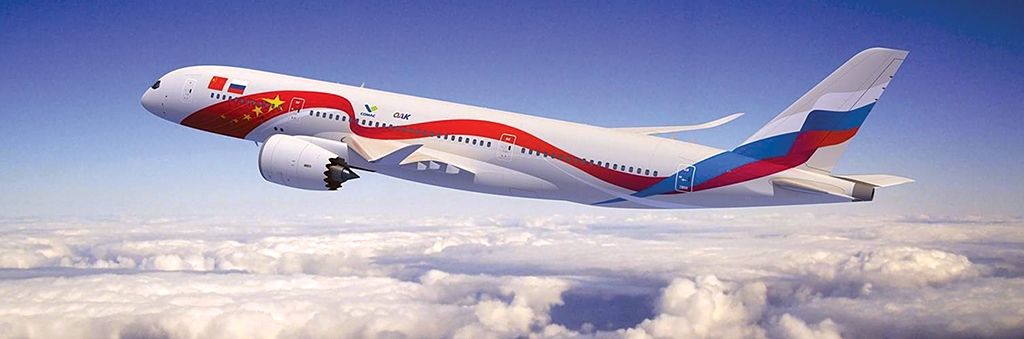
The proposed Chinese-Russian widebody airliner will require investment of between $13 billion and $20 billion. Confirming the outline program budget at last week’s Farnborough International Airshow, Yuri Slyusar, president of Russia’s United Aircraft Corporation, said that the final amount will depend on whether or not customer support arrangements will be able to use existing facilities of UAC and its Chinese partner Comac, AIN reported.
What has been resolved is that UAC and Comac intend to use Boeing “gate” process for managing the program. Gate 3—at which point the aircraft should be completely defined—is currently planned for around the 2018-2019 time frame. Comac and its Avic subsidiary will be responsible for final assembly and the majority of parts manufacturing, using existing factories around Shanghai and other Chinese cities, including those now being used for the ARJ21 and C919 airliners. The Russian partner will mainly be responsible for design and development work, according to Slyusar. UAC’s newlybuilt 463,000-sq-ft engineering center at Zhukovsky, near Moscow, will house Chinese and Russian engineers working on the program. The partners have dropped plans to base the new widebody on the existing Ilyushin Il-96 twinjet, instead opting for a completely clean-sheet design.
UAC and Comac have conducted meetings with a number of Asian airlines, which are the target market for the new aircraft, and their feedback has help to define requirements for an aircraft that will carry 280 passengers on trips of up to almost 6,500 nm, with service entry provisionally pegged for between 2025 and 2027.
During a visit to Beijing last month, Russian President Vladimir Putin signed government-to-government agreements with Chinese President Xi Jinping. At the same time, Russia’s trade and industry ministry signed agreements with its Chinese counterpart to establish a joint venture between UAC and Comac/Avic. The partners will contribute equally to development costs.
Initially, the engines for the new widebody are likely to be provided by Rolls-Royce or/and GE, “which already have suitable models with the required thrust of 35 metric tons,” according to Slyusar. Later on, the Russian design house Aviadvigatel in Perm is expected come up with its own PD-35 turbofan, which will be an up-scaled copy of the PD-14 engine that is now being tested.
For the fourth consecutive year, Corsair is reaffirming its commitment to the fight against breast cancer by partnering with the association "Les Hôtesses de l’Air cont...
British Airways has unveiled the next phase of its Heathrow lounge transformation programme, marking the beginning of a significant investment aimed at modernising every lounge across the airport in t...
FL Technics Indonesia, the first MRO in Indonesia to be appointed as a GE Aerospace avionics support partner, has signed a service support agreement with GE Aerospace covering Boeing 737 and Airbus A3...
UH-60 Black Hawk helicopters operated by Helicopter Alliance played a vital role in combating wildfires across Central and Southern Europe during the aerial firefighting season that has now concluded....

