



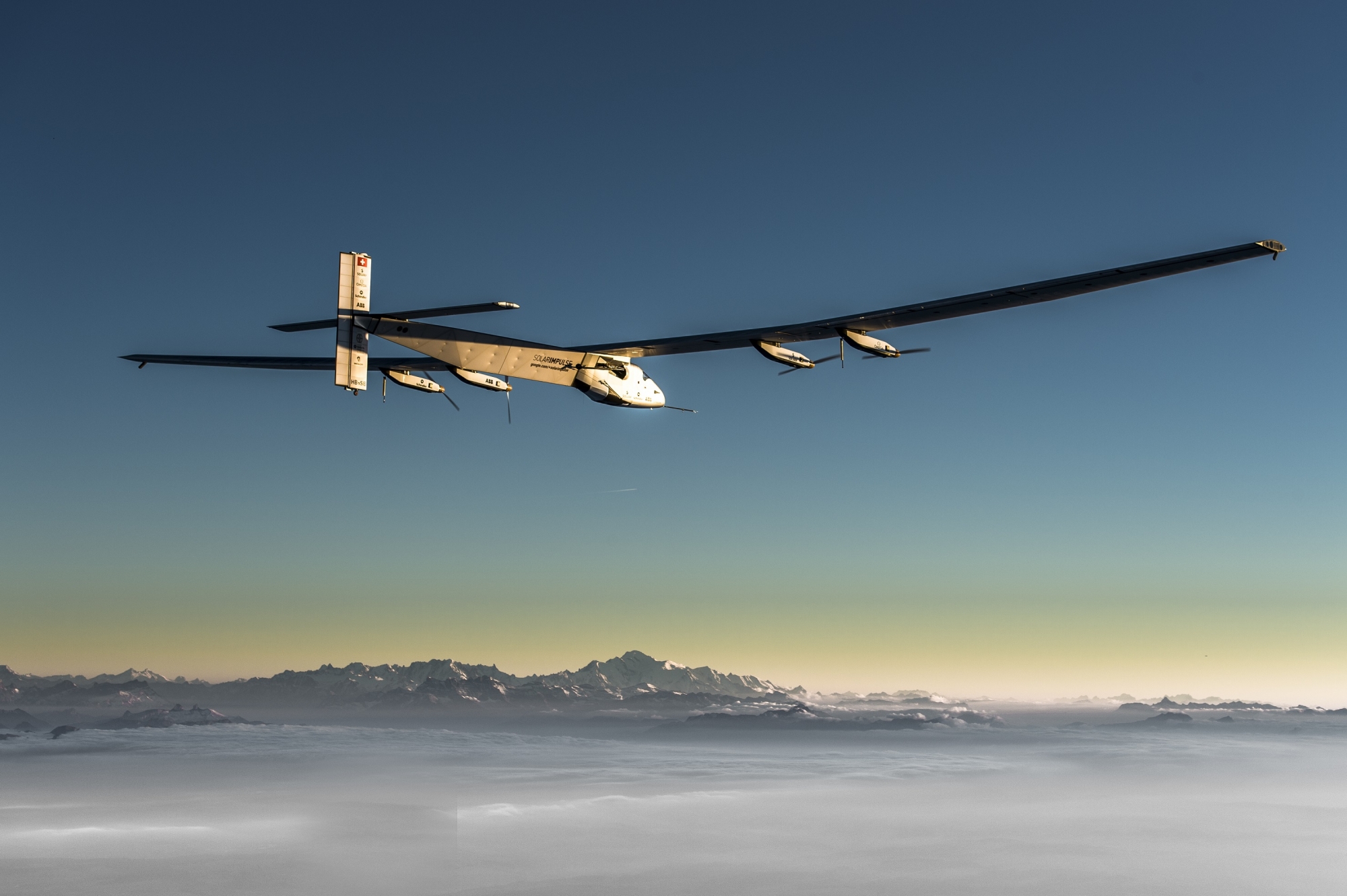
A solar-powered airplane on a journey around the world was preparing to land in California on Saturday night to complete a risky, three-day flight across the Pacific Ocean.
The Solar Impulse 2 was flying in a holding pattern off the San Francisco coast on 70 percent of stored energy while waiting for winds to decrease for landing at Moffett Airfield in Mountain View.
The aircraft performed a fly-by over the Golden Gate Bridge in the late afternoon following 56 hours of flight that began Thursday morning in Hawaii.
"I crossed the bridge. I am officially in America," pilot Bertrand Piccard declared as he flew over the iconic span as spectators watched the narrow aircraft with extra wide wings from below.
Piccard said stopping in Silicon Valley, where the airfield is located, will help link the daring project to the pioneering spirit of the area.
"Can you imagine crossing the Golden Gate Bridge on a solar-powered plane just like ships did in past centuries? But the plane doesn't make noise and doesn't pollute," Piccard said a live video feed on the website documenting the journey.
"It's a priority to link the project we have with the pioneering spirit in Silicon Valley," he added.
The aircraft started its around-the-world journey in March 2015 from Abu Dhabi, the capital of the United Arab Emirates, and made stops in Oman, Myanmar, China and Japan. It's on the ninth leg of its circumnavigation.
The trans-Pacific leg of his journey is the riskiest part of the solar plane's global travels because of the lack of emergency landing sites.
After uncertainty about winds, the plane took off from Hawaii on Thursday morning. The crew that helped it take off was clearing out of its Hawaiian hangar and headed for the mainland for the weekend arrival.
At one point passengers on a Hawaiian Air jet caught a glimpse of the Solar Impulse 2 before the airliner sped past the slow-moving aircraft.
The Solar Impulse 2 landed in Hawaii in July and was forced to stay in the islands after the plane's battery system sustained heat damage on its trip from Japan.
Piccard's co-pilot Andre Borschberg flew the leg from Japan to Hawaii. He was aboard a helicopter to welcome Piccard as he approached the Bay Area.
The team was delayed in Asia, as well. When first attempting to fly from Nanjing, China, to Hawaii, the crew had to divert to Japan because of unfavorable weather and a damaged wing.
A month later, when weather conditions were right, the plane departed from Nagoya in central Japan for Hawaii.
The plane's ideal flight speed is about 45 kph, or 28 mph, though that can double during the day when the sun's rays are strongest. The carbon-fiber aircraft weighs more than 5,000 pounds, or about as much as a midsize truck.
The wings of Solar Impulse 2, which stretch wider than those of a Boeing 747, are equipped with 17,000 solar cells that power propellers and charge batteries. The plane runs on stored energy at night.
Skandia’s King Air 200/300 soundproofing kit has received final approval from Brazil’s ANAC, opening the door for wider adoption among operators across the country. The certifica...
Sky Travel and parent company Cove Capital Investments, LLC, have unveiled plans to bring nearly 20 business aircraft to market during Q4 2026, reinforcing their commitment to meeting growing demand f...
Rotortrade, the global helicopter dealership, has confirmed its participation in EUROPEAN ROTORS 2026, which will take place at EUREXPO Lyon, France. Marking its first edition in France, EUROPEAN...
Dutch flag carrier KLM, part of the Air France-KLM Group, has welcomed its first Airbus A350-900, marking a significant step in the airline’s long-haul fleet modernization strategy. The arrival...

