



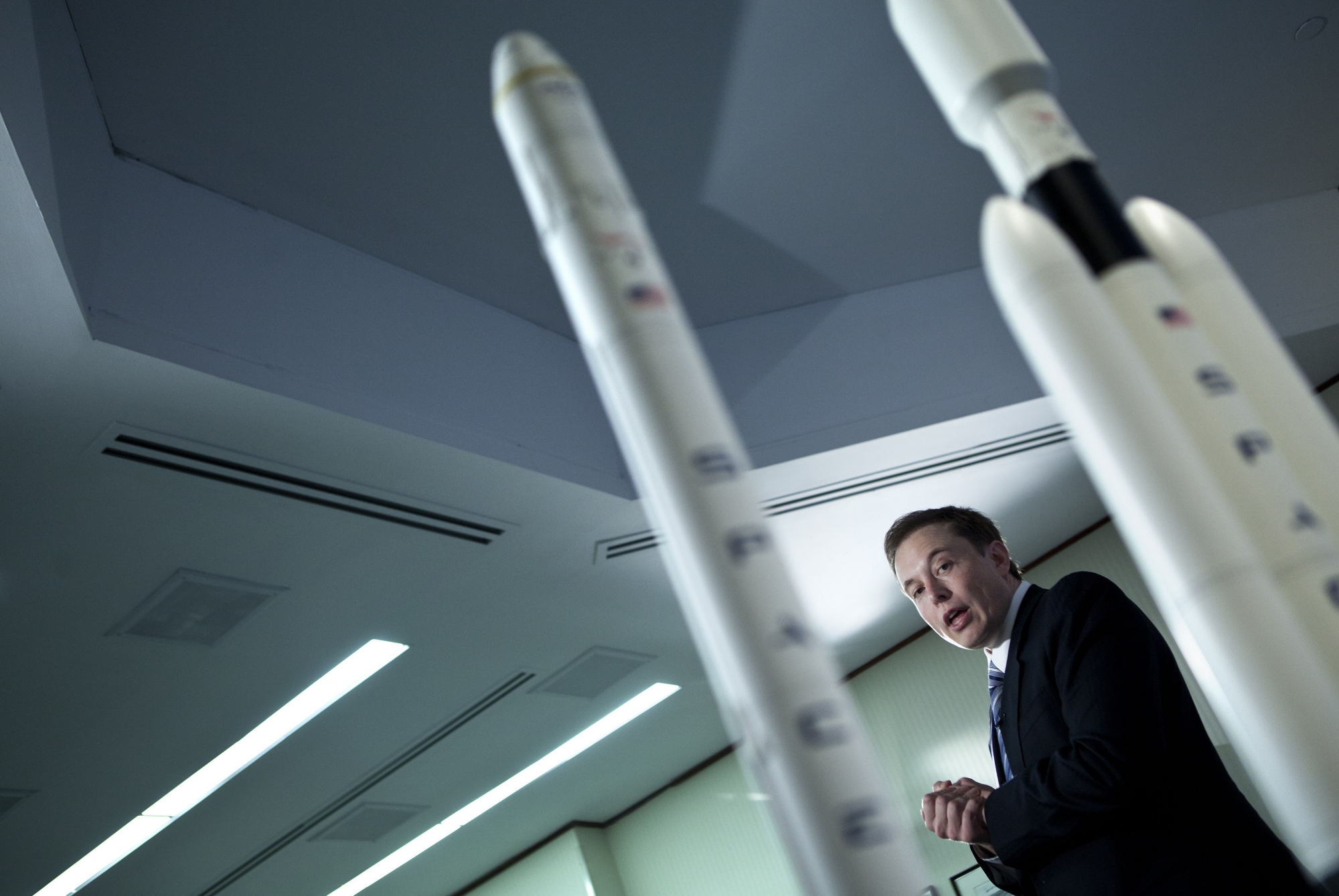
Elon Musk has successfully launched another Space X rocket into space, but failed to land this latest one on its target barge.
Tesla, Musk's company, launched the unmanned Falcon 9 at sunset on Friday. It carried a broadcasting satellite for SES, a company based in Luxembourg. This was Tesla's fifth launch for the past one and a half weeks. Another launch was tried on Sunday, but with the rocket engine shutting down a split second before it lifted off.
As Tesla attempted many times before, it tried to land the first-stage booster of Space X in a barge in the middle of the Atlantic about 400 miles offshore. But before it touched down and about 10 minutes into the flight, the TV camera aboard the platform conked out inducing loud groans from the crowd watching on the premises of the Hawthorne, California Tesla Headquarters.
It turned out that the leftover first-stage booster hit the floating barge hard, knocking of the TV camera and cutting off its live transmission. Tesla claimed that it never expected to have a successful landing since the booster has to have a faster speed so that the satellite it carried could be lifted up to a higher orbit.
Previously in December, Space X was able to complete a successful rocket landing on the Cape Canaveral grounds. However, the car electric company has yet to nail a more difficult barge landing at sea.
The booster also burned up more fuel in going up therefore it has less fuel when it tried for a precision touchdown. When it went up, the crowds cheered as it went higher than before, and more so when the camera showed the successful separation of the satellite it carried.
Elon Musk claimed that the rocket engine reached the target altitude of 40,600 kilometers or over 25,000 miles. "Thanks @SES Satellites for riding on Falcon 9! Looking forward to future missions," he tweeted afterwards.
TRU Simulation + Training Inc. will showcase its Veris Virtual Reality Flight Training Device (FTD) for the Cessna Skyhawk at NBAA-BACE 2026, marking the simulator's first appearance at the indust...
A new travel industry coalition is urging EU policymakers to adopt a balanced and proportionate approach to biometric travel, ensuring passengers can benefit from secure and seamless journeys while ma...
Boeing and Ethiopian Airlines have announced a new cargo fleet expansion agreement, with the African carrier ordering eight 777-8 Freighters and two additional 777 Freighters. The investment will enab...
Dutch flag carrier KLM, part of the Air France-KLM Group, has welcomed its first Airbus A350-900, marking a significant step in the airline’s long-haul fleet modernization strategy. The arrival...

