



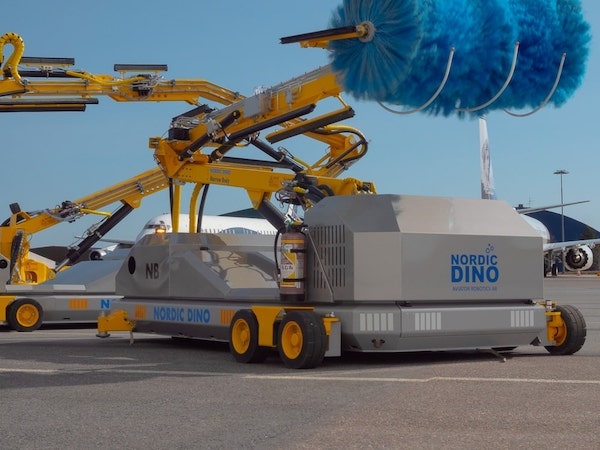
Over the past several years, robots have taken over many of the mundane tasks performed by humans. From complex industrial assembly lines to vacuum or floor-cleaning robots in the home, the robotisation of daily life is already part of modern living. While robots are now commonplace, many airport services companies still choose to perform tasks manually rather than with the assistance of machines. With more and more companies entering the robotised aircraft cleaning market the question arises: what are the benefits of these machines?
Time saved is money saved
One of the specialist companies in semi-automatic aircraft exterior cleaning, Nordic Dino, says that the use of machines to perform cleaning tasks can vastly reduce downtime and result in money saved.
“Most of the time maintenance work is performed on clean aircraft to reveal any scratches or dents hidden under layers of dirt and grime. Thus, a contaminated fuselage has to be thoroughly washed at the MRO facility, costing extra time and money for the aircraft operator. Additionally, if not cleaned regularly the aircraft’s fuselage is at risk of developing rust spots or corrosion, resulting in more downtime to repair the affected material and avoid further damage. From our experience – in many cases – Nordic Dino managed to cut aircraft exterior cleaning times by as much as 80%. As a result, 80% fewer man-hours spent per aircraft equals more savings on employee costs, making robotised cleaning a cost-efficient way of maintaining the pristine look of an aircraft,” says Jan Brunstedt, CEO of Aviator Robotics AB, the manufacturers of the semi-automatic Nordic Dino aircraft exterior cleaning robot.
Greater workplace safety
The average widebody aircraft is approximately 18.6 m tall, which means that in the case of a fall, an employee performing cleaning duties on an aircraft could suffer a serious and disabling injury. As an industry with a high instance of work-related injuries, aviation maintenance, aircraft repair, and aircraft cleaning companies are placing an elevated level of importance on safety in the working environment.
By employing aircraft cleaning robots, the need for cleaning crews working at hazardous heights is eliminated, this increases workplace safety and significantly reduces costs through the need for less specialist training and safety equipment. Some aircraft cleaning machines available on the market are designed with a washing height exceeding 11m, thus cleaning can be performed on all surfaces including vertical and horizontal stabilisers located at the rear of the fuselage.
Consistent quality results
Aircraft exterior cleaning is a tedious and resource-heavy task. Even without considering the need for cleaning solutions and water, the washing of an aircraft fuselage requires a team of physically strong workers. While cleaning one or two aircraft per month is not a challenge, performing two or even three washes a day can be detrimental to an employee’s health, and decidedly reduce the quality of the final result.
“Semi-automatic aircraft exterior cleaning solutions enable companies to relieve workers from physical activity tied to aircraft cleaning, and ensure consistent results and efficient operation across the whole fuselage of the aircraft. Built with the latest technology available, robots from leading manufacturers can perform several aircraft exterior washes per day, making them a superior choice to cleaning operations performed by humans,” adds the creator of Nordic Dino, Jan Brunstedt.

Skandia’s King Air 200/300 soundproofing kit has received final approval from Brazil’s ANAC, opening the door for wider adoption among operators across the country. The certifica...
Foster Aviation, the Dubai-based provider of Advanced Air Mobility and aviation solutions, and Aeroberm, a Skyportz company and developer of the patented modular vertipad system, have announced a...
Ocean Aviation, supported by Kennedy Lewis Investment Management (“Kennedy Lewis”), has officially broken ground on a transformative new private aviation campus at Miami Executive Airport...
Tecnam introduces the P2008JC NG to the United States market, bringing flight schools a certified, next-generation training aircraft designed to dramatically reduce operating costs while maximizing fl...

