


When Major Will Andreotta began flying for the Air Force in 2006, he had to do a lot of work. He was training on the F-16, a fighter jet first deployed in 1978, and almost everything was analog. "I would tell my wingman to target something, then call over: 'Confirm your this, because I'm seeing that,' " he says.
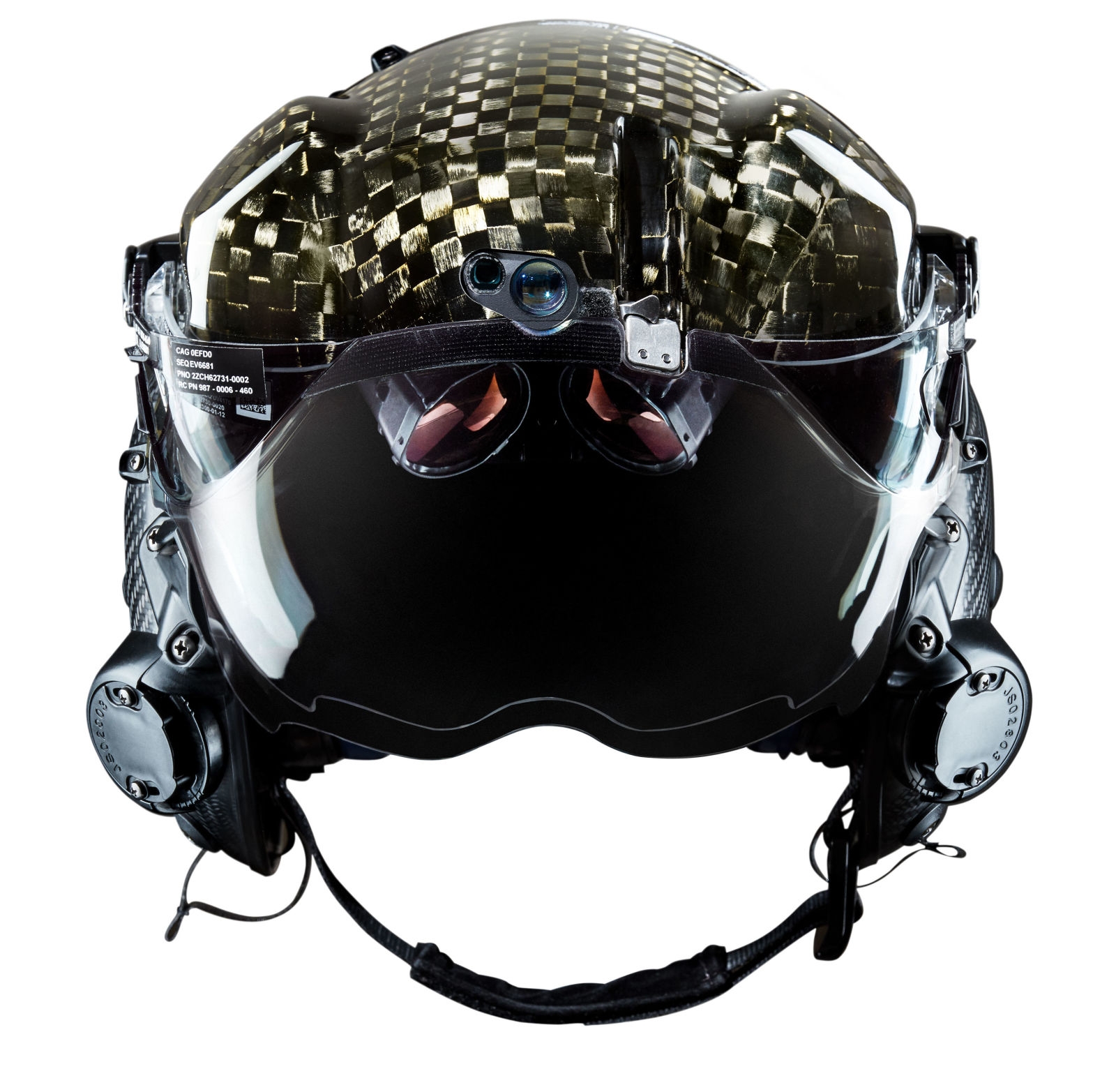
In comparison, the F-35 that Andreotta flies now is a marvel: It has six external articulating infrared cameras and sensors that send maintenance data to the ground crew. And, as of this year, it comes with a helmet unlike any other in the world—one that synthesizes all the live feeds from the plane's exterior cameras and sensors into a lucid, customizable augmented-reality display. Developed by Rockwell Collins, the company responsible for avionics in the Boeing 787 and for NASA's unmanned aircraft projects, the Gen III Helmet Mounted Display System gives a pilot as much visibility as he would have if the entire cockpit were made of glass. "What I wore on the F-16," Andreotta says, holding up the $400,000 carbon-fiber masterpiece, "was a literal helmet compared to this."
The difference such a piece of equipment makes to flying is striking: Now, when Andreotta looks down at his boots in the cockpit, the helmet pulls data from a camera under the plane and shows him a thermal image of whatever's below, as if there were no floor. If he tells his wingman to target an enemy, he watches for a circle to appear around that plane or building. "I can do all that in five seconds or less without having to ask for confirmation," he says.
With so many sensors and readings, there's potential for information overload. But the system is as customizable as a smartphone. "People always ask, 'Doesn't that get to be too much? Doesn't it take away from what you need to do?'" he says. "It's the opposite. I can put whatever I want—another aircraft's range, bearing, airspeed, or altitude, for example—up on my screen." The screen doesn't take over a pilot's entire vision, and whatever numbers and stats he chooses to add appear just outside his focal point. In fact, the F-35's computer prevents pilots from getting overtaxed by helping them prioritize information. The visor will show the numbers for a target ten miles away, but not a target 20 miles away. It knows that the closer one is the more imminent threat. That is, unless Andreotta decides the farther target is more important. There are some decisions only a human can make.

How it works
1. Every Gen III is customized to its owner's head to prevent slippage during flight and to ensure that the displays appear in the correct locations. To do this, technicians scan each pilot's head, mapping every feature and translating it into the helmet's inner lining.
2. Pilots used to have to switch over to a mounted night-vision attachment when flying in the dark. The Gen III projects a night-vision reading of the surrounding environment directly onto the visor when the pilot switches the system on.
3. The shell is made of carbon fiber, which is what gives it a characteristic checkered pattern.
4. A tight coil of bound cables comes out of the back of the helmet to connect it to the plane, Matrix-style. When the wearer turns his head in a specific direction, the wires feed the helmet the proper camera footage.
5. The communications system has active noise cancellation. Speakers produce a sound that opposes wind noise and the low-frequency hum of the jet engines so pilots can hear clearly.
Emirates will introduce its latest-generation Airbus A350 on the Dubai-Mauritius route from 1 November 2026, replacing the Boeing 777 currently operating the carrier’s daily EK709/710 service.&n...
A professional training device such as the new PC-12 PRO simulator is built on flight data supplied and validated by Pilatus. Drawing on actual flight-test and performance data, it accurately reproduc...
Airbus 2026 Cargo Global Market Forecast, unveiled at the Cargo Facts Symposium, predicts that the global fleet of dedicated freighter aircraft will expand by 46%, rising from 2,360 aircraft in 2026 t...
Lufthansa Technik Engine Services (LTES) is significantly expanding its engine maintenance capabilities in Tulsa, Oklahoma, nearly doubling its operational capacity as part of its growth strategy acro...