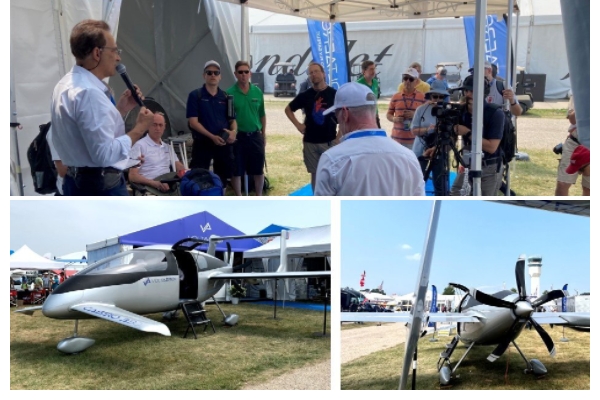
2023 EAA AirVenture fly-in enabled a broad spectrum of the aviation sector and the public to see VoltAero Cassio 330, and to learn about the company’s vision for the future of hybrid-electric aircraft. VoltAero brought its full-scale Cassio 330 mockup to Oshkosh, which attracted a steady flow of visitors to the company’s outdoor exhibit in the main display area. As part of its activity, VoltAero organized a press conference for international journalists, who were provided with an update on the Cassio aircraft family’s development and certification process.
Jean Botti, the CEO and Chief Technology Officer, commented: “We will fly the Cassio 330 initially in pure thermal version to validate the aircraft’s aerodynamic configuration, which is 50 percent more efficient than any aircraft flying today in the same category,” Botti told journalists at the press conference. “This will be followed by flight tests and certification with the Cassio 330 equipped with its electric-hybrid powertrain.”
One of the VoltAero Oshkosh exhibit’s highlights was the display of Kawasaki Motors, Ltd.’s four-cylinder and six-cylinder piston engines that are to operate with hydrogen – providing a look at the future of the Cassio aircraft family’s powertrain.This is part of the Japanese company’s roadmap as it enters the general aviation marketplace, with Kawasaki Motors serving as both an engine supplier and a strategic investor in VoltAero.
For the nearer term, Kawasaki Motors’ gasoline-fueled engines will power the Cassio 330, with testbench operations already underway.
“We have aviation in our DNA, because our motorcycle business started as an extension of Kawasaki’s aircraft business – therefore, it was a natural move,” explained Yuichiro “Jamie” Imai, Manager in the Business Planning Department of Kawasaki Motors. “Motorcycle engines need to be light and compact, while also having the right balance – as well as generating great power. As a result, there are common requirements for engine performance and sizing on a motorcycle and in general aviation airplanes.”
Imai added that Kawasaki’s strategy is to adapt its engines for aircraft applications to operate on both hydrogen and biofuel in addition to gasoline. “A four-cylinder test engine already is operating on hydrogen, and we are very excited about the progress,” he said.
As a next step, Kawasaki is working on an in-line six-cylinder aviation engine with a 2.1-liter displacement, which is more than double the size of the four-cylinder engine. This larger engine currently is running in the company’s research and development department, with a target of delivering sample engines by the end of next year, according to Imai.

Archived
3 years ago
Etihad Airways has signed an interline agreement with Nigerian airline Ibom Air, enabling travellers to connect seamlessly beyond Lagos and Accra to five destinations across Nigeria on a single t...
Following the successful public flight demonstrations at Expo 2025 Osaka, SkyDrive announced plans to undertake a feasibility study exploring the conversion of Osaka City’s existi...
TRU Simulation + Training Inc. will showcase its Veris Virtual Reality Flight Training Device (FTD) for the Cessna Skyhawk at NBAA-BACE 2026, marking the simulator's first appearance at the indust...
British Airways has unveiled the next phase of its Heathrow lounge transformation programme, marking the beginning of a significant investment aimed at modernising every lounge across the airport in t...