



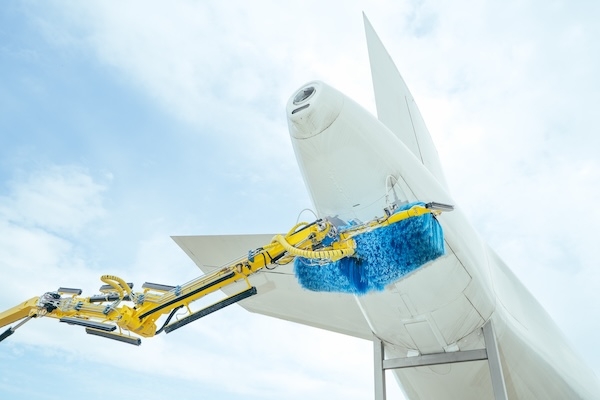
While de-icing is essential for winter flight safety, there’s a preventive strategy that can reduce both its frequency and intensity: keeping aircraft exteriors clean. Not every winter flight requires de-icing, but a dirty aircraft is far more likely to need it. That is because when an aircraft’s exterior is covered in contaminants, they create a rougher, more porous surface that gives ice crystals something to grip onto. Some contaminants can even make surfaces more hydrophilic, that is, more attractive to water. This means that droplets spread wider across the contact area, freeze more completely, and bond more strongly with the surface.
Chief Executive Officer of Nordic Dino Robotics,Veronika Andrianovaite, explains how regular aircraft washing creates surfaces that resist ice adhesion and require less aggressive de-icing procedures:“Experiments in icing wind tunnels show that as the surface roughness increases, the adhesion strength of ice rises proportionally. Particles of soot, dust, or oil residues create a microscopically uneven surface. When water droplets impact this rough surface during flight or cold ground conditions, they lodge into these micro‑valleys and freeze. A thoroughly cleaned aircraft has a more uniform surface. After washing your aircraft, you’re working with an exterior that’s naturally more resistant to ice adhesion. Ice may still form in freezing conditions, but it doesn’t get the same grip.”
Ice layers on clean aircraft are less stubborn, meaning they can be removed easier. In an industry where time is money, a more efficient ice removal process can bring significant benefits.
“De-icing a clean surface is faster. Not only does ice not cling to it strongly, but the de-icing fluid spreads more evenly. This means that removing frost and snow requires less fluid and fewer application cycles. All of this reduces de-icing costs and chemical waste, which is especially relevant at major airports with strict runoff controls.Full exterior aircraft washing is often scheduled ahead of winter to remove summer grime and make subsequent de-icing more effective. This proactive approach helps airlines establish a clean baseline before the cold season begins,” Andrianovaite notes.
Beyond the financial and environmental aspects, there’s a significant time advantage. Quicker de-icing of a previously cleaned aircraft shortens the turnaround time on the ground and can improve on-time performance. During harsh winter conditions, when delays tend to cascade throughout the day, taking off on time is important for passenger experience.
More importantly, a clean aircraft is less likely to need de‑icing in the first place. This is significant as de-icing chemicals can build up on aircraft exteriors and corrode paint and metal. And since cleanliness directly reduces the formation and adhesion of ice, maintaining a clean aircraft makes financial sense, according to Andrianovaite:
“Airlines often budget €4,000-€6,000 per de-icing event for narrow-body jets during European winter operations. If de‑icing operations are needed less frequently and with less intensity, it means both economic and environmental savings, as well as enhanced winter reliability.”
Keeping aircraft exteriors clean is essential for safe and efficient winter operations. While de-icing will always be a critical safety procedure, regular aircraft washing offers airlines a proactive strategy to minimize its frequency and intensity. With robotic cleaning solutions like Nordic Dino, airlines can maintain the level of cleanliness needed to reduce de-icing requirements and improve winter operational efficiency.

Bristow Group Inc., in partnership with Electra, Avinor and the Norwegian Civil Aviation Authority (CAA Norway), will undertake a series of demonstration flights across five locations in Norway using...
Few infrastructure projects have the potential to reshape an island's future quite like the ongoing transformation of Nevis Airport. To gain deeper insight into this ambitious development and the...
Daher Aircraft announced the delivery of a Kodiak 900 to Swiss owners Roland and Claudia Primus, who plan to use the aircraft for adventure flying to remote and short-runway destinations. Their travel...
A Discover Airlines Airbus A330 has become the first Airbus aircraft worldwide to enter regular commercial service after undergoing a full-scale AeroSHARK retrofit, marking a signi...

