



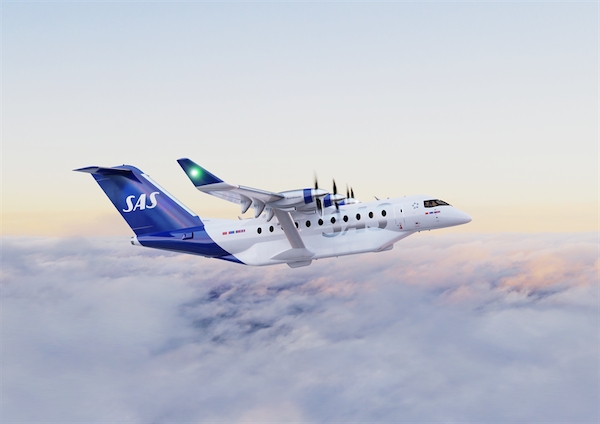
On 2 June at 12:00 CET. SAS launched seat reservations for its first-ever commercial electric flight in Sweden, Norway, and Denmark. SAS invites travelers to join in writing this next chapter in aviation history with 30 seats available for reservation on each of the three inaugural flights – which are expected to take place during the course of 2028. SAS' goal is net-zero emissions by 2050. An important part of achieving this goal is to develop and use technological innovations such as electric aircraft on shorter trips.
Anko van der Werff, President & CEO of SAS commented: "Since its inception in 1946, SAS has been one of the pioneers in the airline industry, being for instance the first commercial airline operator to fly over the North Pole to significantly shorten flight time between continents. A groundbreaking activity for which SAS received the Columbus Prize. The fact that we can now invite our passengers to the next major milestone in the future of aviation is a natural continuation of that pioneering spirit and a significant step on our journey towards more sustainable aviation."
The ticket price for the inaugural flight will be SEK/NOK/DKK 1946 – a tribute to the year when SAS first started flying. A start-up that also marks the beginning of SAS’ innovative nature, with then-founder Wallenberg stating that “moving from the old to the new is the only tradition worth preserving”.
Reservations can be made at flysas.com/electric starting 2 June at 12:00 CET.
Facts
Towards a more sustainable aviation
Being a driving force in a more sustainable aviation is our priority, and we are working actively to lower CO₂ emission and reduce climate impact. This includes supporting innovation and partnerships to find new solutions, making investments in new, more fuel-efficient aircraft, increasing production and use of more sustainable aviation fuels and many other enhancements to our inflight offerings and service.
To reduce our emissions and drive our environmental initiatives, we have short- and long-term climate actions and targets.
Significant sustainability milestones include:
2019: a partnership with Airbus to pave the way for large-scale use of low- and zero emission commercial aircraft.
2019: SAS cooperates with Heart Aerospace to drive the development of electric aircraft. Subsequently, in September 2022, we signed a letter of support concerning their new electric ES-30 to our regional fleet.
Future sustainability targets include:
2030: 50% noise reduction compared with 2010
2030: Sustainable aviation fuel equivalent to SAS' domestic production.
2050: Net-zero carbon emissions in line with IATA’s updated ambition.
Piaggio Aerospace will return to NBAA-BACE this October, bringing its flagship P.180 Avanti EVO to one of the most important gatherings of the global business aviation community while also highlightin...
Embraer has delivered the first E175 fitted with next-generation RECARO passenger seats to American Airlines, marking another step in the ongoing modernization of one of the world's most successfu...
Aviation Capital Group, the Newport Beach, California-based global aircraft asset manager, has signed a firm order for 75 additional Airbus A320neo Family aircraft, bringing its cumulative orders for...
AMAC Aerospace Group continues to experience strong business momentum, marked by new certifications, contract wins and rising demand across its maintenance, completion and aircraft modification activi...

