

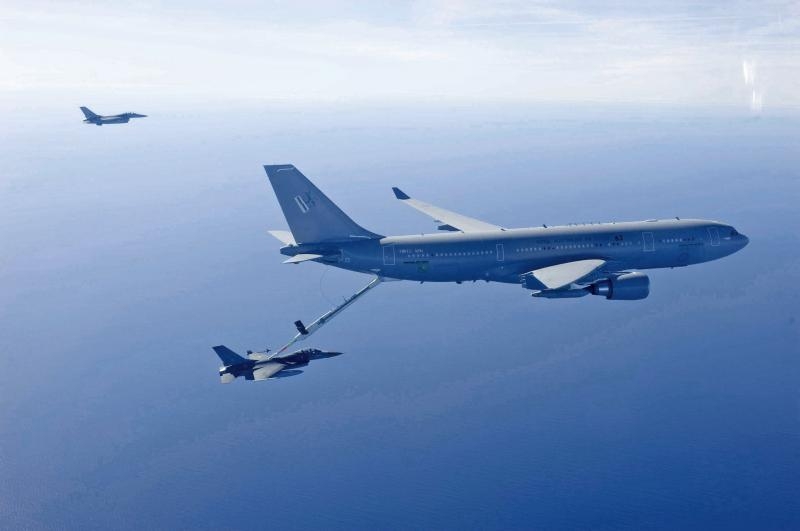
Germany has revealed plans to join the Multinational MRTT Fleet (MFF) alongside the Netherlands, Norway and Poland, to share a fleet of Airbus Defence & Space A330 multi-role tanker transports.
In 2014 the three other nations announced plans to share the burden of operating multirole tanker transports in Europe, and now Germany has decided that as its A310 tanker fleet ages, it will join the effort.
“Germany has decided it has to stop any investment in the ageing A310 fleet,” Col Ludger Bette, Wing Commander of the air force’s Air Transport Wing 62, told SMi's Military Airlift and Rapid Reaction Operations conference in Seville on 1 December. “An initiative was created and the result of a feasibility study concluded that the A330 is the favoured option, and we see benefits of this initiative.
“Germany is currently an observer [of MFF] as of April this year, and we are planning to sign the MoU [memorandum of understanding] and contract in the second quarter of next year, with the option to procure three aircraft.”
The nations involved are in the negotiation stage with Airbus regarding acquisition of the shared fleet, which had previously been touted as a buy of four of the type.
“This is good news that Germany would like to be a partner of this initiative,” Bette says.
Airbus Defence & Space
Germany is also in the process of acquiring the Airbus A400M, with a second delivery imminent, and 40 are expected to be delivered by 2019, Bette says.
By the end of 2015 there will be three delivered, plus nine additional aircraft in 2016, 11 each in 2017 and 2018, and six in 2019.
Bette acknowledges that the programme of record for Germany is for 53 of the type, but plans have not yet been made past 40, and decisions still need to be made on the remainder of the fleet.
“From my point of view a decision needs to be made on this by 2018 at the latest,” he notes. “What I know is that the German air force is looking for customers to sell these 13 aircraft to.”
Delays in the A400M programme have also led to Germany having to reassess the planned retirement of its Transall C-160 fleet.
“The programme has been delayed several times, and this has of course had repercussions on the operation of the C-160,” Bette says. “If there are capabilities missing it will have an immediate effect on the life of the C-160.”
The retirement of the C-160 has been pushed back from 2018 to 2021, and 24 of the type will be retained with an electronic warfare capability. However, Bette notes that keeping aircraft past 2018 is expensive, because of obsolescence issues.
The Tennessee Valley Authority is demonstrating the real-world value of the Tecnam P2012 Special Mission Platform (SMP), which has become a vital tool for monitoring and maintaining its...
Bombardier marked the 40th anniversary of its industry-leading Smart Services cost-per-flight-hour programs, which today support more than 1,500 enrolled aircraft and account for over 11 mil...
Embraer has delivered the first E175 fitted with next-generation RECARO passenger seats to American Airlines, marking another step in the ongoing modernization of one of the world's most successfu...
Samson Sky has enlisted renowned Italian automotive designer Luigi Memola to develop the interior design of its Switchblade Flying Car, bringing world-class automotive styling expertise to the roadabl...