



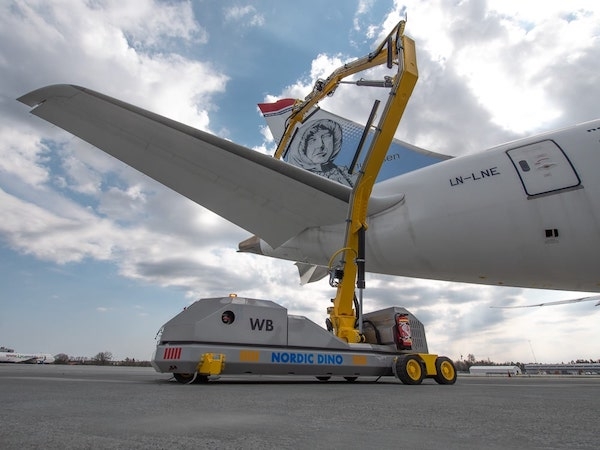
Sustainability and optimizing time when aircraft are on the ground continue to play a major role in shaping aviation. Using electric semi-automatic washing robots to minimize energy consumption, and reduce waste, while optimising processes paves the way for a greener future in industrial automation according to Jo Alex Tanem, CEO of Nordic Dino Robotics AB.
Championing sustainability
Airlines experiment with biofuels, launch new sustainability programs, and offset their carbon emissions on flights each year. However, sustainability should be a topic of conversation when an aircraft is on the ground.
Semi-automatic exterior cleaning robots provide an answer to the need for more environmentally friendly aircraft exterior cleaning and a solution for the aviation industry’s shift in future environmental standards since 2021 regarding the sustainability of aircraft on the ground.
The new electric semi-automatic exterior cleaning robots are expertly designed to both speed up industrial processes and significantly reduce their environmental impact. They have a simplified design and components thanks to a single adaptable chassis for all three aircraft body types—narrow-body (NB), wide-body (WB), and extra wide-body (XWB). CAN bus electronic control systems with built-in and improved safety measures, the possibility for remote access to CAN bus system data, and improved access are also included in the new version.
Electric semi-automatic exterior cleaning robots have marked the beginning of a new era. Going beyond simple automation and integrating innovation with sustainability, these robots reduce energy use, eliminating waste, enhancing operations reducing man-hours, and producing savings of up to two-thirds of labour costs.
The biggest cost reductions from a robotic cleaning system come from less downtime during AOG (aircraft on ground) scenarios. Airlines' CEOs and CFOs live in continual fear of AOG situations, thus any method, practice, or piece of technology that lessens downtime should be embraced wholeheartedly.
Optimised AOG
Airlines frequently look for ways to streamline this procedure, even though safety is unquestionably the most crucial element and maintenance inspections are needed.
According to data, deploying electric semi-automatic exterior cleaning robots can cut the time needed to clean an aircraft's exterior by up to 80%. For instance, using these robots can help complete the same operation in just 3 man-hours, cutting the needed AOG time from 3 to 1 hour. Cleaning the fuselage of a Boeing 737 airplane by hand currently requires 10.5 man-hours. “Similar to how washing an Airbus A330 or Boeing 777 for maintenance preparation takes 36 man-hours by hand but just 12 with a robot's help, cutting down the AOG time from 6 to 2 hours,” explains Tanem. And the time savings get more impressive as planes get bigger. "It takes a staggering 112 man-hours to manually clean the exterior of an Airbus A380, although the AOG time was also cut in half, from 10.5 hours to just 3.5 hours,” Tanem states further.
Clean aircraft will always contribute to the improvement of performance and efficiency, and when combined with other new technology, they will always play a part in producing higher performance, and greater fuel efficiency, and on the path towards more sustainable aviation practices.
Airbus 2026 Cargo Global Market Forecast, unveiled at the Cargo Facts Symposium, predicts that the global fleet of dedicated freighter aircraft will expand by 46%, rising from 2,360 aircraft in 2026 t...
Embraer has delivered the first E175 fitted with next-generation RECARO passenger seats to American Airlines, marking another step in the ongoing modernization of one of the world's most successfu...
The U.S. Federal Aviation Administration has certified the Boeing 737-10, the newest and largest member of the 737 MAX family, paving the way for Boeing [NYSE: BA] to begin customer deliveri...
Daher Aircraft will present its TBM and Kodiak aircraft families at next week’s NBAA Business Aviation Convention & Exhibition (NBAA-BACE), showcasing how their combination of performance, e...

