



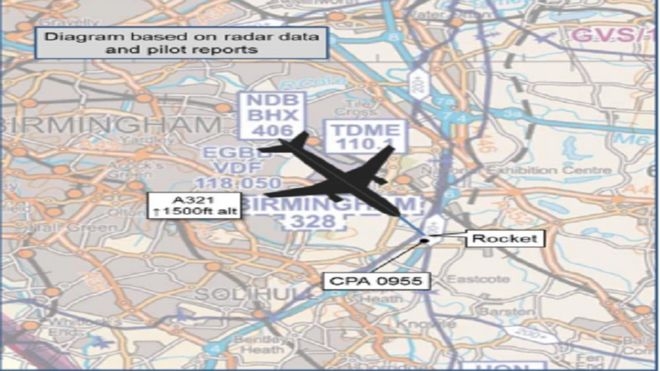
A rocket-shaped object the size of two "two litre fizzy drink bottles" passed "very close" to a passenger aircraft at about 1,500ft (457m), a report has found.
The A321 Airbus pilot estimated the object passed 100ft (30m) from his jet, the UK Airprox Board report said.
The pilot saw the object pass the jet's starboard side after departing from Birmingham Airport last August said the Birmingham Mail. The air safety body put the risk of collision as "medium".
The incident on 18 August 2015 was reported to Air Traffic Control but did not show on their radar, so the "exact separation" between the unknown object and the plane was not known.
"However, the board noted that the A321 pilot had estimated that the object was 100ft vertically and 200m horizontally from his aircraft, and that he had been able to give a clear description of its size, which indicated that it had flown very close to the aircraft," the report said.
The UK Airprox Board (UKAB) said its investigations had not been able to find the operator of the "rocket" or "indeed whether the reported object was a rocket at all".
But it pointed to aviation laws stating operators of model rockets must ensure they do not endanger real aircraft.
The object was "launched into conflict with the A321" and should not have been operated in controlled airspace, without the prior permission of the Civil Aviation Authority, the report concluded.
Daher Aircraft will present its TBM and Kodiak aircraft families at next week’s NBAA Business Aviation Convention & Exhibition (NBAA-BACE), showcasing how their combination of performance, e...
Embraer has delivered the first E175 fitted with next-generation RECARO passenger seats to American Airlines, marking another step in the ongoing modernization of one of the world's most successfu...
Aviation Capital Group, the Newport Beach, California-based global aircraft asset manager, has signed a firm order for 75 additional Airbus A320neo Family aircraft, bringing its cumulative orders for...
BPE Air, the aviation company founded and wholly owned by entrepreneur Aldrew Crowe, reported approximately US$90 million in revenue in 2025, marking a major milestone in the growth of its integrated...

