



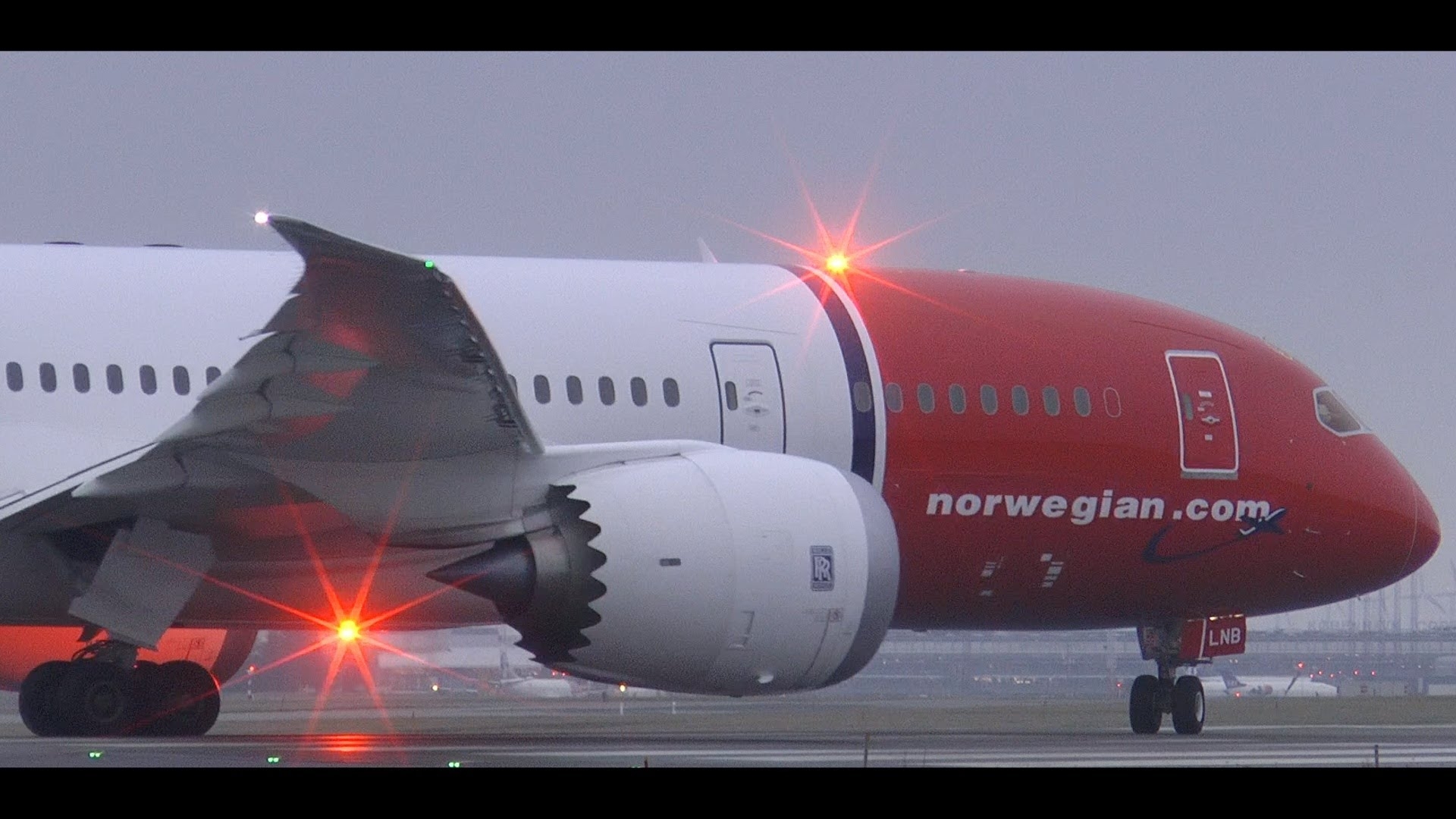
Boeing 787 operator Norwegian Air Shuttle was the most fuel efficient airline of the top 20 carriers flying routes between Europe and North America in 2014, according to a new study. British Airways was the least fuel efficient, followed closely by Lufthansa and SAS.
The International Council on Clean Transportation (ICCT) issued its “Transatlantic Airline Fuel Efficiency Ranking” on November 17, claiming the study is the first such analysis to combine publicly available commercial operations data with sophisticated aircraft fuel burn modeling. In October, the nonprofit organization released a similar study of U.S. domestic airlines that identified Alaska Airlines as most fuel efficient.
The ICCT study establishes a benchmark of fuel efficiency based on passenger kilometers flown per liter of fuel on transatlantic routes. By that measure, Norwegian Air Shuttle provided 40 passenger kilometers per liter (pax-km/L) using its mainly Boeing 787-8 Dreamliner fleet. In last place, British Airways provided 27 pax-km/L; Lufthansa and SAS each provided 28.
“It’s surprising to see such large differences in fuel efficiency among airlines on long-haul flights over the Atlantic,” said Dan Rutherford, ICCT program director for aviation, and a coauthor of the report. “The airline you fly, and the aircraft they choose to operate, really matters if you’re concerned about the climate.”
Delta Air Lines, which commanded the largest share of available seat kilometers, and Icelandair provided the industry average fuel efficiency of 32 pax-km/L. Three other U.S. carriers—American Airlines, United Airlines and the former US Airways (now merged with American Airlines)—scored below the industry average.
Seating configuration and the average fuel burn of aircraft were the most important drivers of fuel efficiency in the study, which also considered factors including passenger load factor and freight carriage, the ICCT said. “The impact of premium seating on emissions is substantial,” the organization found. First class and business class seats accounted for just 14 percent of available seat kilometers flown, but were responsible for roughly one-third of overall emissions.
Not surprisingly, the study found that airlines that invest in new, advanced aircraft score better on fuel efficiency than carriers that use older, less efficient aircraft. “Norwegian’s outstanding performance is attributable to its young fleet, which averaged two years old; the use of fuel-efficient Boeing 787-8 aircraft for the large majority of its flights; a high (86 percent) passenger load factor; and a below average prevalence of business and first class seats (11 percent),” the study states.
In its October study on U.S. domestic carriers, the fourth in a series of yearly analyses, the ICCT found that Alaska Airlines was the most fuel efficient U.S. carrier for the fifth year running, followed in order by Spirit, Frontier and Southwest. American Airlines was the least fuel efficient in 2014.
Bristow Group Inc., in partnership with Electra, Avinor and the Norwegian Civil Aviation Authority (CAA Norway), will undertake a series of demonstration flights across five locations in Norway using...
Velocity Maintenance Solutions, an FAA-certified provider of maintenance, repair and overhaul services, has announced a significant expansion of its facilities at Wilmington Airport (ILG) in Delaware,...
Daher Aircraft will present its TBM and Kodiak aircraft families at next week’s NBAA Business Aviation Convention & Exhibition (NBAA-BACE), showcasing how their combination of performance, e...
Daher Aircraft announced the delivery of a Kodiak 900 to Swiss owners Roland and Claudia Primus, who plan to use the aircraft for adventure flying to remote and short-runway destinations. Their travel...

