



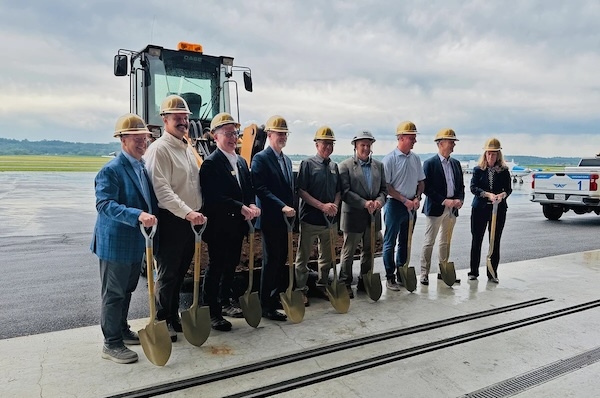
High Flying Hangars celebrated the groundbreaking event at its development now in progress at the Frederick Municipal Airport in Maryland (KFDK). Frederick City Mayor Michael O’Connor; Airport Manager Andrew Moore; Richard Griffin, Director of Economic Development; Randy Sibold, CEO of Warner Construction; and Kenny Hinkes, CEO of High Flying Hangars, were on hand to commemorate the first turn of the shovel for the new hangar community at Frederick. The need for hangars in the Washington, D.C., metropolitan area continues to outpace supply, and High Flying Hangars is on its way to meeting this demand with the first new hangar construction on the Frederick airport in more than 20 years.
Frederick Municipal Airport Manager Andrew Moore stated: “The Frederick airport team looks forward to working with High Flying Hangars to make this project a reality and welcome new aviators into our FDK community. This project represents a significant investment into the growth story of the Frederick Municipal Airport as the preferred access point to the region.”
Kenny Hinkes, CEO of High Flying Hangars, commented on the importance of the Frederick development, from both a local and regional perspective, as well as for the company: “As Maryland’s fastest-growing city, Frederick is a community on the move. New businesses are choosing to locate here, new families are making Frederick their home, and the airport has an important role to play in supporting that growth. These hangars are another step in ensuring that the airport continues to serve the needs of a vibrant and expanding community.” The 11.45-acre development will be located at midfield within the airport layout and will be constructed in two phases, with 44 hangars to be built in Phase 1, and about 34 hangars planned for Phase 2. The Hangar Club clubhouse forms a key part of the Phase 1 build, and it will feature multiple restrooms, a meeting room, a commercial-grade kitchen, a patio and a sky deck for optimum flight line viewing, high speed internet, and a large, open floorspace on both levels.
The design plan can be viewed on the High Flying Hangars website, with the ability to make initial reservations for interested owners. Hangars are available in several sizes: 1,245 sq ft (41.5 ft by 30 ft), 2,000 sq ft (50 ft by 40 ft), 3,600 sq ft (60 ft by 60 ft), 4,200 sq ft (70 ft by 60 ft), and 8,000 sq ft (100 ft by 80 ft) and feature Diamond Bi-Fold Doors with a clear opening that varies with hangar dimensions, and Smart Door technology for the ultimate in security. Larger hangars (2,000 sq ft and larger) are planned to come with an in-unit bathroom, frost-free hose bibs with a wash basin, and in-floor drainage. All units include the following amenities:

Piaggio Aerospace will return to NBAA-BACE this October, bringing its flagship P.180 Avanti EVO to one of the most important gatherings of the global business aviation community while also highlightin...
Desert Jet has broken ground on its long-planned ramp expansion at Jacqueline Cochran Regional Airport (KTRM), advancing a key infrastructure investment designed to accommodate rising business av...
In business aviation, exceptional service is defined by attention to detail, and few amenities reflect that more clearly than premium catering. At the intersection of hospitality and private aviation,...
HondaJet Classic and APMG operators across the European Union can now access the latest enhancements developed for the HondaJet family following the European Union Aviation Safety Agency’s valid...

