



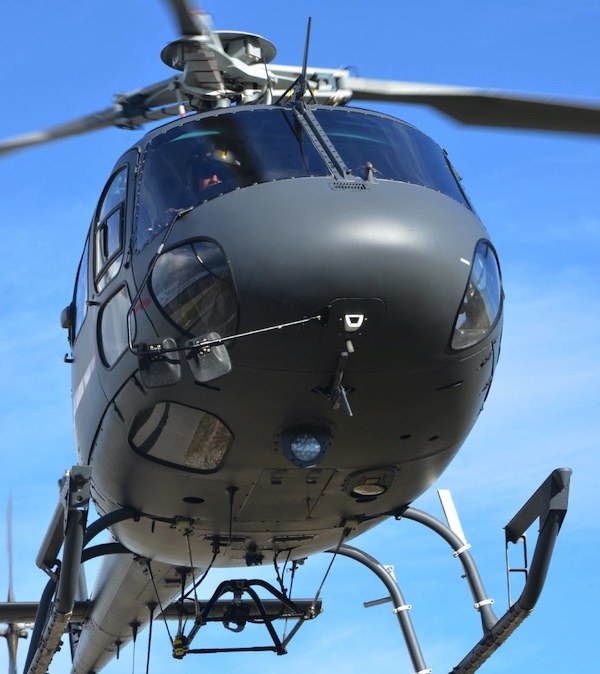
Astronics Corporation announced that the Unites States and Canada approved Astronics' Max-Viz 1400 and 1200 Enhanced Vision Systems (EVS) for Airbus Helicopter's AS350 Écureuil. In cooperation with AVIO dg in Calgary, Canada, Astronics obtained the Supplemental Type Certificates for its Max-Viz 1400 and 1200 EVS from the U.S. Federal Aviation Administration (FAA) and the Transport Canada Civil Aviation (TCCA) for approved models which are the Airbus Écureuil AS350B, AS350B1, AS350B2, AS350B3, AS350BA, and AS350BD.
"Our EVS is perfectly suited for aerial firefighting, heli-skiing, search and rescue, and utility operations. The Astronics Max-Viz technology provides pilots with an unprecedented level of situational awareness and safety," stated Tom Geiger, Max-Viz Business Unit Director for Astronics.
"We worked closely with AVIO dg to get this terrific technology approved for daily missions on AS350s." he added.

Astronics' Max-Viz 1200 and 1400 systems are lightweight, solid-state, low power, and feature an uncooled thermal camera. The sensor image displays on any cockpit equipment that accepts NTSC or PAL/Analog RS-170 video signals, including MFDs (Multi-Function Displays), PFDs (Primary Flight Displays) or on standalone displays depending on aircraft configurations.
Astronics' Max-Viz EVS provides improved safety through enhanced vision, enabling pilots to see more precisely in adverse weather conditions, such as haze, smoke, smog, and light fog, even on the darkest night. In addition, pilots can detect and avoid clouds for a smoother ride. While landing, pilots using the Max-Viz EVS can identify the runway and view the terrain clearly to avoid wildlife and unlit obstructions.
The FAA permits properly equipped aircraft to fly certain Instrument Flight Rule (IFR) approaches to landing, in lieu of natural vision. Of the over 3,500 installed Astronics Max-Vis EVS systems, approximately 60 percent are on fixed-wing general aviation aircraft and 40 percent are operating on rotor wing aircraft.
With Supplemental and Type Certificates in both aircraft types, Astronics offers products built on more than 15 years of success in enhanced vision systems. To view the EVS offerings in detail, visit Astronics.com.


In business aviation, exceptional service is defined by attention to detail, and few amenities reflect that more clearly than premium catering. At the intersection of hospitality and private aviation,...
Viasat has significantly expanded the capacity of its JetXP in-flight connectivity service across the United States, delivering up to five times more bandwidth for business aviation customers equipped...
Qantas Freight and Australia Post have entered the next chapter of their long-standing partnership with the arrival of the first of three additional Airbus A321 Passenger-to-Freighter (A321P2F) aircra...
AMAC Aerospace Group continues to experience strong business momentum, marked by new certifications, contract wins and rising demand across its maintenance, completion and aircraft modification activi...

