



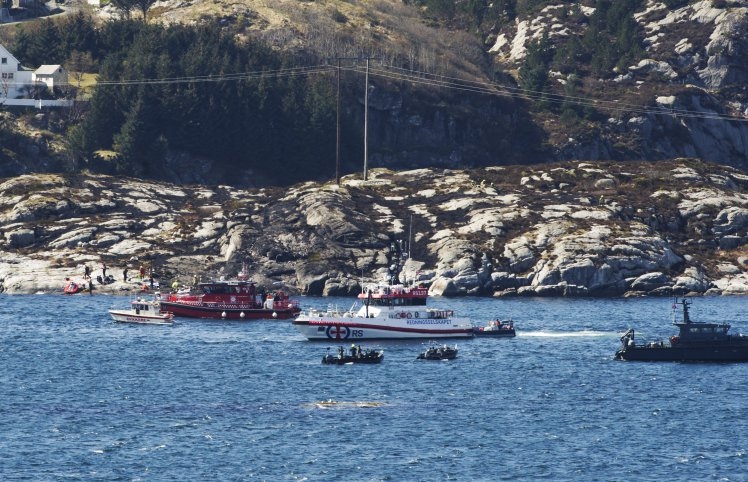
The Norway helicopter crash, which killed 13 people including a British oil worker, was caused by technical failure and not human error, according to investigators.
Eleven passengers and two crew were killed after the aircraft came down near the city of Bergen on Friday.
British oil worker Iain Stuart, from Laurencekirk in Aberdeenshire, was among those who died in the crash.
Norway’s Accident Investigation Board said today that its probe and visual evidence indicated sudden mechanical failure, according to reports.

The twisted wreckage of the salvaged helicopter which crashed on Friday (Picture: AIBN / NTB scanpix via AP)

The memory unit retrieved from the Flight Data and Cockpit Voice Recorder (Picture: AFP/Getty Images)
But the board did not elaborate, saying a full investigation would take time.
The Super Puma was travelling from the North Sea Gullfaks B oil field, around 74 miles off the Norwegian coast when it crashed en route to Flesland Airport.
The tragedy led to the Civil Aviation Authority grounding all UK commercial passenger flights using the Airbus EC225LP – or Super Puma – model.
While a team from the UK’s Air Accidents Investigation Branch (AAIB) is assisting with the crash investigation.

The helicopter was en route to Flesland Airport (Picture: Getty)

A police officer talks to members of the media on Friday (Picture: AFP/Getty)
Mr Stuart’s family have said they are devastated by his death.
A statement released by relatives of the 41-year-old said: ‘Iain was a loving husband and devoted father to his two children and as a family we are heartbroken.
‘He was a caring son, brother, uncle and friend to many.’


TARMAC Aerosave has set a new industry benchmark by becoming the first company in the world to secure Aircraft Fleet Recycling Association (AFRA) accreditation across all three scopes of aircraft disa...
Viasat has significantly expanded the capacity of its JetXP in-flight connectivity service across the United States, delivering up to five times more bandwidth for business aviation customers equipped...
A Discover Airlines Airbus A330 has become the first Airbus aircraft worldwide to enter regular commercial service after undergoing a full-scale AeroSHARK retrofit, marking a signi...
Velocity Maintenance Solutions, an FAA-certified provider of maintenance, repair and overhaul services, has announced a significant expansion of its facilities at Wilmington Airport (ILG) in Delaware,...

