



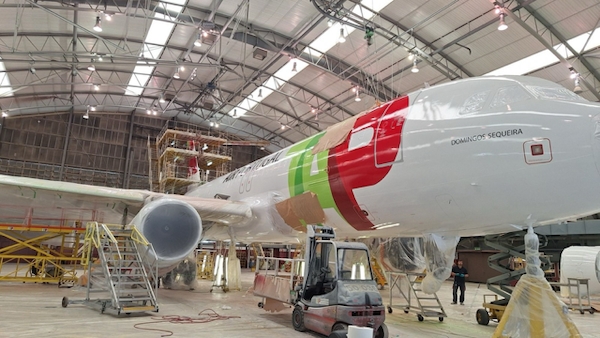
TAP Air Portugal successfully conducted operational tests of a new lightweight aircraft paint technology capable of reducing the weight of its aircraft by up to 26 kg per plane. This innovation is part of the airline’s strategy to improve its operational efficiency, reduce fuel consumption, and minimize its environmental impact. Tests conducted using the Aerobase UPD formulation developed by AkzoNobel Aerospace Coatings demonstrated a 36% reduction in the total thickness of the primer coat compared to the traditional two-coat process, while ensuring the same standards of durability, aesthetics, and finish quality required in commercial aviation.
Initial tests, conducted on a TAP Air Portugal Airbus A320, reduced the aircraft’s weight by 24 kg. Following these conclusive results, a second A320 was painted using this technology, and a phased rollout across the entire fleet is now under consideration. Ultimately, applying this lightweight paint to all TAP Air Portugal aircraft could save approximately 428.5 metric tons of fuel per year—representing annual savings of more than 500,000 euros—while reducing CO₂ emissions by approximately 1,353 metric tons per year.
João Carvalho, a structural engineer at TAP Air Portugal explained: “At TAP Air Portugal, we are constantly seeking to improve our operational efficiency while reducing our environmental impact. The results achieved through this collaboration with AkzoNobel Aerospace Coatings demonstrate that even small weight reductions, when applied across the entire fleet, can generate significant fuel savings and sustainably reduce CO₂ emissions, while improving our operational performance.”
Aurore Bournazel, Segment Manager for OEM, MRO & Airlines at AkzoNobel Aerospace Coatings, stated: “This program with TAP Air Portugal demonstrates that incremental innovations in the field of aerospace coatings can deliver measurable benefits for airlines. By reducing paint thickness and simplifying application, Aerobase UPD helps reduce aircraft weight, improve paint shop productivity, and maintain the quality standards required by commercial aviation.”

Developed from AkzoNobel Aerospace Coatings’ Aerobase platform, Aerobase UPD formulation incorporates several improvements designed to optimize the application process, including better control of paint thickness, increased resistance to sagging, and greater consistency during painting operations. Thanks to an optimized application technique, a single coat of paint is now sufficient to achieve the required level of coverage and finish, eliminating the need for a second coat as well as intermediate drying steps. This process not only helps reduce aircraft weight but also improves productivity in paint shops. The new formulation also offers approximately 40% greater resistance to sagging compared to the traditional system, ensuring more consistent quality regardless of application conditions.
For TAP Air Portugal, this innovation illustrates how targeted technical improvements can contribute to broader performance and sustainability goals.Certified to the AMS3095 standard for MRO operations, Aerobase UPD technology is compatible with existing processes, thereby facilitating its phased deployment across TAP Air Portugal’s entire fleet.
MySky, the spend and revenue management platform trusted by operators of more than 2,000 business aircraft worldwide, announced the launch of MySky Pay at NBAA-BACE 2026, introducing a purpo...
Phenix Jet Cayman has added a Bombardier Global 8000 to its managed fleet, successfully completing the aircraft's CAACI registration transfer and entry into service in less than five business days...
From Learjets and Challengers to turboprops such as the Pilatus PC-12, different aircraft bring different capabilities to a medical flight. Sebastian Demiet, COO of MTI 24/7, explains why aircraft sel...
Desert Jet has broken ground on its long-planned ramp expansion at Jacqueline Cochran Regional Airport (KTRM), advancing a key infrastructure investment designed to accommodate rising business av...

