



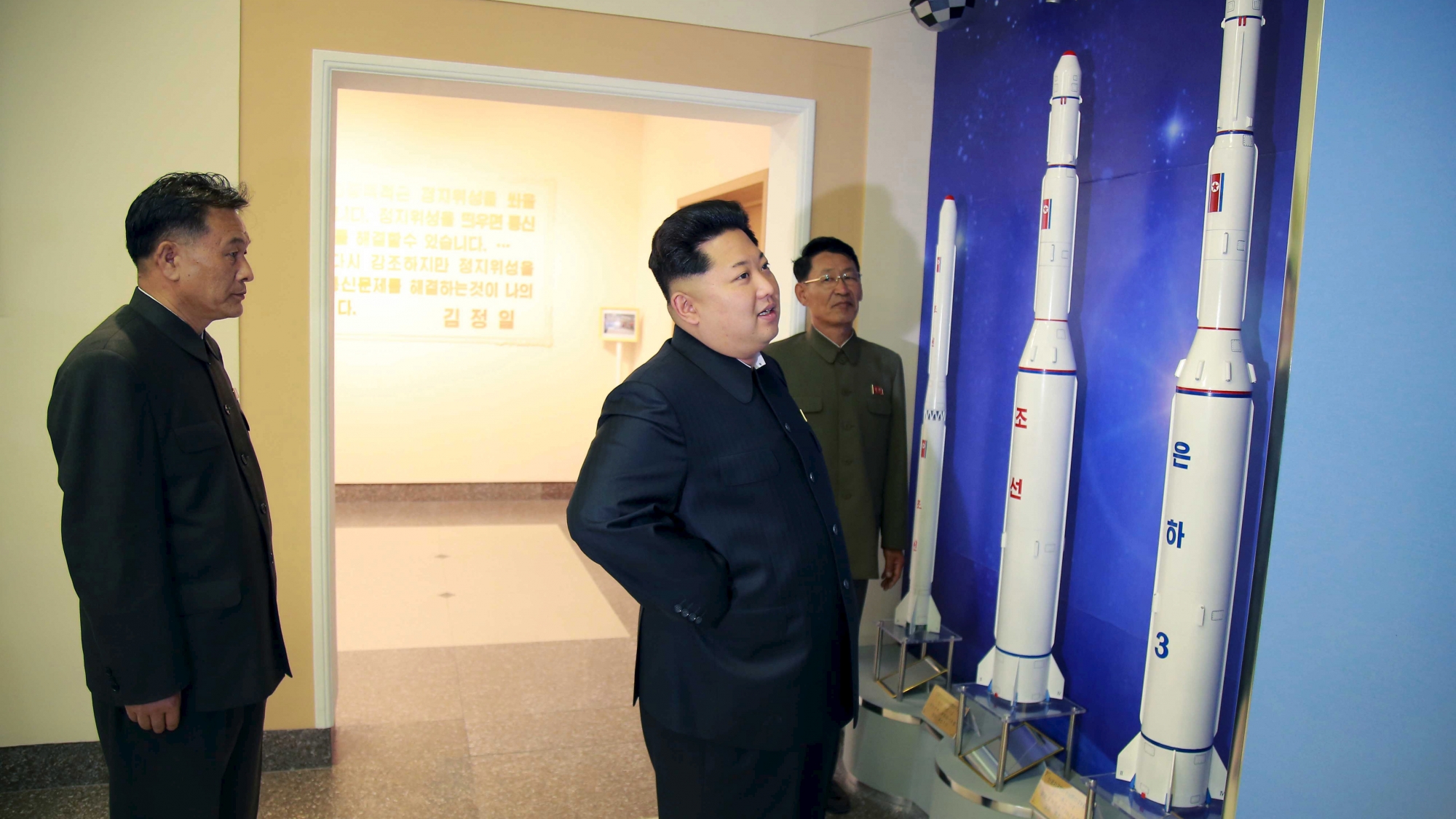

The satellite that North Korea launched into space three years ago circles the earth every 95 minutes at an altitude of about 540 km (335 miles), its orbit decaying.
No signal has ever been detected from the crude-looking 100-kg (220-pound) hunk of black metal that the North said was mounted with cameras to take images and transmit them back to Pyongyang.
The North is planning another satellite launch next month, re-igniting fears that it is really testing a system to deliver nuclear weapons. The secretive state is already under international sanctions for its nuclear and missile tests.
South Korean Foreign Minister Yun Byung-se said this month the North's plan to launch a new satellite, which could be timed around the 70th anniversary of its ruling party on Oct 10, would be a disguised missile test. The United States has said such a launch could lead to more sanctions.
North Korea says its space program is peaceful and any attempt to stop it is an attack on its sovereignty.
While many observers were impressed that Pyongyang managed to put an object into orbit in 2012, German aerospace engineer Markus Schiller said in a 2013 analysis that the mission was a "low performance" event and "not a game changer."
"Nothing that has happened in the past years has changed my assessment," Schiller told Reuters this week, despite further short-range missile launches by Pyongyang using existing technology.
"Most of these activities still seem to be more motivated by political reasons than by engineering ones," he said.
The North's space agency said last week it is building a new satellite and readying it for launch, possibly around Oct. 10, which suggests it has made advances in developing a ballistic missile.
South Korea's defense ministry said this week it had not detected any signs of preparations at the main launch site, about 50 km from the Chinese border.
While a satellite launch utilizes technology also found in ballistic missiles, the thrust and speed of the launch vehicle, as well as the point of engine cut-off, are different. Also, a missile must be designed for its warhead to withstand the stress of atmosphere re-entry, which is not the case when putting a satellite into space and leaving it there.
SOVIET TECHNOLOGY
North Korea's successful December 2012 satellite launch came after a failed attempt earlier that year, an embarrassment for its new young leader, Kim Jong Un.
He had taken over from his father, who died in December 2011, and was trying to make a mark as the leader of a country that had defied years of international pressure and sanctions in pursuit of missile and nuclear weapons programs.
The satellite was propelled by North Korea's Unha-3, a home grown three-stage rocket based on 1950s Soviet Scud missile technology, with advanced fuel used in its final stage. Unha is Korean for galaxy.
South Korean and U.S. officials, as well as space experts, said after the launch that no signal was ever detected from the object, whose orbit can be tracked online.
The design and engineering that made the 30-metre-high Unha 3 suitable to launch a satellite make it a poor vehicle to deliver weapons, largely because launch preparations are difficult to hide due to the time it takes to assemble the rocket, stand it up and fuel it.
A new launch vehicle has yet to be spotted by satellite imagery, with its location still unknown.
"Preparations for the Unha-3, and whatever new space launch vehicle they might roll out, will be observable well in advance of a launch," said Daniel Pinkston, a visiting fellow at Babes-Bolyai University in Romania.
"So it is not a system that can be used for any military objective," said Pinkston, who has studied the North's political and weapons strategy.
Still, the North's pursuit of long-range rocket technology should be taken seriously because of potential capabilities it might acquire in the future, Pinkston added.
"It should be clear how important these capabilities are to the leadership because they are expensive and difficult to acquire," he said.
Daher Aircraft will present its TBM and Kodiak aircraft families at next week’s NBAA Business Aviation Convention & Exhibition (NBAA-BACE), showcasing how their combination of performance, e...
Aviation Capital Group, the Newport Beach, California-based global aircraft asset manager, has signed a firm order for 75 additional Airbus A320neo Family aircraft, bringing its cumulative orders for...
Qantas Freight and Australia Post have entered the next chapter of their long-standing partnership with the arrival of the first of three additional Airbus A321 Passenger-to-Freighter (A321P2F) aircra...
Dassault will introduce the fourth-generation EASy IV flight deck on newly built Falcon 2000LXS aircraft, while also making the upgrade available as a retrofit across the entire Falcon 2000 EASy fleet...
