




French aerospace firm Airbus has filed a patent for a revolutionary new 3D printing process that would make it possible to print out an entire aircraft's exteriors in one go from multiple metals – a feat that is definitely not possible today.
3D printing, also known as additive manufacturing, is a new technology that enables industries to manufacture materials much faster than the traditional injection moulding technique traditionally used.
Today, 3D printing is being used more and more in healthcare and to rapidly prototype designs in manufacturing, and there is a great interest in using 3D printed components to speed up production of aircraft and space rockets.
The 3D printing process described by Airbus in the patent filing involves using Selective Laser Sintering (SLS) – a 3D printing technology whereby a laser is used as a power source to sinter tiny powdered particles of materials like plastic, ceramic, glass or metal in order to bind it together to form a solid structure.
Speeding up aircraft component manufacturing
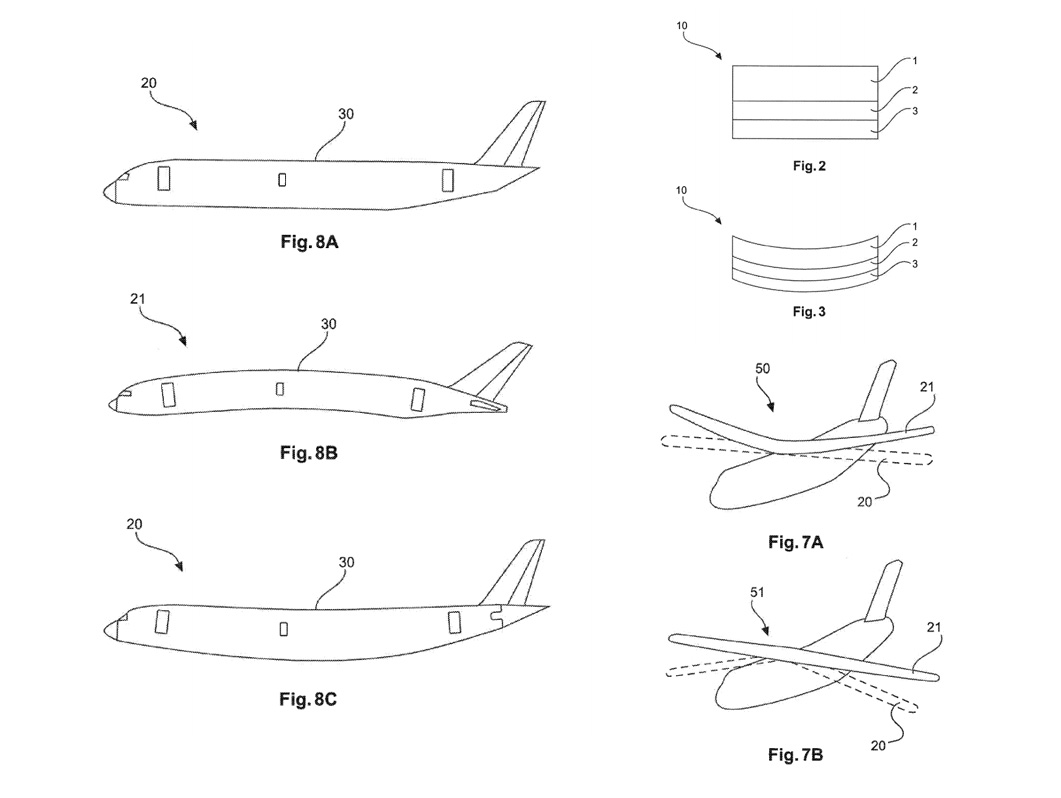
The patent describes sintering multiple metal materials together onto a shell-like structure, which then bends to form the shape of the aircraft componentUnited States Patent and Trademark Office
The process starts with a shell-like structure that is used as a base. A powder – either silicone, iron, copper, manganese, chromium, tin, vanadium, titanium, bismuth, gallium, lead, aluminium or zirconium – is placed on the structure and a laser beam is used to heat the structure and the powder together.
Once the shell-like structural component cools, the internal stress generated by the component causes it to bend to match the original structure, and then the process is repeated multiple times to add more materials on top.
Airbus explains that there will be different shell-like structures designed for different parents of the aeroplane – whether it's the aircraft's outer skin, or a part of an aircraft door, or the floor panel belonging to the aircraft's cargo hold.
So essentially, the patent doesn't mean that Airbus has suddenly figured out how to press a button and then 3D print out an entire aeroplane – that would be impossible.
But at the moment, each component that aerospace engineers want to create has to be painstakingly modelled in 3D on a computer, printed and then stress-tested to make sure that it is as strong as parts that are manufactured the traditional way. The Airbus method described in essence finds a way to make fast mass production possible, if it works, and it would still be faster than traditional processes.
Warning: 3D printed metal still has structural problems
Other aerospace companies are already experimenting with 3D printing – Boeing is using 3D printing to create fuel nozzles, sensors and fan turbine blades for its high tech Boeing 777x line of huge passenger airliners, while Lockheed Martin-Boeing joint venture United Launch Alliance (ULA) is testing plastic 3D printed parts on its Atlas V rockets.
However, a recent study by Carnegie Mellon University (CMU) cautions engineers to be wary of 3D printing metal. Researchers analysed 3D printed titanium parts with deep X rays and found that there are significant flaws when titanium metal powders are sintered together as gas can become trapped in the resulting liquid layer, creating porous bubbles within the final solidified metal part.
"Like any other metal, titanium has a certain amount of fatigue resistance until it cracks or breaks. The more porosity in the printed metal, the more its resistance to fatigue is decreased," said Anthony Rollett, professor of materials science and engineering at CMU and co-author of the study.
"Porosity was present in every piece. To us it was a surprise that it was always there. Our next step might be to ask if there is a better way to process the powder before printing."
Few infrastructure projects have the potential to reshape an island's future quite like the ongoing transformation of Nevis Airport. To gain deeper insight into this ambitious development and the...
Viasat has significantly expanded the capacity of its JetXP in-flight connectivity service across the United States, delivering up to five times more bandwidth for business aviation customers equipped...
AMAC Aerospace Group continues to experience strong business momentum, marked by new certifications, contract wins and rising demand across its maintenance, completion and aircraft modification activi...
Bombardier marked the 40th anniversary of its industry-leading Smart Services cost-per-flight-hour programs, which today support more than 1,500 enrolled aircraft and account for over 11 mil...

