




US aircraft maker Boeing is throttling back production of its biggest jet, the Boeing 747-8 Jumbo, and Europe's Airbus is likewise making fewer giant A380s. But experts say big jets may make a comeback in a decade or so.

Boeing's head of passenger aircraft production, Ray Conner, announced Friday in New York that the company would reduce its annual production rate of Boeing 747-8 "Jumbo" jets down to six aircraft per year. That's way down from the 24 Jumbos per year the company had previously planned, and miles down from the production rate of the 1970s, when Jumbos were being produced at rates as high as 80 per year.
The 747-8 is a recently updated version of the 747, which was introduced for the first time in 1969. For many years, the big four-engined aircraft, with a bulge along the top for first -class high-flyers, had no rivals either in size or in luxuriousness. That changed when Airbus came up with the A380, which is also a double-deck wide-body four-engine airliner. The A380 entered commercial service in October 2007 with Singapore Airlines.
At the moment, there are just 121 Jumbos left on Boeing's order books. Most of them are 747-8F models, which are freight carriers rather than passenger aircraft. Currently there are only twenty 747-8 intercontinental passenger Jumbos left to build. Of the 51 Intercontinentals ordered, 19 were purchased by Lufthansa (one is pictured during takeoff, at the top of this page.)
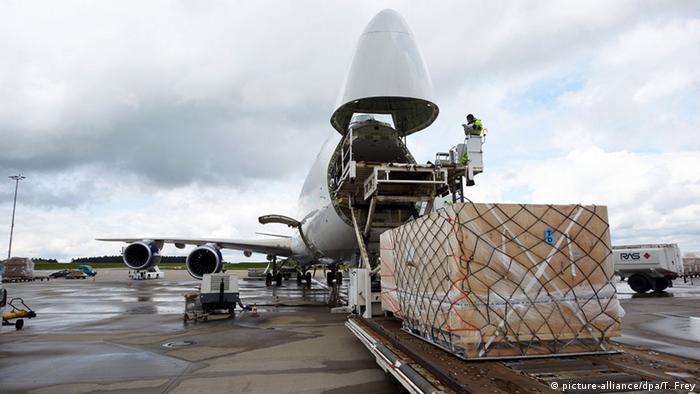
Loading a 747-8F: the freight airliner's nose cone tilts up to allow easier loading of big objects
Airbus is doing a bit better with its A380 order book, but not as well as it had hoped a few years ago. 319 of the big birds had been ordered since the aircraft was offered for sale, and more than half of those have already been delivered. About 140 of them are yet to be built. However, since Emirates ordered 50 of the big Airbus jets two years ago, the company has struggled to obtain any new orders.
That's why Fabrice Brégier, the head of Airbus passenger jet production, announced last week that the company would adjust its plans and produce only twenty A380s per year, rather than thirty, as had previously been planned.
Smaller long-distance aircraft - for now
The reason for the cutbacks in king-sized passenger aircraft orders isn't a shortage of passengers. It's a corresponding increase in orders for smaller, newer, more fuel-efficient long-distance aircraft, like Boeings 787 Dreamliner and the Airbus 350. Those aircraft make more sense for airlines that have increasingly been offering direct flights between second-tier cities, rather than feeding passengers into major hubs and having them change planes.
So does that mean the end is nigh for great big passenger aircraft?
Airline sector analyst Howard Wheeldon doesn't think so. He points out that IATA, the International Air Transport Association, estimates that the number of flight passengers per annum will double between now and the year 2034, reaching seven billion a year.
Wheeldon argues that means big aircraft will necessarily make a comeback eventually. Given constraints on the number of airports and runways, the increased passenger numbers will have to be accommodated at least in part by increasing the number of passengers per takeoff and landing - in other words, with bigger aircraft.
That's why it makes sense for aircraft makers like Boeing and Airbus to reduce the annual pace of production of the Jumbos and A380s they still have on their order books, rather than keeping up a higher pace of production until the order books are empty. They want to provide steady work to the skilled production crews who know how to build their biggest birds - because they anticipate that eventually, they'll need to ramp up production again.
Airbus's Fabrice Brégier said last year that the A380 "was probably introduced ten years too early."
As for Boeing, it has recently scored at least one new customer for a very special version of its 747 Jumbo: POTUS, the President of the United States. President Obama has said he intends to order a replacement for Air Force One, which is a modified Jumbo, and the new Air Force One is also going to be a 747.
Embraer has delivered the first E175 fitted with next-generation RECARO passenger seats to American Airlines, marking another step in the ongoing modernization of one of the world's most successfu...
Cirrus Aircraft is celebrating the 10th anniversary of its Collier Trophy-winning Vision Jet at NBAA-BACE 2026, marking a decade of innovation that has continuously advanced the world&r...
In business aviation, exceptional service is defined by attention to detail, and few amenities reflect that more clearly than premium catering. At the intersection of hospitality and private aviation,...
TARMAC Aerosave has set a new industry benchmark by becoming the first company in the world to secure Aircraft Fleet Recycling Association (AFRA) accreditation across all three scopes of aircraft disa...

