



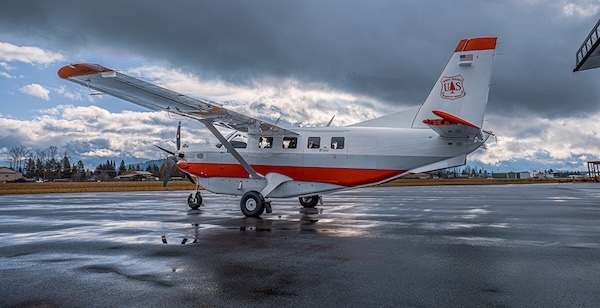
From the forests of Canada and the Pacific Northwest to the fire-prone landscapes of Florida, Daher Aircraft’s Kodiak and TBM platforms are playing an increasingly critical role in wildfire response operations. Deployed on the front lines, these aircraft support aerial coordination efforts, oversee air tanker missions and provide real-time situational awareness in some of the most challenging firefighting environments.
Government agencies and private operators continue to expand their use of the Kodiak 100 and larger Kodiak 900 for aerial firefighting support and multi-mission operations. Meanwhile, the TBM 960 is emerging as a highly effective airborne command-and-control platform, helping crews monitor fire activity, evaluate evolving risks and direct the strategic deployment of water and fire retardant drops by aerial tanker fleets.
Nicolas Chabbert, Daher Aircraft’s CEO commented: “Our Kodiak and TBM bring complementary strengths to aerial wildfire operations. The Kodiak combines ruggedness, excellent handling qualities and multi-mission adaptability; while the TBM delivers the speed, efficiency and versatility needed to cover distances quickly and respond to changing operational demands. Together, they demonstrate the breadth of Daher Aircraft’s capabilities in support of those working to protect communities and natural resources.”
Paul Carelli, Senior Director of Multi Missions and Business Development – Americas at Daher Aircraft stated: “This integration represented a significant step forward for our team in both complexity and the level of capability delivered. The challenge goes well beyond installing individual pieces of equipment. The systems must work together reliably, the different crew positions must be able to communicate effectively, and the aircraft must meet the customer’s specific mission requirements. The experience on this project strengthens our ability to deliver this level of integration for future customers.”
Integrating communications for demanding missions
The unpressurized Kodiak offers several key advantages for wildfire missions, combining long-range endurance with exceptional low-speed handling characteristics and short takeoff and landing capabilities. These attributes allow the aircraft to operate effectively from remote, backcountry and semi-prepared airstrips, bringing greater flexibility to aerial firefighting and emergency response operations.
As demand for specialized wildfire response aircraft continues to grow, Daher Aircraft has expanded its in-house expertise in integrating advanced multi-mission systems. This enhanced capability enables the company to tailor aircraft to increasingly complex operational requirements while supporting a broader range of mission profiles.
One recent example is a newly delivered Kodiak 100 Series III configured for the U.S. Forest Service. At Daher Aircraft’s facility in Sandpoint, Idaho, the aircraft underwent extensive mission-system integration to support wildfire management, aerial supervision, forest health monitoring and logistics operations.
A key component of the aircraft’s mission package is the Canyon AeroConnect digital communications control system. Integrated by Daher Aircraft, the solution links the pilot, co-pilot and cabin operator stations, enabling seamless communication across multiple radio networks. The system allows all crew members to coordinate efficiently while maintaining the ability to operate independently when necessary. This level of connectivity enhances collaboration between airborne teams, ground crews and partner agencies, supporting more effective decision-making during complex wildfire response missions.
The project demanded significant engineering expertise and maintenance support to integrate advanced communications equipment and mission-specific systems while ensuring full compliance with the U.S. Forest Service’s operational and contractual requirements.
The U.S. Forest Service has relied on the Kodiak 100 platform since 2015, making the acquisition of the latest Kodiak 100 Series III a natural progression. By building on an established fleet, the agency benefits from operational continuity, fleet commonality, and existing pilot training and maintenance frameworks, helping to maximize efficiency while reducing transition costs.

A growing Kodiak customer base in the aerial firefighting sector
The Kodiak has become an increasingly popular choice among operators supporting aerial wildfire suppression and a wide range of special mission applications.
Among the latest organizations to adopt the platform is the Montana Department of Natural Resources and Conservation (DNRC), for which Daher Aircraft recently completed a communications-focused integration on a new Kodiak 900. The aircraft is designed to support multiple mission profiles, including aerial fire attack, personnel transport and conservation-related operations.
The customized configuration features a Canyon AeroConnect digital audio control system, an expanded communications suite and Air Tactical Group Supervisor (ATGS) capabilities. From the dedicated rear operator station, mission personnel can monitor radio traffic while maintaining real-time visual oversight of ground activities, enhancing the coordination and effectiveness of aerial firefighting resources.
The Montana DNRC program highlights Daher Aircraft’s ability to tailor mission systems to specific operational requirements. While the U.S. Forest Service’s Kodiak 100 Series III incorporated a broader package of modifications, the Montana DNRC’s Kodiak 900 was optimized with communications and radio systems designed to support its unique mission set.
Also based in Montana, Bridger Aerospace remains one of the most established Kodiak operators, utilizing a fleet of four Kodiak 100 aircraft for air attack supervision, wildfire mapping, detection missions and multi-role intelligence gathering.
Elsewhere in the United States, the Washington State Department of Natural Resources operates two Kodiak 100s in support of wildfire response efforts throughout the Pacific Northwest. In the Southeast, the Florida Forest Service has added two Kodiak 100 aircraft to its fleet for fire patrol, personnel transport and Air Tactical Group Supervisor duties. Equipped with advanced multi-purpose infrared imaging systems, these aircraft can map active fires and identify hotspots, providing critical intelligence for wildfire management teams.
The North Carolina Forest Service’s Aviation Division also employs a Kodiak 100, using the aircraft as a logistical support platform to transport equipment and supplies to operational locations, helping sustain aerial tanker missions during wildfire suppression operations.
The TBM 960 as a “birddog” aircraft for the Conair Group
In Canada, Conair Group has expanded its aerial firefighting capabilities with the acquisition and conversion of two new-production TBM 960 aircraft, configured as airborne command-and-control platforms. The aircraft play a critical role in coordinating airtanker operations, directing retardant and water drops, and providing real-time operational oversight during wildfire suppression missions.
The pressurized TBM 960 was selected by Conair following an extensive evaluation of 50 aircraft types. Both aircraft entered operational service during British Columbia’s 2025 wildfire season, bringing a new level of efficiency and situational awareness to aerial firefighting efforts.
According to Conair, the TBM 960’s combination of speed, visibility and handling performance made it the standout choice for the mission. The aircraft is capable of keeping pace with large airtankers while offering excellent visibility in congested firefighting airspace. Its stable low-speed flight characteristics also allow crews to effectively guide airtankers to designated drop zones, ensuring precise and coordinated wildfire response operations.
MTU Maintenance and Garuda Indonesia have entered into a three-year agreement for the maintenance, repair and overhaul of the airline’s GE90-115B engines, which power its fleet of eight Boeing 7...
Embraer reported a record backlog of US$35.7 billion in the third quarter of 2026, surpassing its previous all-time high by 3% quarter-over-quarter and increasing 14% compared with the...
Etihad Airways has marked a significant milestone with the arrival of its iconic Airbus A380 in Thailand for the first time. The airline’s flagship aircraft touched down in Bangkok this morning,...
Lufthansa Technik Engine Services (LTES) is significantly expanding its engine maintenance capabilities in Tulsa, Oklahoma, nearly doubling its operational capacity as part of its growth strategy acro...

