



EU RESEARCH PROJECT “SPIRIT” WITH A VALUE OF € 4 MILLION IN COOPERATION WITH PROFACTOR AND OTHER INDUSTRIAL PARTNERS
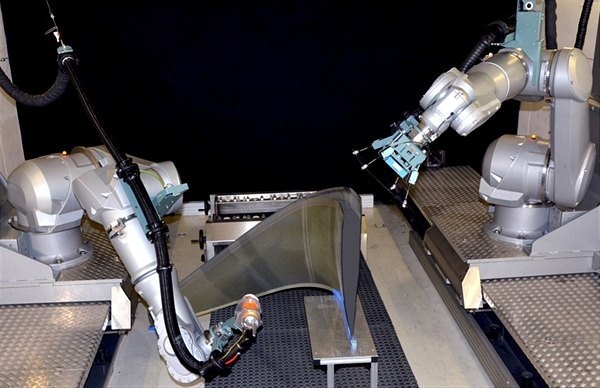
FACC, one of the world’s leading aerospace companies specializing in the design, development and production of innovative aircraft components and systems, has been awarded a three-year research project in the field of robotics entitled “SPIRIT- A software framework for the efficient setup of industrial inspection robots”. The project under the lead of Profactor GmbH (Steyr) along with eight international scientific and industrial partners from Austria, Germany and Italy aims to develop a new generation of inspection robots, which will be used for a vast range of inspection tasks – without programming effort.
“The goal of the project, in line with our aim of advancing robotic solutions, is to replace the time-consuming and highly skilled task of robot programming with simply configuring the inspection task,“ explains Helmuth Hoeller, director of the NDT division at FACC. When a new component or a complex shape is to be inspected, the main challenge with inspection robots is to plan the robot motion path in such a way that the whole surface of the component is inspected. This process is usually carried out by specialists and is therefore resource and time intensive. SPIRIT aims to move this task from the programming level to simple configuration, thereby saving time and reducing the resources required. FACC, with its extensive experience in industrializing innovative solutions, is expected to integrate the results of this project directly into the production workflow.
SPIRIT aims at developing the “universal inspection machine”
The software developed within the framework of SPIRIT aims at the development of inspection robots, which can deal with a wide range of challenges such as switching between different inspection technologies, inspecting new parts etc. All that the inspection robot will need is a CAD model of the component along with the CAD model of the work cell – to avoid collisions. Given this information, it will process the selected inspection technology and automatically generate an inspection program for the particular task at hand.
During the demonstration phase at FACC, the robot will be used to inspect a winglet, which will involve X-ray radiography. The robot will then switch to a second technique, active thermography, and configure the inspection with the additional technique. In this way, relevant areas can subsequently be subjected to a fast test, thereby considerably speeding up the inspection process with multiple techniques.
Reactive Planning
The robot will, furthermore, have the additional feature of being able to optimize the inspection process in real-time while it is running. For instance, in the case of unknown deformations, which are not accurately represented in the CAD model, slight mispositions of components or X-ray inspections where the sensor needs to be adjusted to the orientation of the honeycomb core in a composite part, the required optimization will be performed spontaneously.
Multiple benefits for FACC and other industry partners
Upon implementation, the project will offer multiple benefits such as
Few infrastructure projects have the potential to reshape an island's future quite like the ongoing transformation of Nevis Airport. To gain deeper insight into this ambitious development and the...
Samson Sky has enlisted renowned Italian automotive designer Luigi Memola to develop the interior design of its Switchblade Flying Car, bringing world-class automotive styling expertise to the roadabl...
Archer Aviation all-electric Midnight air taxi successfully completed several days of piloted flights across the San Francisco Bay Area as part of the company’s “No Roads” flight tou...
Piaggio Aerospace will return to NBAA-BACE this October, bringing its flagship P.180 Avanti EVO to one of the most important gatherings of the global business aviation community while also highlightin...

