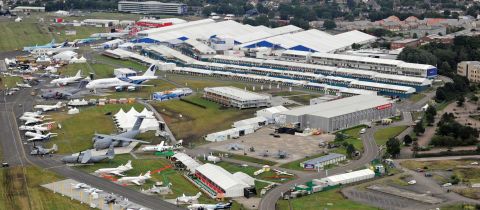
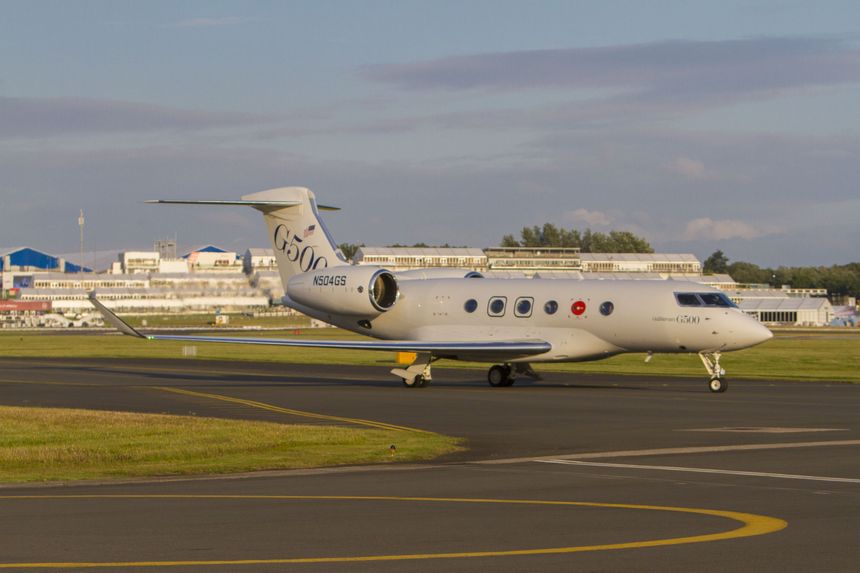
Gulfstream Aerospace Corp.’s all-new G500 made its European debut this week, traveling across the Atlantic to participate in the Gulfstream static display at the 2016 Farnborough International Airshow.
The G500 flew nonstop from Savannah/Hilton Head International Airport to Farnborough Airport in 6 hours and 55 minutes, accomplishing the 3,732-nautical-mile/6,912-kilometer flight at an average speed of Mach 0.90 and altitude of 45,000 feet/13,716 meters. Gulfstream pilots Scott Evans, Brian Dickerson and Sean Sheldon were in the flight deck with Flight Test engineers Darren Klaus and Ray Beach on board.
“Since the first flight of the G500 in May 2015, we have been steadily expanding the test fleet and progressing toward the aircraft’s certification in 2017,” said Mark Burns, president, Gulfstream. “I’m pleased that we were able to bring the G500 to Farnborough to show the aircraft’s industry-leading safety, performance and comfort to our customers.”
The G500 participating in Farnborough is the fourth test aircraft and serves as the test bed for avionics, water ingestion and select systems (water/waste, lighting, fire protection).
To date, the G500 test fleet has flown more than 300 flights and surpassed 1,280 flight hours. The aircraft have achieved a maximum speed of Mach 0.995 and an altitude of 53,000 ft/16,154 m. The longest duration flight was 7 hours and 35 minutes.
The fifth test aircraft, P1, is at the Savannah Completions center, where it is receiving a full interior that will be used to test the form, fit and function of various cabin elements.
At this point in the test program, the G500 flight-test aircraft have completed expanding the flight envelope, which includes flutter, altitude, Mach and temperature, as well as testing of initial handling qualities, ice shapes and stalls.
Gulfstream has conducted more than 50,000 hours of ground testing in its state-of-the-art labs to support the aircraft’s continued development. The company recently completed ultimate load testing, taking the G500 structural test article beyond 150 percent of limit load. It is set to begin a multi-year fatigue testing program that will simulate three lifetimes of airframe operation.
The G500 is slated to receive type certification in 2017 and deliver in 2018. The G600 is projected to enter service in 2019.
The G500 can fly 5,000 nautical miles/9,260 kilometers at Mach 0.85 or 3,800 nm/7,038 km at Mach 0.90, while the G600 can carry passengers 6,200 nm/11,482 km at Mach 0.85 and 4,800 nm/8,890 km at Mach 0.90. The maximum operating speed for both aircraft is Mach 0.925, the same maximum speed as Gulfstream’s G650 and G650ER.
Archived
10 years ago

Dassault will introduce the fourth-generation EASy IV flight deck on newly built Falcon 2000LXS aircraft, while also making the upgrade available as a retrofit across the entire Falcon 2000 EASy fleet...
Piaggio Aerospace will return to NBAA-BACE this October, bringing its flagship P.180 Avanti EVO to one of the most important gatherings of the global business aviation community while also highlightin...
Airbus 2026 Cargo Global Market Forecast, unveiled at the Cargo Facts Symposium, predicts that the global fleet of dedicated freighter aircraft will expand by 46%, rising from 2,360 aircraft in 2026 t...
Bristow Group Inc., in partnership with Electra, Avinor and the Norwegian Civil Aviation Authority (CAA Norway), will undertake a series of demonstration flights across five locations in Norway using...