



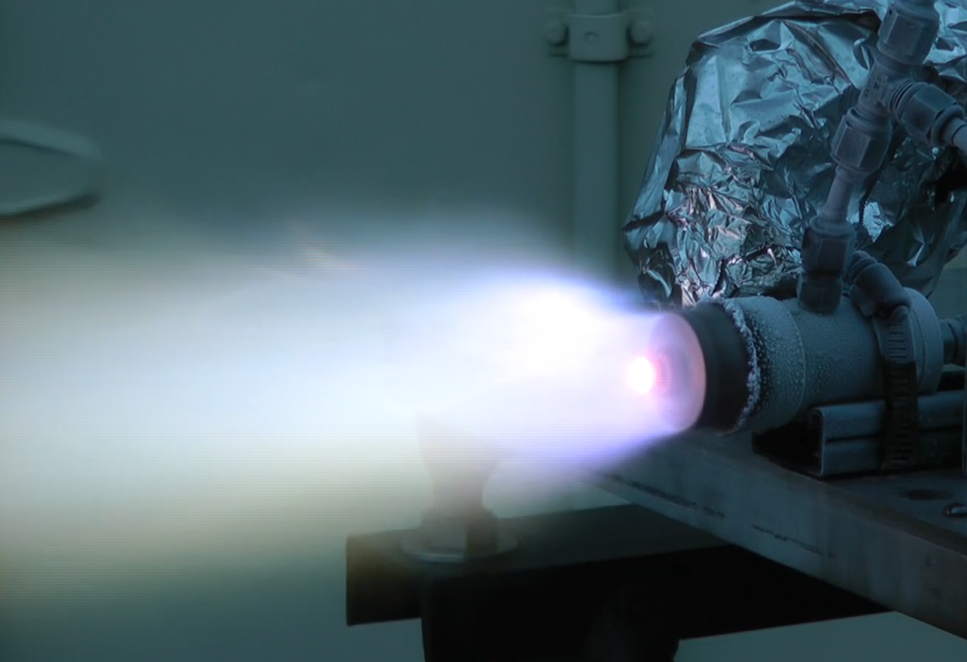
The RTR turborocket combines the best of both rockets and jets to enable faster, higher flying aircraft.
Ever since the Concorde was put out to pasture, supersonic travel has remained out of reach for commercial air passengers. And while SpaceX and Blue Origin are showing re-usable rocket boosters are possible, actually putting anything in orbit still remains a very, very expensive proposition.
But all that could change, thanks to a small team of engineers in Huntsville, Alabama, who have revealed a vision for a new type of engine that combines the speed of rockets with the gas mileage of jets in a single package. Led by aerospace and mechanical engineer John Bossard at BSRD LLC, the team has built and tested a rocket engine of Bossard's design that he calls a "turborocket."
The engine does away with the separate turbopump, combustion chamber, and nozzle of a conventional pump-fed, liquid-fuel rocket engine. Instead, all three are combined in a single structure that Bossard says makes the engine both simpler and more compact. It is the compact nature of the design that Bossard says ideally suits it for so-called combined cycle engines—that is engines that can be toggled between multiple modes of operation.
Bossard's combined cycle design, which incorporates a turborocket and a turbojet, and which he calls the RTR turborocket or just RTR, could allow an aircraft to take off as a jet and switch to rocket power to fly faster than a jet could alone—and potentially right out of the atmosphere. "Simple also means lightweight, and we think the RTR could have an excellent thrust-to-weight ratio," says Bossard. "Maybe really excellent."
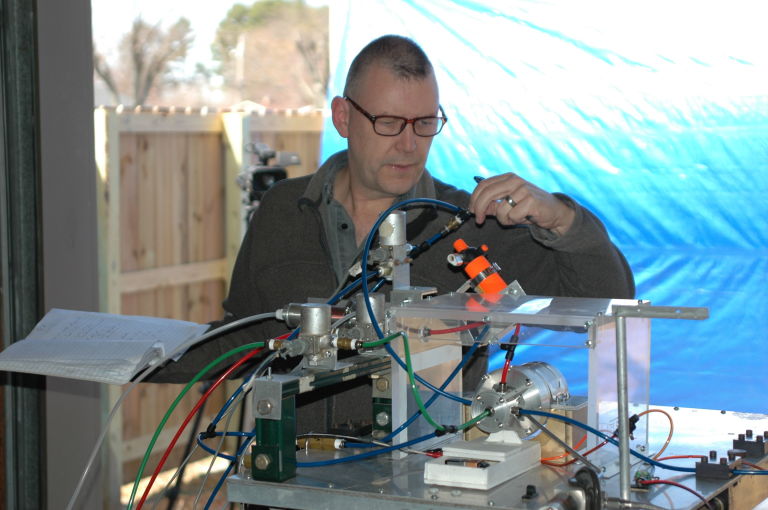
Bossard and his prototype.
BSRD LLC
In the turborocket prototype that the team has built, fuel and oxidizer flow into a rotating, cylinder-shaped combustion chamber, where it is ignited. Exhaust gases exit a pair of nozzles built into the business end of the engine at a slight angle to the axis of rotation. The angle of the nozzles not only pushes the engine, as in a conventional rocket, but also starts the combustion chamber spinning. The resulting centrifugal force pumps fuel and oxidizer into the chamber at a higher pressure, serving the same function as the turbopump in a conventional design.
Bossard says that doing away with the extra gear and plumbing of a conventional rocket engine enables the new design to be integrated with a jet engine without having to make major changes to the jet Both rocket and jet can use the same fuel, says Bossard, further saving space and weight that might otherwise be required for separate fuel tanks for each mode of operation. The rocket would still need a separate oxidizer tank.
In addition to building and running the stand-alone turborocket, Bossard and company have also successfully integrated it with a model aircraft turbojet engine and run the system in both rocket and jet mode. "The engine is small," says Bossard. "You can hold it in one hand." He says this small-scale RTR turborocket could be ideal for fast, high-flying drones.
So far, Bossard has spent about $1 million of his own money on the turborocket project. He is seeking an additional $2.5 million to further perfect the design, ramp up engine thrust, run more tests, and ultimately develop production engines. Interested researchers at the Air Force Research Laboratory have been briefed on the project, Popular Mechanics has confirmed, but they haven't bitten yet.
Beyond their first possible use in drones, team member John Bergmans—a consulting mechanical engineer in the NewSpace industry—sees the RTR turborocket as the next step in the development of reusable rockets. SpaceX and Blue Origin, he points out, have taken an important step toward more affordable spaceflight by bringing rockets back to Earth intact for refueling and reuse. But it is only the first step, he says. "In the short term, this approach will provide a competitive advantage to firms that can master this technique. However, this advantage will be quickly eroded once this method becomes commonplace in the industry.We think the time is now to be laying the groundwork for the next step change in launch costs."
Ultimately, says Bossard, the team is all about "providing alternative propulsion approaches that will enable humankind's transition off the planet and out into the Cosmos." Here's hoping they'll help get us high-speed air travel along the way.
To see their promo video:
http://50skyshades.com/video/manufacturer/the-rtr-turborocket-revolutionizing-propulsion-performance
Piaggio Aerospace will return to NBAA-BACE this October, bringing its flagship P.180 Avanti EVO to one of the most important gatherings of the global business aviation community while also highlightin...
Archer Aviation all-electric Midnight air taxi successfully completed several days of piloted flights across the San Francisco Bay Area as part of the company’s “No Roads” flight tou...
Dassault will introduce the fourth-generation EASy IV flight deck on newly built Falcon 2000LXS aircraft, while also making the upgrade available as a retrofit across the entire Falcon 2000 EASy fleet...
The U.S. Federal Aviation Administration has certified the Boeing 737-10, the newest and largest member of the 737 MAX family, paving the way for Boeing [NYSE: BA] to begin customer deliveri...

