



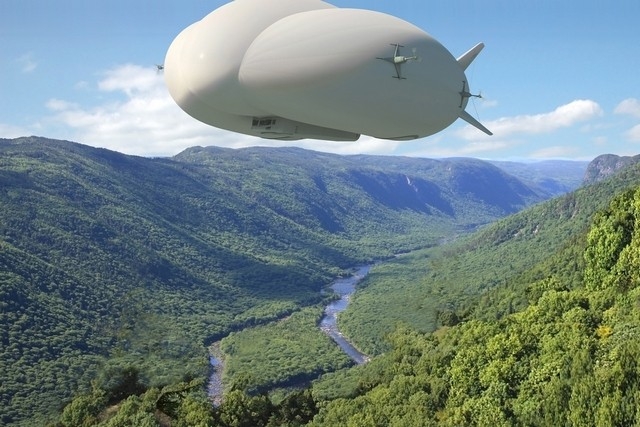
A novel concept to end Africa’s logistics deficit is being proposed by the US defence company Lockheed Martin, which intends to use airships to deliver payloads of hundreds of tonnes into the interior.
Under the slogan “No Roads, No Problem”, the Hybrid Airships division of the group is building an airship that will pick up and deliver cargo where no formal airports exist.
“It will land on water, sand, a field, even ice,” said Rob Binns, the chief executive of Hybrid Airships. The prototype had already proven itself in Alaska, in the wildest of conditions.
Mr Binns was speaking on the sidelines at the African Mining Indaba, where the company hoped to draw interest from mining companies that were struggling with logistics difficulties across the rugged continent. Oil and gas companies were also being approached. “This is a dedicated cargo carrier, so it’s built with moving material and equipment in mind,” Mr Binns says.
The first airship will be completed in 2018 and plans are underway for a 90 tonne-lift model, which would have similar lifting capacity to a cargo-configured Boeing 747. Eventually, a 500 tonne-lift model will be built, which would put it in the same category as an average cargo ship.
“It will theoretically be possible to load a cargo in central China and, using the earth’s curvature, fly it to mid-western USA in two days. Much quicker and cheaper than first railing or trucking it to port, shipping across the Pacific, offloading again for road or rail,” Mr Binns says.
The concept may seem eccentric – the airship looks like a cheery character from a Pixar children’s cartoon – but it has behind it the company developing the F-35, the most advanced fighter aircraft. It was a spin-off of the fighter programme, and draws on its technology.
“Essentially Lockheed have taken the same technology they are putting into the F-35, and applied it to the problem of moving cargo around quickly and cheaply. The flight control system is basically straight out of the F-35, which will be used to plot course, navigate and fly,” says Mr Binns.
The airship is helped aloft by helium gas bladders, but needs forward momentum to stay airborne. The design of the gasbag emulates that of an aircraft wing, giving lift when its four V6 diesel motors are running.
At a top speed of about 110 kilometres per hour, it has a range of 2,600 kilometres. A more modest speed of 50kph should allow it to circle the globe without landing.
When it does return to earth, it uses a hovercraft mechanism – three blowers where wheels should be – to suck the ground to hold it fast. The thrust on these can be reversed to manoeuvre it on the ground.
Even if the engines fail in flight, the airship will not hit the ground with much of a bump. “It will fall at a rate slower than that of a man in a parachute,” Mr Binns says.
Embraer has delivered the first E175 fitted with next-generation RECARO passenger seats to American Airlines, marking another step in the ongoing modernization of one of the world's most successfu...
Turkish Airlines has taken another major step in its fleet expansion strategy with the signing of a Memorandum of Understanding with CFM International for more than 300 LEAP-1B engines and a long-term...
Gogo has unveiled its long-term vision for the Galileo connectivity platform at NBAA-BACE 2026, outlining a roadmap designed to enhance and protect customer investments well into the mid-2030s and bey...
The Tennessee Valley Authority is demonstrating the real-world value of the Tecnam P2012 Special Mission Platform (SMP), which has become a vital tool for monitoring and maintaining its...

