



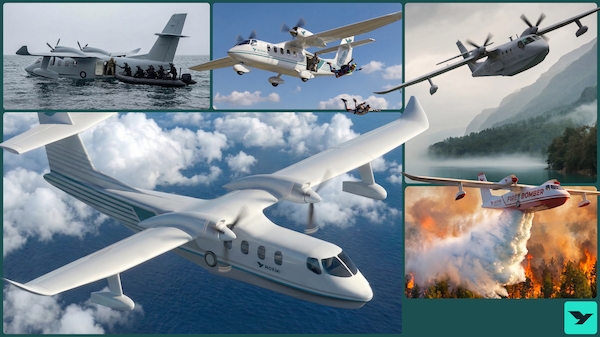
NOEMI Aerospace unveiled a broader platform strategy that expands company’s vision beyond its initial fully electric amphibious passenger aircraft programme. The company remains firmly committed to its core mission, developing a fully electric amphibious aircraft for regional passenger transportation. Now NOEMI Aero sees significant long-term opportunities in adapting the same aircraft platform for additional mission profiles, propulsion configurations and dual use. The strategy builds on proprietary intellectual property spanning aerodynamics, hydrodynamics, composite structures and propulsion integration, enabling future derivatives to share common architecture and development foundations.
I had the opportunity to speak with representatives of Noemi Aerospace team: Eric Lithun, Founder and Chief Executive Officer, and Simon Bendrey, Chief Engeneer,Head of Design. Take your time—it’s absolutely fascinating to read their openness, their true vision of the market, and their clear understanding of the changes that NOEMI aircraft could bring to the industry.
T.O.: What would be the most challenging with certification? You always must plan B.
S.B.: I think the biggest risk is over the propulsion system because it's where the new regulations apply. The structure and the aeologics and everything else is standard and has been looked at for years. So, there isn't a CF-23 aircraft that's certified to date for electric propulsion. There certainly isn't a twin-engined aircraft for propulsion. We need to agree with the authorities what is the right level of safety and how does our system then demonstrate that level of safety. The hardware I'm less concerned about because hardware is hardware. And so, it's really the control software that's and the system failure analysis that will drive the level of certification that's required and therefore the risk. For example, if we have a failure mode that turns out to be catastrophic, then it will have a high down level associated with it. So we've tried to design a system where we have inherent redundancy within the system to mitigate us having these types of failures. But until we do the first HA and FMEA at the system level and agree that with the authorities, there is a risk that that part of the programme will take longer than we planned, basically.
T.O.: Your team is impressive with the number of already certified aircraft. Is it easy to work with regulators with the experience you have? Or there are always...something that might change, is there still a lot of unknown?
S.B.: I think you're right, especially where you're dealing with the new technology, because if anything, the regulator at that point knows less than the OEM, because we're living and breathing the new technology, the electric systems, whereas they're coming to it fresh. So it's important that we work early with the regulator and we explain what we're doing and why we're doing it, why we believe we are achieving the levels of safety, and take them on the journey so that they are as...to speak with the system and the safety as can be so that it mitigates their being an overrun on the program.
E.L.: I would add something also. He's using his words from the engineering side, but for me as the investor side, I would put it in a different way also to say, I like to keep the product, the case plain, simple and stupid. So we're building a very conservative and simple plane in many ways. And when people ask, can you make it autonomous? Can you do? And I said, no, you can't do anything. But the beauty of stuff and the real challenge is to keep things as simple as possible. So it's easy to certify and then rather do something else and add complexity and stuff at the later stage. Have success with customers and make them fall in love with the product and make them pay for getting the added stuff. And not add it in the beginning. That's my approach.
T.O.: Eric, you invested money and you need results. You need the ROI. When are you hoping to have the return on investment?
E.L. : When we have an entry into service, right, then there will be customers getting delivered their first planes. And going towards that point, there will be, I mean, down payments and customer payments with normal contracts for getting an airplane that you start to pay when we start to order the parts. We will have a revenue stream when we start to come towards the certificate. But there is a road to go before that. I think that the market is there for a seaplane. I think the seaplane is a smart approach to do zero-emission or low-emission. I think there is a high paying revenue customer out there who wants to do a seaplane trip. And we will deliver a premium product to that customer, to the partners and the operators.
T.O.: 70% of the world could be your runway. That's true. How many of potential customers are looking for you even before you've certified the aircraft? Anyone from Caribbean, asking how it would fit in their aviation ecosystem, your aircraft?
E.L.: We have a MOU with an operator from Panama. We have the MOU with an operator willing to do the Panama Express, they want to reintroduce and that is to go to Divini Island and Bahamas and Key West and those places there. In the Caribbean there is not that many seaplanes now but there are some people, you have the Tropic Ocean people, that is part of Miami also. I would think that the world would probably have 10 times more seaplanes if we deliver on our promise, make it a cost-efficient way to travel and operate, then there will be a lot more seaplanes all over the world when we have the product out there. We just come back from a meeting with Indian government and the big issue they've got is the lack of aircraft. They want to open route 100 in India, but they can't get the aircraft to support the operating missions they've now identified. There's not been any investment during last 40 years in new seaplanes. Now, what the Indian government are doing is having to recycle old planes to start their operations. If we had the seaplane certified today, it would effectively be selling an Indian show. We'd be selling hotcakes. But obviously, we've got a regulatory challenge to go through to get it there. But the market is actually already intercepting.

T.O.: I am sure Caribbean will need your aircraft because it's a solution without the infrastructure. But the regulations are not the same and this will be a challenge as always.
E.L.: And this is why some of the operators are using time now and doing conventional seaplanes to introduce a Cessna Caravan or Twin Otter to some markets. But they know that if they could have our plane and a good business case is even better. But it is true, you need to work with the government to get acceptance of reintroducing seaplanes in some areas. I think that zero emission, lower noise and good service offered to the local community is something that any government would try to encourage. And if you have the high paying customers, it's also good for tourism and business. But yeah, there is a road to go down with the regulatory stuff in local communities all over the world. It's not just the aircraft; it's charging infrastructure and maintenance as well. We're involved with the EASA and the authorities within Europe looking at what other support network is needed. It's not good enough to just put an aircraft out there and then not have any interconnectivity for it or anybody to maintain it. Over the next three years, we'll be working to develop the ground side of things with charging stations and maintenance development plan and training for maintenance engineers, so that when the aircraft rolls out the infrastructure is there to support its release into the into the operators basically. Otherwise, you're and I think this is something that you know, over the last sort of five, six years, and I come from the eVTOL industry as well. Everyone's been rushing into the eVTOL industry, which was probably the latter stage of what should be done. Aircraft that more suits electrification, the seaplanes, the skydivers, these sort of southern one-hour missions is where electrification can work now. And the industry can develop off that and work all these things out over the next three or four years. And then you can move into the eVTOL, once the technology catches up.
T.O.: Where your aircraft is needed the most in Europe?
E.L.: I mean, anywhere where you have a water base. We have a customer in Greece; And that's a good example that they would like to have a take a tourist from Athens to the Oracle of Delphi, which is a 3 hour drive with the bus and traffic and then it's a 3 hour bus traffic back, so 6 hour of transport. But to do the seaplane trip from the harbor of Athens to this place, it's like a 25 minute flight, right? And that's an example. I have some islands in the north in Greece where you could use it. I mean, there has been initiatives in Croatia where they want to do seaplanes that have been back and forth some years ago. I think there is a good market opportunity in Turkey, in the islands and around in Turkey. You have islands outside of Spain where we had the dialogue, was it the Canary Islands, Thomas? We had a discussion there, have the initiative that they use boats today.
They wanted to have the sequence. And then our friend in Denmark that is operating Copenhagen to Aarhus. An agreement to do this in Götland in Sweden. In Norway, we have something that I call the Maldives of the Europe. And that's the Lofoten. We have an agreement with the municipals up there, because they have an enormous growth in tourism. I know they have a problem to have this kind of doing once. A way is needed to get to these islands and different places because even the roads cannot do all the logistics of these people.
T.O.: Anyone from Baltic states was ever approaching you?
E.L.: Yes, we are talking to some people. You have Helsinki to Tallinn. That was a seaplane route in the old days. Some people have even tried to do this in helicopter. Then you have the thing from Stockholm to Mariehamn. Then to Turku, which is a Finnish island, but it's run by the Swedes. There are potential routes in the Baltic Sea. We have a real customer demand. And people that are using seaplanes today are asking when we can have the electric seaplane because they would like to cut their fuel costs. As fuel price is crazy now and if you run the airline, one third of your cost is the fuel and if you can mitigate that cost in some ways, everything is a great achievement, right?
T.O.: From my perspective, your aircraft is just a genius solution. If you can accelerate the process and be on the market even before the schedule, I think people will be just happy. Last question. Do you think that media maybe aren’t talking enough about your concept and your solution for regional air travel?
E.L.: Yeah, I agree. I am not a believer of this urban air mobility. But regional air mobility exists. We can do regional air mobility. And the thing is that if we put this into production for the end user and they start to fly, we would displace emissions that would have been done with a Twin Otter or a Caravan. Right. We are when these planes are starting to get into operation, they would maybe start to displace some of the old emissions planes. We would not add anything, but we will be able to give operators reductions of the emissions, but also reduction in noise. This is very important. Noise reduction can help us to achieve the premium product.

To remind, potential future applications under evaluation include:
The company has also outlined a broader propulsion roadmap. While the fully electric amphibious aircraft remains the core business case, future mission requirements may require hybrid-electric or conventional fuel-based configurations where greater range, payload or mission flexibility are needed. Alongside the strategic announcement, NOEMI provided updates on programme progress, including PDR completion, ongoing prototype development activities, propulsion testing initiatives and progress under its Pre-Application Contract agreement with EASA. The company continues toward its ambition of first flight in 2027 and commercial operations by 2030.
In business aviation, exceptional service is defined by attention to detail, and few amenities reflect that more clearly than premium catering. At the intersection of hospitality and private aviation,...
TARMAC Aerosave has set a new industry benchmark by becoming the first company in the world to secure Aircraft Fleet Recycling Association (AFRA) accreditation across all three scopes of aircraft disa...
Viasat has significantly expanded the capacity of its JetXP in-flight connectivity service across the United States, delivering up to five times more bandwidth for business aviation customers equipped...
The Tennessee Valley Authority is demonstrating the real-world value of the Tecnam P2012 Special Mission Platform (SMP), which has become a vital tool for monitoring and maintaining its...

