



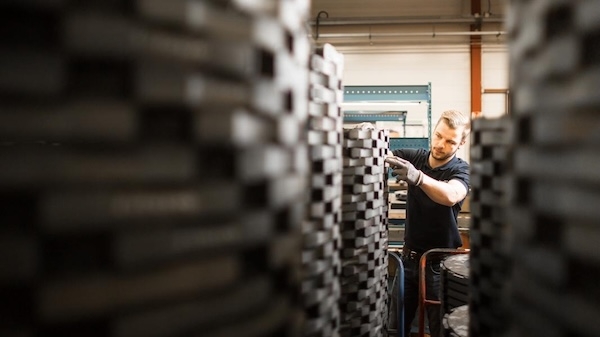
Following a decision by its Board of Directors, Safran announced the location of its new aircraft carbon brake production facility at the Plaine de l’Ain Industrial Park (PIPA) near Lyon in the Auvergne-Rhône-Alpes region of France. The new facility will operate alongside Safran Landing Systems’ existing production plants worldwide in Villeurbanne (France), Walton (USA) and Sendayan (Malaysia). Scheduled to begin operations in 2030, the site will enable Safran to achieve gradually an increase in volumes of 25% by 2037.
This 30,000 square meter (323,000 sq.ft) facility represents an investment of over €450 million once fully completed. Equipped with state-of-the-art technology and industrial systems specifically developed for this project, the facility will be highly automated and will offer employees a working environment of the highest standards. It will have around 100 highly qualified employees when it opens and will double its workforce at full capacity.
Since energy can account for up to 30% of the cost of manufacturing a carbon brake, the choice of location was dependent on a guarantee of secure access to low-carbon electricity at a stable and competitive price over the long term.
Olivier Andriès, Chief Executive Officer of Safran, commented: “With this new facility, we’re strengthening our global leadership in carbon brakes and ensuring our ability to support our customers, against a backdrop of strong air traffic growth. The choice of this site in France is the result of a collaborative effort by the French government, the Auvergne-Rhône-Alpes regional authority, French electric utility EDF, national grid operator RTE and all the stakeholders, whose support I gratefully acknowledge.”
These new technologies will also enable the plant to achieve zero emissions* in support of Safran’s environmental commitments. It will use biomethane and low-carbon electricity. As a result, its electricity and gas consumption will be reduced by nearly 30% and water consumption by 80%. In addition, all the heat generated by the carbon production process will be recovered to supply a heating network. Some of the production technologies developed for the new plant will also be rolled out at other carbon brake facilities to further enhance competitiveness and sustainability.
As the world leader in carbon brakes, Safran Landing Systems currently equips 55% of commercial airliners with over 100 seats and supports more than 500 airlines worldwide on a daily basis. Carbon brakes are lighter, more efficient and three times more durable than steel brakes and help operators reduce fuel consumption.
Samson Sky has enlisted renowned Italian automotive designer Luigi Memola to develop the interior design of its Switchblade Flying Car, bringing world-class automotive styling expertise to the roadabl...
Bombardier marked the 40th anniversary of its industry-leading Smart Services cost-per-flight-hour programs, which today support more than 1,500 enrolled aircraft and account for over 11 mil...
The Tennessee Valley Authority is demonstrating the real-world value of the Tecnam P2012 Special Mission Platform (SMP), which has become a vital tool for monitoring and maintaining its...
Bristow Group Inc., in partnership with Electra, Avinor and the Norwegian Civil Aviation Authority (CAA Norway), will undertake a series of demonstration flights across five locations in Norway using...

