



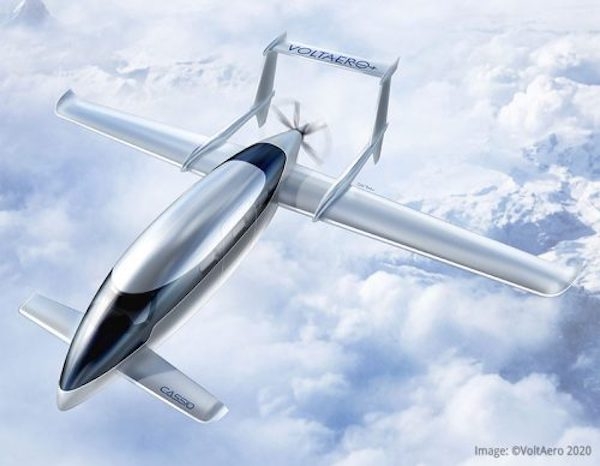
The creation of a regional air mobility ecosystem for VoltAero’s new Cassio hybrid-electric airplane has taken an important step forward through the French company’s collaboration with U.S.-based KinectAir, which is developing a flexible on-demand flight network utilizing an artificial intelligence-enabled smartphone application. This cooperation foresees Cassio aircraft integrated with KinectAir’s short-haul infrastructure, applying artificial intelligence to balance passenger demand with air transport availability. KinectAir’s software platform will interface directly with Cassio’s “intelligent cockpit.”
“The KinectAir collaboration opens exciting opportunities, combining the full benefit of our Cassio aircraft’s low-noise, environmentally-friendly flights with an app that offers an accessible, affordable, sustainable and safe way to travel regionally by air,” explained Jean Botti, VoltAero’s CEO and Chief Technology Officer.
Botti added that ensuring regional air service is more important today than ever, especially when economically-challenged airlines around the world are abandoning shorter routes – threatening air links that serve as vital lifelines to thousands of communities.
VoltAero is developing a family of airplanes that use the company’s proprietary hybrid-electric power module. Featuring a sleek, aerodynamically optimized design, Cassio will fly at 200 knot-cruise speeds (360 kilometers per hour) out to flight ranges of 800 miles (1,300 kilometers). Available in three versions with four to 10 seats, the aircraft are designed to take off and land in distances of less than 1,800 feet (550 meters), thereby opening the use of runways typically available at local and regional airports.
Cassio deliveries will begin in late 2022. The aircraft will be produced on a purpose-built final assembly line in the Nouvelle Aquitaine region of southwest France, with licensed production opportunities pursued in North America and Asia.
KinectAir’s regional air mobility smartphone app will allow users to order a flight directly from their nearest airfield. Utilizing its fleet of leased and fractionally-owned aircraft, KinectAir’s artificial intelligence engine then balances supply and demand for air travel, giving passengers control over their choices – both economically and environmentally.

“With Cassio aircraft in our fleet, it completes the KinectAir vision for democratizing personal air mobility. Being mindful and intentional about the need for connectivity, and the ability to fly sustainably, is in our company DNA,” said Chief Executive Officer Jonathan Evans. “We will be able to offer a clean, quiet, and intelligent regional air service to move people to where they need to be. Partnering with VoltAero during Cassio’s development also allows our software platform’s functionality to be integrated directly into the aircraft’s ‘intelligent cockpit,’ which will enable a two-way interface for the rapid exchange of intelligence between the network and the aircraft as a node.”
Evans added that having a deeply integrated partnership with VoltAero from the start takes full advantage of KinectAir’s platform in coordinating the customer experience, aircraft maintenance, pilot scheduling and virtual assistance, along with route planning/dispatch and operational availability.
Gogo has unveiled its long-term vision for the Galileo connectivity platform at NBAA-BACE 2026, outlining a roadmap designed to enhance and protect customer investments well into the mid-2030s and bey...
Airbus 2026 Cargo Global Market Forecast, unveiled at the Cargo Facts Symposium, predicts that the global fleet of dedicated freighter aircraft will expand by 46%, rising from 2,360 aircraft in 2026 t...
Dassault will introduce the fourth-generation EASy IV flight deck on newly built Falcon 2000LXS aircraft, while also making the upgrade available as a retrofit across the entire Falcon 2000 EASy fleet...
Bombardier marked the 40th anniversary of its industry-leading Smart Services cost-per-flight-hour programs, which today support more than 1,500 enrolled aircraft and account for over 11 mil...

