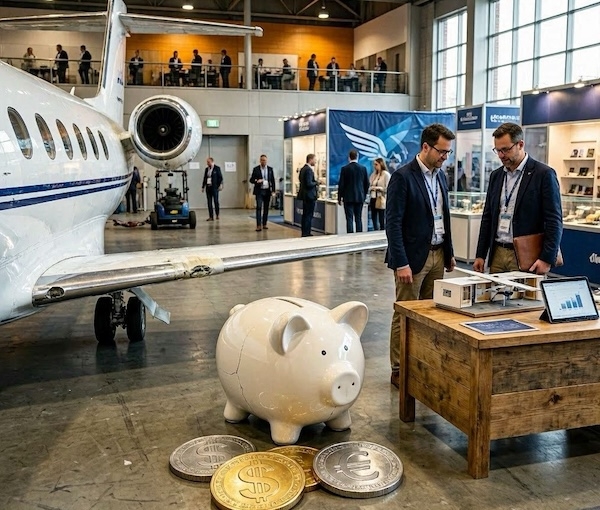
When EBACE was cancelled, the total measurable, quantifiable economic impact is an estimated €23–42 million, plus the unquantified strategic losses. So now what? Let’s start with some numbers.
EBAA lost its largest revenue engine. EBACE historically generated 40–60% of EBAA’s annual operating revenue. This is the typical percentage for associations with a single flagship event. In the past EBAA explicitly stated that EBACE “helped generate the financial means that enable the association to continue its advocacy, representation and member support work.” EBAA is now in a significantly challenging financial position.
The estimated total annual revenue loss for EBAA and partners is €10–17 million. This is not published directly, but it is consistent with the scale of comparable aviation trade shows. Exhibitor fees for a show of this size typically reach €8–12 million. Sponsorship revenue likely adds €1–3 million. Ticketing revenue (attendees) adds €1–2 million. (€ and $ is about the same in these estimates).
In addition the total regional economic loss: €13–25 million. Important to know for a potential new future location; the estimated loss of the old indicates the opportunity for the new.
The quantifiable regional impact (based on event‑industry multipliers): 10,000–13,000 visitors × €1,000–€1,500 average spend (hotels, transport, food, services) means €10–19 million lost for Geneva’s local economy. PALEXPO venue revenue loss: €2–4 million. Local aviation services (handling, logistics, static display support): €1–2 million.
Quantifiable impact (based on historical EBACE scale which is higher when times were better but lower more recently. 10,000–13,000 attendees per year (historical range) and 400–500 exhibitors. Dozens of aircraft on static display (except 2025, which had none). Hundreds of millions of euros in deal flow (inferred from OEM announcements in prior years). Even if only 5–10% of attendees were directly involved in transactions, the cancellation removed the annual European moment where the entire supply chain converged.
Loss of Global Visibility and Policy Leverage. EBAA stated in the past that EBACE created “visibility and momentum for the industry” and served as its “policy megaphone.”
Quantifiable proxies are not easily expressed in euros, but the strategic cost is enormous. EBACE typically generated hundreds of media stories annually. Policy engagement: 20–40 regulators and government delegations typically attend. Loss of a unified European message at a time of environmental and regulatory pressure.
Loss of industry cohesion and network density as EBACE was the place where the community “comes together as a sector.” Quantifiable proxies: Thousands of B2B meetings no longer occur. Hundreds of partnership announcements that normally cluster around EBACE disappear. Operator–OEM–supplier alignment cycles are disrupted. This fragmentation has long‑tail economic consequences.
When the shepherd sleeps, the flock finds a new hill. When institutions sleep, creators wake. The pivotal question: so now what?
The question is not whether Europe needs a new EBACE. The question is who has the courage and the capability to build it. Maybe a coalition of the willing. A coalition is not a challenger, it is the industry reclaiming its own stage. An industry without a stage is an industry without a story. When institutions fail, markets correct them. The new EBACE opportunity is a market correction, not a rebellion.
A new, properly reformatted EBACE could realistically target an ROI between 150% and 400%, depending on how radically it departs from the old “Geneva model”. This range is derived from what exhibitors report as ROI at NBAA‑BACE and from the financial failures that led to EBACE’s collapse. It is not a single number; it's a function of design choices.
A redesigned EBACE—leaner, more targeted, and built around high‑value dealmaking, can outperform the old model legacy EBACE ROI which collapsed when OEMs withdrew because other targeted marketing expenditures delivered a much higher ROI.
EBACE became extremely expensive and manufacturers did not always see a return on investment. The ROI problem was about misalignment between cost structure and value structure. They realized that targeted meetings delivered higher returns than traditional trade‑show spending and they could replicate the same deal flow with private, curated meetings at 1/10 the cost.
By contrast, NBAA‑BACE exhibitors still report “real ROI in B2B sales” and “the most successful day ever,” indicating that well‑designed business‑aviation shows still generate strong returns. It is said that 75% of attendees influence purchasing decisions.
A minimal reformed EBACE like a traditional trade show is a “don’t bother” scenario. A new EBACE must flip the failed equation. If EBACE is redesigned to behave more like NBAA‑BACE (high‑signal, high‑dealflow, curated), ROI can return to strong levels.
A Fully re‑architected EBACE could have an estimated ROI of 250%–400%. This is the model where EBACE becomes a policy + capital + technology engine. A year‑round platform with flagship characteristics and welcomed by stakeholders and participants with a 21 salute. A curated investor–operator–OEM marketplace. This is the only scenario where EBACE becomes profitable for exhibitors, sponsors, and the association.
The fall of EBACE and the rise of a new summit is a morality tale, a market lesson, and a once‑in‑a‑generation rebrand opportunity. Brands live only as long as they create value. A brand must never forget who it serves. Loyalty is not permanent. A loss is often self-inflicted by ignoring principles of commerce and branding. An event is just a classification. A brand is a value that is created in the mind and the intangible sum of beneficial attributes.
“Your premium brand had better be delivering something special, or it’s not going to get the business.” — Warren Buffett (Buffett is the quiet, principle‑driven investment leader who built empires by making disciplined decisions, and letting long‑term wisdom outperform short‑term noise. He bought NetJets because he saw a business model that matched his deepest investment principles).
When virtue and modesty enlighten their charms, the luster of these beautiful Caribbean islands is brighter than the stars of heaven, and the influence of their powerful magnetism is in vain to resist...
This is about redefining what a top aviation event can be without competing with other aviation events. Creating a summit worthy of its orbit and positioning itself as the "State of Business Aviation"...
Have you ever heard of a “Zig when they Zag” campaign? “Study the methods of your competitors and do the exact opposite”, David Ogilvy an advertising pioneer often hailed as the “Father of Advertising...
EBAA’s ego failure mode forms a system of self-importance, where the association confuses administration with leadership, ritual with relevance, and legacy with legitimacy. Those modes ultimately holl...
"Once upon a time there were three young women who graduated from a flight academy. Despite proving their capability during training, they were each assigned mediocre duties at aviation operations. Th...