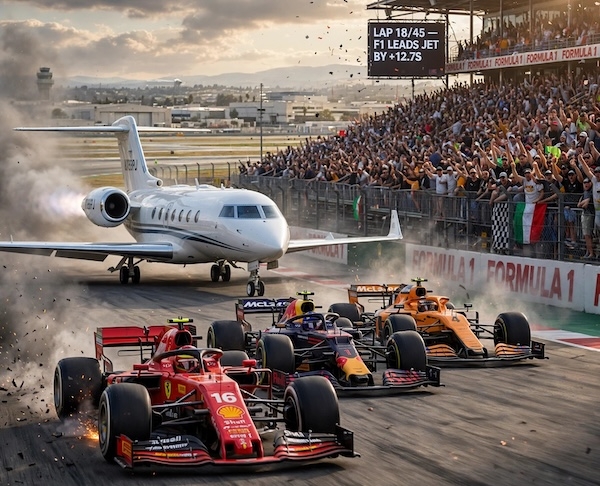
Formula 1 is the perfect “bridge” to explain aviation innovation. But both share the same engineering culture: extreme precision, extreme safety, extreme performance and zero tolerance for failure.
F1 is extremely popular. It operates as a global media network, not just a sport, with billions of cumulative viewers, tens of millions per race, and massive attention across Europe. Formula 1 reached a total cumulative audience of 1.83 billion in the most recent season, it’s largest in five years. It confirms F1 as the most-watched motorsport on Earth. F1 Shows the thrill. Aviation shows the discipline. Same DNA.
A problem in Europe that touches every operator, every flight, every airport, every OEM, and every political conversation: Europe’s regulatory, political, and societal pressure — especially environmental scrutiny and taxation— is the dominant, structural challenge particularly for business aviation. Europe’s regulatory environment is uniquely heavy compared to North America or the Middle East.
Both Formula 1 and business aviation are elite testbeds. Formula 1 tests the technologies that make a car safer. Business aviation tests the technologies that make flights safer.
Clean aviation will be born in business aviation first—small fleets, fast adoption cycles, and early propulsion testing. Smart regulation will accelerate innovation; punitive taxation slows it. Europe’s penalizing taxes are framed as climate action but are counterproductive. Taxing business aviation slows the very technologies Europe needs to meet its climate goals. The sector is a climate innovation engine, not its climate problem.
Europe’s political pressure is rooted in the belief that business aviation is behind on sustainability. However, business aviation is where clean aviation technologies scale first. Business aviation adopts new propulsion 10–15 years earlier than commercial fleets. SAF (Sustainable Aviation Fuels) usage is highest in business aviation. Electric and hydrogen prototypes are entering the market through small aircraft first. Business aviation is the flexible, fast, innovation-ready mobility layer that fills the gaps commercial aviation cannot.
Across Europe, a debate is unfolding about business aviation. Some call it luxury. Some call it unnecessary. Some consider it a symbol of inequality. When people hear “private jet,” they imagine champagne and celebrities.
Everyone understands Formula 1. It’s fast. It’s elite; when was the last time that you owned or drove a race car? But we also know something else: F1 innovations end up in family cars, business aviation innovations end up in commercial airlines, protecting millions of passengers. If people understood what business aviation actually does, they would celebrate it the way they celebrate Formula 1.
Headlines should reframe business aviation as innovative and useful, not status and not elitist. “If you want clean aviation, support the sector where new propulsion starts. If you like safer commercial flights, you should like business aviation, where innovation takes flight first.”
Common people don’t want to hear industry-self-praise, complaints about regulation and defensive arguments. These messages alienate the public. People don’t trust industries that sound defensive. They want to hear: “We hear you. We understand your concerns—and we’re fixing them. We’re improving. And we’re doing it faster than anyone else.”
Formula 1 didn’t just make race cars faster—it changed how everyday car engines are designed, cooled, lubricated, controlled, and protected. Modern engines in cars all quietly carry DNA that was first proven at 300 km/h on a racetrack. Engines last longer, fail less, and perform better. Formula 1 made everyday engines lighter, cleaner, stronger, more efficient, and more reliable. The engineering that wins races is the same engineering that makes a family car safer. Formula 1 radically improved and revolutionized tire technology—materials, construction, heat resistance, grip, and failure prediction.
Formula 1 is the perfect analogy. It removes the “luxury jet” stigma and replaces it with “innovation testbed”. F1 tests the limits of automotive engineering. Business aviation tests the limits of aviation engineering. The same spirit that pushes a Formula 1 car forward pushes clean aviation forward. This is the foundation of what is called the halo effect. Public perception shifts from “private jets” → “precision mobility”. Business aviation inherits F1’s glamour. F1 is exciting; to be honest, business aviation is not, at least not yet for the non-aviation-geeks.
The core truth? Business aviation is to aviation what Formula 1 is to the automotive world: the elite testbed where safety, sustainability, and innovation are born. Europe can be the global lab for clean aviation; guilt should be replaced with leadership.
Have you ever heard of a “Zig when they Zag” campaign? “Study the methods of your competitors and do the exact opposite”, David Ogilvy an advertising pioneer often hailed as the “Father of Advertising...
Air Antilles, re‑founded on 10 October 2023, launched operations in late June 2024, ceased flying on 8 December 2025, and is now expected to enter bankruptcy proceedings in early 2026. The airline sur...
I am the author of incisive articles, commentaries and interviews. Yet, in contrast, I also write fictional stories about fictitious people. I know the difference between both worlds and if you ask me...
The Caribbean understands aviation. But does it fully understand private aviation? The potential blind spot is the distinction between airline passengers and private-aviation passengers. Commercial av...
Aren't we all trying a bit of manipulation here and there to make things happen? Come on, admit it! Your middle name is not "holiness". You want prospects to stop going to contestants or competitors a...